(Jose A. Bernat Bacete/Moment/Getty Images)
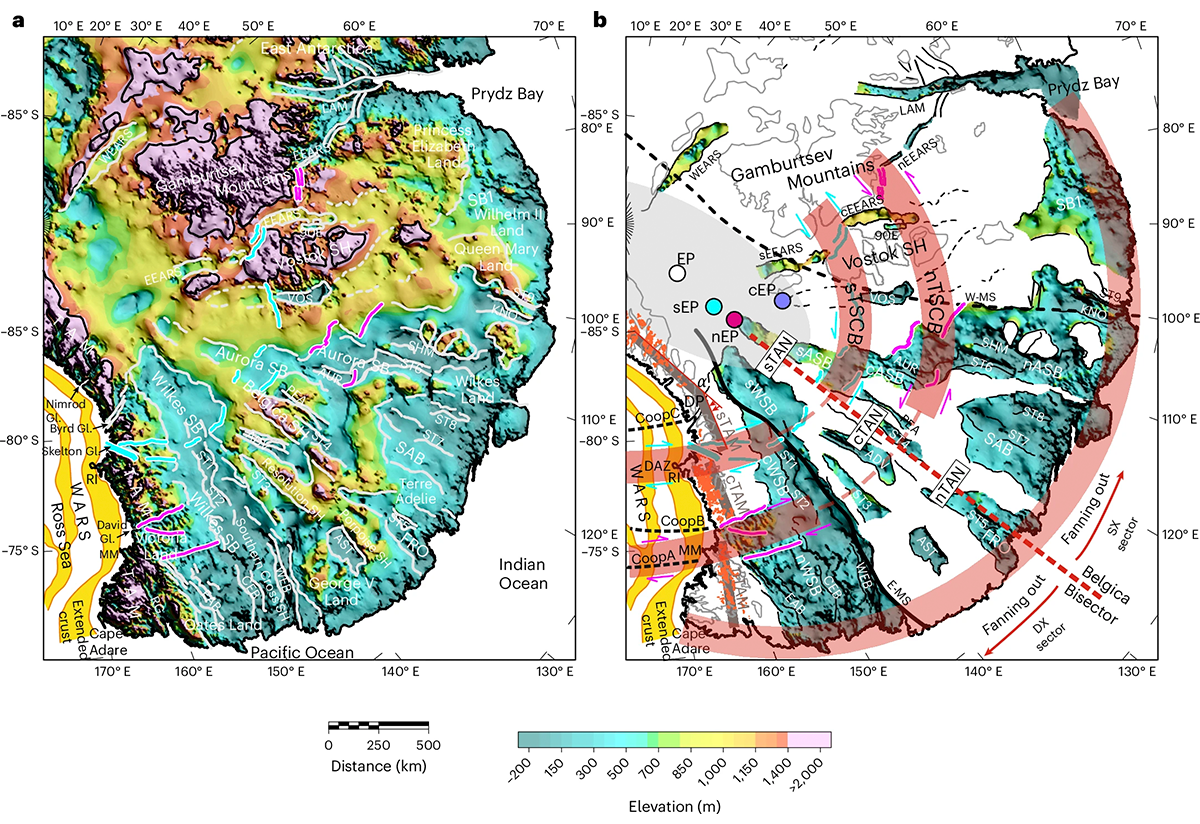
If a movie opened with scientists discovering hundreds of earthquakes deep under Antarctica – in a place where they're not supposed to happen, geologically speaking – you might expect the next scene to involve aliens, ancient monsters, or something equally dramatic.This isn't science fiction though: A team from the US and Spain has identified more than 500 deep earthquakes beneath the continent, and they are trying to find explanations that fit the data.The region doesn't run across any tectonic plate boundaries, which typically drive the friction that causes earthquakes.Instead, this deep seismic activity occurs when softer, warmer rock heats and bends the rigid, brittle crust from below.A map and cross-section of the detected quakes under David Glacier (DG). (Ho et al., Science, 2026)Nevertheless, this study shows that these intraplate earthquakes are indeed occurring beneath Antarctica, matching other puzzling outbreaks of seismic activity in places such as Afghanistan, Morocco, and Romania."Intraplate earthquakes (events that occur within plate interiors, far from active margins) challenge the traditional plate tectonic paradigm, which indicates that plate interiors should experience little deformation," write the researchers in their published paper."Intermediate-depth earthquakes (IDEs, >70 km) within intraplate settings are even more difficult to explain because high-temperature and high-pressure conditions in the upper mantle are not conducive to brittle failure."Temperature and pressure are likely to be causing the earthquakes, the researchers determined. (Ho et al., Science, 2026)The team gathered data from 49 seismic monitoring stations across East Antarctica, then used a deep learning AI technique to sift through it and identify earthquakes amid the general noise.By analyzing faster primary waves (p-waves) that move through any material and slower secondary waves (s-waves) that only move through solid, not molten, rock, it's possible to detect rock-fracture events and pinpoint their locations.That gave the researchers a total of 510 IDEs, clustered beneath the David Glacier, bunching at depths between 100 and 150 kilometers (62 and 93 miles).The local magnitudes of these quakes were between 1.6 and 3.5 – relatively small in earthquake terms."We identified and characterized intraplate IDEs beneath East Antarctica using an automatic deep-learning earthquake detection package enhanced by transfer learning, a technique that leverages previously trained models to solve new, related tasks more efficiently," write the researchers.This adds to other studies showing that Antarctica isn't quite as quiet, seismologically speaking, as was previously thought.But then the next question is, what's driving these quakes?While the area isn't on a tectonic plate boundary, it is close to a lithospheric boundary, where two slabs of rock with different densities come together. Specifically, the thick, cold East Antarctica slab and the thinner, hotter West Antarctica slab.The coming together makes the rock structure vulnerable at this point, posit the researchers. Combined with the stress of the hot mantle pushing up and the cold glacier pushing down, this could explain the earthquakes."This creates a steep lithospheric strength gradient, and it has been suggested that stress concentrations along such boundaries can lead to intraplate seismicity at the edge of the stronger lithospheric block," the researchers explain.In other words: It's not aliens or ancient monsters, probably.These findings give geologists a better understanding of the pushing and pulling that goes on deep underground and far from tectonic plate boundaries.They also highlight the many different ways that earthquakes can be triggered – even in unexpected places, by processes that may have been difficult to detect until recently.Some mysteries remain: The 'bending' processes explain why the earthquakes occur so deep, but not why they are clustered only beneath David Glacier. Similar lithospheric boundaries extend elsewhere along the Transantarctic Mountains, suggesting other local factors must also be involved.Related: 'Megathrust' Earthquake Could Trigger San Andreas Fault, Scientists WarnThe study team suggests the use of deep learning AI and modern data collection methods here could be applied elsewhere in the world to uncover other intraplate IDEs that have so far remained hidden."As detection capabilities continue to improve and deep-learning pickers can be finely tuned to search for the otherwise obfuscated signals, these types of events could prove to be more widespread than currently recognized," write the researchers.The research has been published in Science.