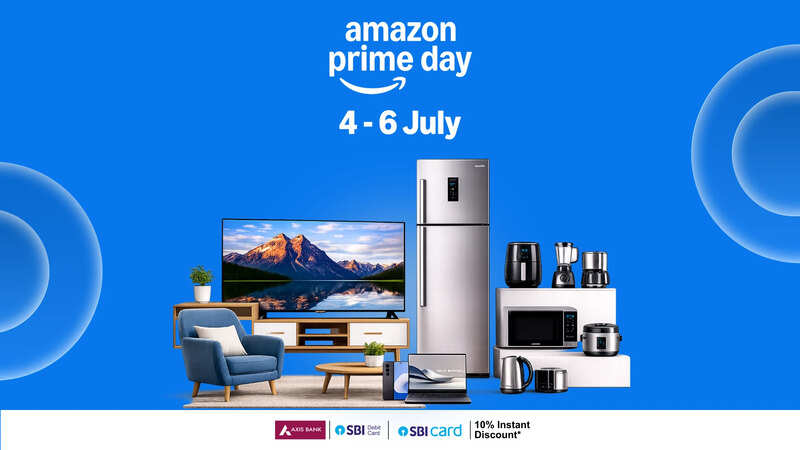
The 10th Prime Day runs 4–6 July — Director Abhinav Agarwal on the decade that turned India from Amazon's market into its product lab.Amazon will run the tenth Prime Day in India from midnight on 4 July to 11:59 pm on 6 July, a 72-hour sale tied to the tenth birthday of a membership that opened in 2016 as a Rs 499 shipping perk and today sells in three tiers up to Rs 1,499 a year. "Prime Day has always been about celebrating our members, sellers and brand partners," Abhinav Agarwal, Director — Prime at Amazon India, said in announcing the dates in an interaction with Gadgets Now. "As we mark the 10th edition of Prime Day, this milestone makes the celebration even more special, reflecting a decade of delivering shopping, savings and entertainment across Bharat," he added.The sale is the marker. The decade is the story — and the sharpest line in it runs through tier-2 and tier-3 India, where the growth came from, and through a set of product ideas that India built first and Amazon then exported.Key TakeawaysPrime Day 2026 runs 4–6 July, the 10th edition in India and the marker for ten years of Prime, which launched here in July 2016.New-member growth skews to smaller cities: Agarwal says 70 per cent of new members sign up from tier-2 and tier-3 towns, with the base on course to double against three years ago.India built Prime's multi-tier pricing and its savings dashboard first; both have since travelled to other Amazon markets, Mexico and the United States among them.Anniversary pricing drops annual Prime to Rs 999 (from Rs 1,499), Prime Lite to Rs 599 (from Rs 799) and Prime Shopping Edition to Rs 299 (from Rs 399), with up to 10 per cent off on SBI and Axis cards.The drive to keep Prime relevant meets a quick-commerce war: Amazon Now plans 100 cities in 2026, chasing a market where Blinkit leads.A word on the maths, because Amazon runs two anniversaries into one. The Prime membership opened in India in July 2016; the first Prime Day here followed in July 2017. So 2026 marks ten years of the programme and the tenth edition of the sale at once — a tidy overlap the marketing folds into a single 'decade'. The sale itself has grown from a metro-led deals window into the year's second big shopping moment after the October festive rush, with small businesses now a headline act: Amazon says SMB participation hit records last year, the majority of those sellers based in tier-2 and tier-3 towns.Who is buying Prime now? The metro early-adopter who signed up in 2016 for faster delivery has plenty of company. "Prime is no longer just a metro phenomenon; it is for Bharat," Agarwal said, returning to the phrase twice across the conversation. He puts 70 per cent of new Prime members in tier-2 and tier-3 cities, and reads the trend as gathering pace. "We only see this trend accelerating," he added.The base, by his account, is on course to double in 2026 against where it sat three years earlier — the smaller cities doing most of the lifting. "It is very compelling, and we are excited about how customers in tier-2 and tier-3 cities are resonating with Prime," Agarwal said.Agarwal credits the language strategy for the spread. "Prime Video India offers the largest language selection globally. Our Prime Video content is available in 10+ languages today, which is very unique to India," he said. "Because the content is so localized, it resonates with a pan-India audience."That tilt shows up across Amazon's India business. In April, when Amazon launched a dedicated AI Store for consumer electronics, Zeba Khan, the company's consumer-electronics director, called it a product "built for Bharat" and pointed to two-thirds of AI-device searches arriving from outside the big metros. The Prime numbers tell the same story from the membership side: the demand sits where the next 100 million shoppers live.The features India built first The thesis in Agarwal's own words: "India Prime is not just a growth story for Amazon, but also an innovation story. Over the years, as the team stayed focused on building the most loved membership program for Bharat, it also spawned many new innovations. Many of them are now being adopted globally at Amazon." Two products carry most of that argument — the tiered membership and the savings dashboard.For most of Prime's two decades, Amazon sold one all-inclusive membership and trusted the bundle to do the work. "Globally, for about two decades since Prime launched, our belief was that we should have one great, all-inclusive Prime program," Agarwal explained. "Because it's a bundle, we see many customers who join for shopping but eventually start using Prime Video or Amazon Music, or they join for Prime Video and then start shopping."India broke the habit. "The insight we had about India was that it is a very diverse country with multiple different socio-economic segments," Agarwal said. "We also realized that Indians appreciate flexibility and choice, perhaps more than other locales. That led us to think if there is a Prime program where we can work backward from these different customer segments and their need states, and invent on their behalf."Today Prime sells in three trims, in Agarwal's own breakdown. "We start at the top with our Rs 1,499 per year plan, which offers customers a bundle of benefits across shipping, shopping, entertainment, and music. This is our most premium plan," he said. "Next, we have a Prime Lite plan, which is Rs 799 per year. It offers customers the same shipping and shopping benefits, but limited video benefits at a much lower price point. Finally, we have a Prime Shopping Edition, which is priced at Rs 399 per year. This provides customers all the same shipping and shopping benefits. It is great for customers who are not yet willing to take us up on our video offerings."The cheaper tiers double as a front door. "We see many customers who join our Shopping Edition upgrade to our core Prime plan within a year," Agarwal said. "It becomes a way for customers to start experiencing Prime and, over time, go deeper with the program."Here is the part that matters beyond India. "This has been something that the India team invented. We rolled it out a couple of years back, and it is now seeing adoption across multiple other marketplaces for Amazon," Agarwal said of Prime Shopping Edition. "This same income parity or socio-economic diversity is not unique to India. There are many other emerging marketplaces that have a similar level of socio-economic diversity, with Mexico being one."The same export logic covers the savings dashboard. "Many of our members wanted to learn about how much value they were getting from the program, so we built this new product experience where customers can see how much delivery savings they are getting, how many same-day or next-day deliveries they have received, how many hours of music they have listened to, and how many titles they have watched with Prime Video," Agarwal said. "This has been very popular with our members and is now live globally."He traces the build to a specific reader trait. "We found that the Indian consumer is highly value-conscious and wants to make sure they are getting a good bang for their buck," he said. "That led us to invent the value realization dashboard, and customers globally are loving it because it brings a level of transparency to the program that they really appreciate."Run the arithmetic on that and the relationship inverts. The India operation spent the decade as a net exporter of Prime ideas inside Amazon — a country long cast as a price-sensitive market to be served turned into a design studio the rest of the company borrows from.From a shipping perk to a daily habit The bundle does the retention, and Agarwal traces the shift from a delivery service to a lifestyle product to a deliberate widening of the membership's footprint in a member's day. "Ten years back, it started off as a shipping-only program. As a member, you would get value out of the program or engage with it maybe once a week or four to five times a month," he said. "What we have realized over time is that we want to be part of the daily lives of our customers; we want to add value on an everyday basis. That's where the bundle really comes into the picture."He sketches the everyday geometry himself. "You might not buy on Amazon every day, but you might stream a song on your way to work. Similarly, you might not listen to music every day, but you might stream a movie on Friday night," Agarwal said. "When you think of Prime as a lifestyle bundle, with a Rs 1,499 price point, you can unlock multiple benefits that touch different aspects of your life. Hence it works, and hence you see deep engagement, with members getting double the value that they are investing in the program."The savings claim is the number Amazon leans on, and Agarwal frames the brief plainly. "Our objective with Prime has always been to deliver disproportionate value to members vis-à-vis the subscription fee they pay us," he said. "In 2025, on average, Prime members in India saved more than two times the cost of their annual Prime membership. For example, if a customer paid us Rs 1,499 for a subscription, they got Rs 3,000 back in savings. Our top 10% of members saved more than eight times their membership cost." Those figures come from Amazon and sit outside any external audit, so read them as the company's own scorecard rather than a neutral one.Music is the quiet workhorse of the bundle. Rivals sell a music subscription as the headline product; Amazon hands it over inside Prime, where members build playlists, let the service learn their taste, and stay. "We see members who start using music become very sticky because they build their playlists, and the service starts to learn what their preferences are," Agarwal said. "So music is a very integral part, but it works well as part of the bundle."The line he keeps coming back to belongs on a poster in an Amazon corridor. "As we say internally, Prime is the best it has ever been and probably the worst it will ever be, because we continue to make the program better every day," Agarwal said. Self-serving, sure. Also a fair description of a bundle that has gained a layer roughly every couple of years.Put a number on Prime India and the picture turns hazy by design. Amazon stopped publishing member counts worldwide after it crossed 200 million in 2021, and it keeps India folded into the global total. Analysts peg the global base between 220 and 250 million as of early 2026, with India among the fastest-growing markets and an estimated 65 million-odd Prime Video viewers here — figures to treat as directional rather than a hard count. The silence is its own tell: Amazon would rather talk about savings delivered than members counted.Why push Prime so hard right now? Agarwal's reading of the delivery push runs through everything else. "Prime continues to be the most compelling delivery offering, and it is only getting better by the minute with Amazon Now," he said. "Our mental model for delivery speeds at Amazon has always been to offer the fastest speeds across the largest selection." That logic is being put to work in a fight Amazon entered late. India's quick-commerce surge — groceries and essentials in 10 to 20 minutes from neighbourhood dark stores — has rewired what 'fast' means to the urban shopper, and Amazon arrived after the pure-plays built the habit. Datum Intelligence data cited by Reuters in January put Blinkit at about 46 per cent of the quick-commerce market, Swiggy Instamart at 24 per cent and Zepto at 22 per cent, with Amazon Now, Flipkart Minutes and BigBasket's BB Now splitting the rest. India ran more than 6,000 dark stores by early 2026, on Bernstein's count, in a market worth around Rs 95,500 crore.Amazon Now is the catch-up. "With Amazon Now expanding to 100 cities in 2026, Prime will be more relevant than it has ever been before," Agarwal said. Reporting from BusinessToday and others puts the build at 500-plus dark stores and a plan for more than 1,000 micro-fulfilment centres, with Amazon leaning on startup-run stores and third-party logistics for a lighter, faster build. The discounting tells the urgency — a UBS note tracked Amazon Now's discount levels jumping from 26 to 57 per cent between November and January, the steepest move in the sector.Flipkart, Amazon's oldest India rival and now Walmart-owned, opened Flipkart Minutes in August 2024 and has pushed past 800 dark stores, with a target near 1,200 by the end of 2026. The two marketplace giants are scaling quick commerce fastest among the six players — which makes Prime's lock-in the edge Amazon holds over a Flipkart loyalty programme still building the same depth.The calendar matters too. Prime Day sits in early July, half a year clear of the October Great Indian Festival and Flipkart's Big Billion Days, the metro-heavy festive sales that still set the annual peak. A mid-year, members-only event lets Amazon pull demand forward, test anniversary pricing and lock in renewals ahead of the festive quarter — and more of that work now happens in the same small cities driving the membership.Here is where Prime earns its keep. Quick commerce, for all its speed, runs on thin loyalty. Counterpoint's Neil Shah has pointed to shoppers hopping between apps on whichever discount lands that day — a customer the category rents rather than owns. Prime is the answer to that. "When Prime members start engaging with Amazon Now, they increase their visit frequency on Amazon by more than three times," Agarwal said. "It is a step-function change when they start using Amazon Now." The membership turns a price-shopping quick-commerce user into an Amazon habit — the loyalty the dark-store players still chase. So the 100-city Amazon Now push and the tenth-birthday Prime drive are one move: get members into fast delivery, and the bundle keeps them.What the 10th Prime Day carries "This will be our 10th Prime Day in India. It's going to be an anniversary Prime Day, bringing our members exciting new launches, blockbuster entertainment, and great deals," Agarwal said of the event itself. "This event is a marquee event for Prime members, only available to customers who have a Prime membership. This 10th edition will run from midnight on July 4th to July 6th. It will be a 72-hour celebration extravaganza for Prime members. Given that this is our anniversary Prime Day, it will be special in a few ways."Strip the anniversary language and the sale reads familiar, scaled up. Amazon promises more than 500 new product launches from over 100 brands — Samsung, OnePlus, Asus, Boat, Lenovo, Adidas, Puma, Atomberg and Lego among them — plus the year's lowest prices across phones, home, fashion and electronics. "We are going to have special 10th-anniversary deals, which will be once-in-a-decade deals across a wide array of categories, including home, smartphones, electronics, apparel, and shoes," Agarwal said. New members get the anniversary pricing; everyone gets the bank stack.Prime membership: regular versus anniversary pricingTierRegular (per year)Anniversary offerPrimeRs 1,499Rs 999Prime LiteRs 799Rs 599Prime Shopping EditionRs 399Rs 299On payments, SBI and Axis Bank credit cards and EMI transactions carry up to 10 per cent off, and the Amazon Pay ICICI Bank card adds unlimited 5 per cent cashback. Amazon Pay Later breaks carts above Rs 1,500 into three instalments, the interest absorbed.The delivery promise is the spine the whole membership hangs on, and Agarwal recites the catalogue tiers like a bowler reading conditions. "Prime members today can get thousands of their everyday essentials delivered in minutes with Amazon Now. They can get 40,000 of our top-selling products delivered within four hours, another 10 lakh products delivered the same day, and 40 lakh products delivered the next day," he said. "It is a very compelling end-to-end speed offering across India." Amazon has built it into a ladder of speeds across a widening catalogue.How fast Prime delivers in IndiaServiceSpeedCatalogueAmazon NowMinutesThousands of everyday essentialsFast trackWithin 4 hours40,000 top-selling productsSame-daySame dayOver 10 lakh productsNext-dayNext dayOver 40 lakh productsEntertainment carries the anniversary load. "Prime Video will celebrate 10 years of Prime Day with 21 new releases. This is our highest number of releases ever during a Prime Day," Agarwal said, citing titles including Drishyam 3, Raakh and Scream 7. The press note widens the slate to include Suriya's Karuppu, Dacoit and the anime Ghost in the Shell, plus YA originals across English-language and international titles. That 21 figure sits with Agarwal rather than the PR — read it as his count.The personal flourish is Prime Playback, an AI-built recap video Amazon will push to long-time members. Agarwal's own pitch for it is the most lived-in moment in the conversation. "Given that this is a 10th-year anniversary, we are launching something called an AI Diary, or you can think of it as a Prime Lookback," he said. "For our most tenured customers, we are going to share a personalized video of their journey with Prime. It will show them over time what categories they have shopped in, what type of music they like, and what type of movies they have watched. It's a very quirky, fun video, and we're going to share it with some of our most tenured members." The feature reaches select members from 18 June.The next ten years bend on whether the bundle holds its grip as the dark-store war drives delivery times toward zero and loyalty toward a coin-flip. "All in all, it's been a great 10-year journey," Agarwal said at the close of his pitch — a line that reads, in the context of everything that came before it, less as a victory lap than as the only thing left to say after a decade of additions to the same membership. Amazon's bet is that a member who reads a savings dashboard, finishes a series and keeps a playlist stays put — that habit beats the next discount. The tenth Prime Day will move a lot of washing machines. The number Amazon will watch is quieter: how many of the tier-3 first-timers it signs up this week are still members when the eleventh edition comes around.FAQWhen is Amazon Prime Day 2026 in India?The 10th Prime Day runs for 72 hours, from midnight on 4 July to 11:59 pm on 6 July 2026, open to Prime members across all three membership tiers.How much does Amazon Prime cost during the anniversary offer?New members can join Prime at Rs 999 a year (regular Rs 1,499), Prime Lite at Rs 599 (regular Rs 799) and Prime Shopping Edition at Rs 299 (regular Rs 399), for a limited period.What is Amazon Prime Playback?Prime Playback is an AI-generated personalised video that recaps a member's Prime journey — shopping milestones, savings and streaming favourites. Agarwal described it as "a very quirky, fun video" that will go to select tenured members on Amazon. in from 18 June 2026.Which bank offers apply on Prime Day 2026?SBI and Axis Bank credit cards and EMI transactions get up to 10 per cent off, while the Amazon Pay ICICI Bank credit card gives Prime members unlimited 5 per cent cashback.end of article
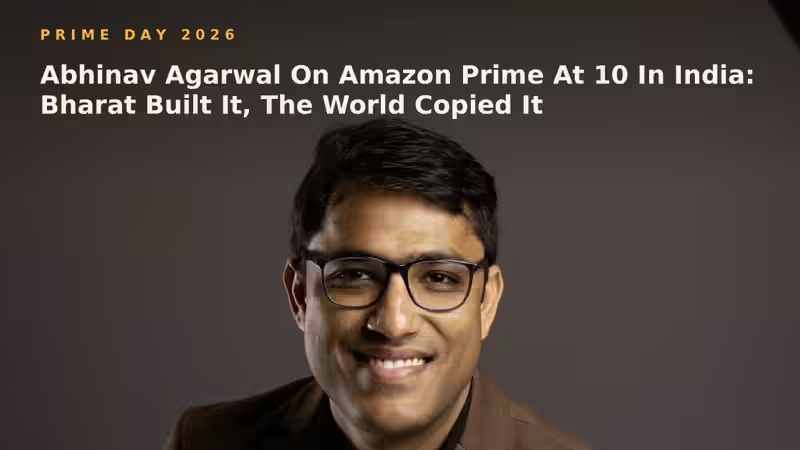
Abhinav Agarwal On Amazon Prime At 10 In India: Bharat Built It, The World Copied It
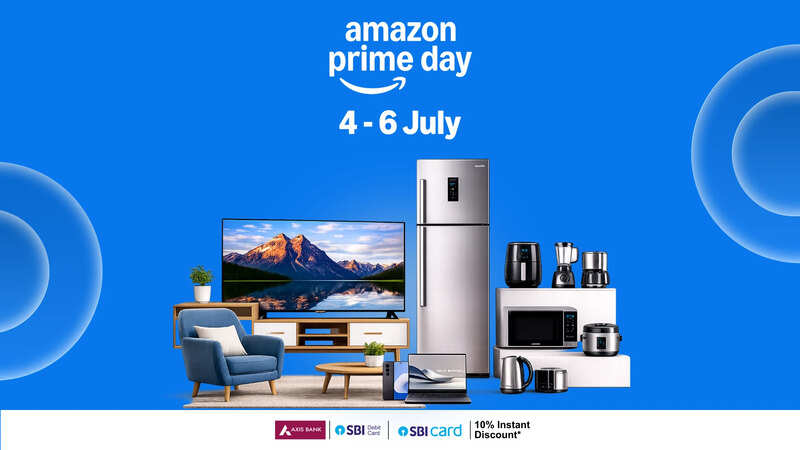
Amazon will run the tenth Prime Day in India from midnight on 4 July to 11:59 pm on 6 July, a 72-hour sale tied to the tenth birthday of a membership that opened in 2016 as a Rs 499 shipping perk and today sells in three tiers up to Rs 1,499 a year. "Prime Day has always been about celebrating our members, sellers and brand partners," Abhinav Agarwal, Director — Prime at Amazon India, said in announcing the dates in an interaction with Gadgets Now. "As we mark the 10th edition of Prime Day, this milestone makes the celebration even more special, reflecting a decade of delivering shopping, savings and entertainment across Bharat," he added.
3,238 words~15 min read