US President Donald Trump
| Photo Credit:
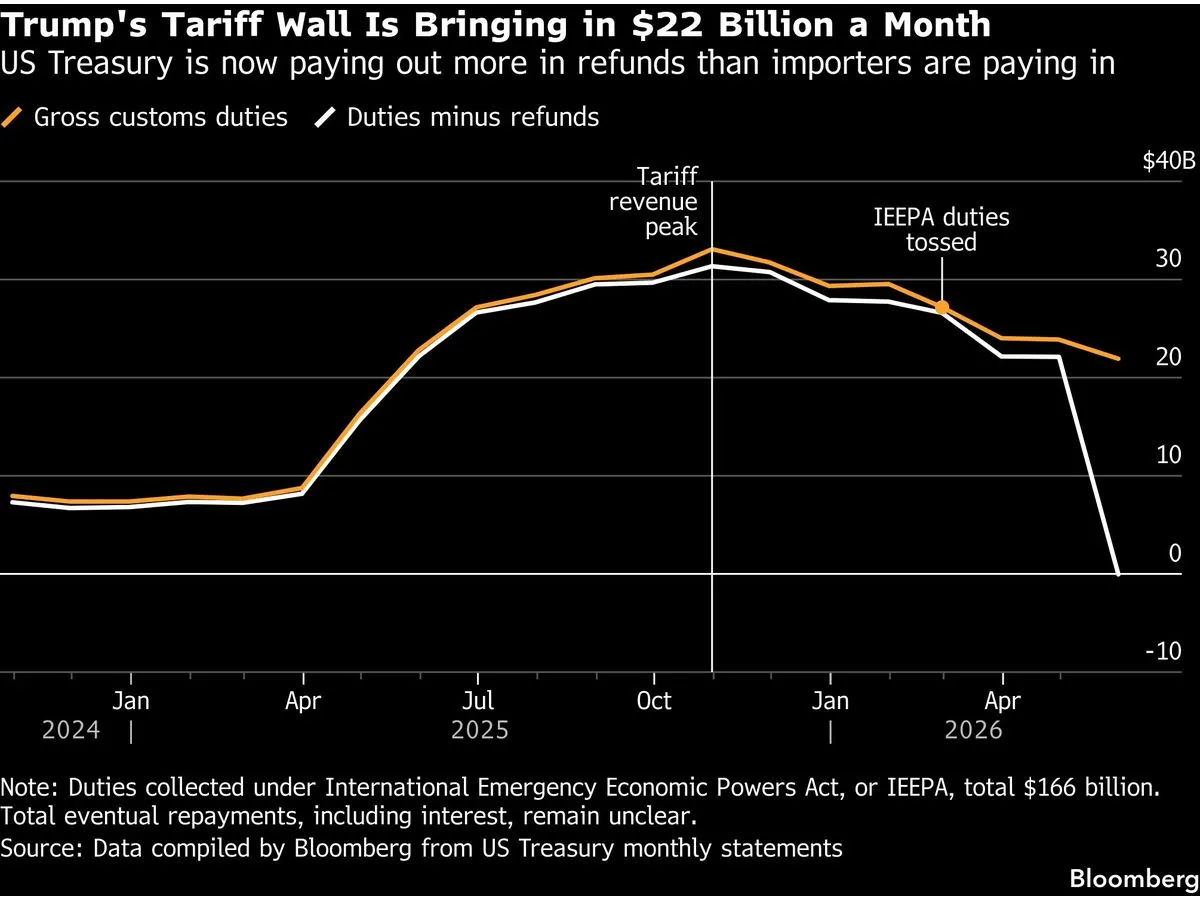
Tariff revenue is now flowing out of the US Treasury’s coffers faster than it’s coming in, with nearly $22 billion in unlawfully collected duties reimbursed to importers in May. American consumers shouldn’t breathe a sigh of relief with this unusual form of tax returns, though. Businesses continue to pay tariffs on goods from nearly every country, even after the Supreme Court struck down President Donald Trump’s “emergency” tariffs in February. While the clock runs out at the end of July on the temporary 10 per cent global rate Trump put in place immediately after the ruling, White House officials have pledged to restore the revenue with more durable import duties. A proposal released earlier this month that resulted from a forced labor investigation into dozens of US trading partners is seen as the first step.“If implemented as expected, these new levies will raise the average US tariff rate by 0.6 percentage point from current levels, to about 11 per cent,” according to Nicole Gorton-Caratelli and Chris Kennedy of Bloomberg Economics. That’s below the 13.5 per cent rate that prevailed when Trump’s so-called reciprocal tariffs were still in place, but several other investigations in the works are expected to arm the president with new tariff powers.The US Trade Representative has proposed duties on goods from Brazil, also citing Section 301 of the Trade Act of 1974, a provision intended to combat unfair trade practices by other nations. Another Section 301 investigation into dozens of US trading partners pegged to excess capacity and production is underway.‘Not abated’It’s unclear how quickly or how much in refunds will flow through to consumers, and the fresh duties are set to hit as the US economy absorbs higher costs for everything from oil to plastics tied to the Iran war. A interim peace agreement was signed this week. A dashboard of economic indicators has flashed warnings: The University of Michigan’s consumer sentiment index is hovering near a record low, while US inflation accelerated in May to the fastest pace in more than three years. At the same time, the uncertain trade landscape has prompted businesses to pause additional investments or expansions over the last year.“We think that pricing pressures have not yet abated, nor will they anytime soon,” said RSM Chief Economist Joe Brusuelas, pointing to higher energy prices and higher costs related to the buildout of AI infrastructure.The new duties are starting off on more solid legal footing than those Trump imposed under the International Emergency Economic Powers Act, or IEEPA, which the US customs agency and Treasury Department are currently refunding.Former President Joe Biden not only left the tariffs on goods from China that were put in place by Trump’s first term, but he expanded them. Even so, the temporary tariffs, imposed under Section 122 of the 1974 trade law, are under legal challenge already, although an appeals court recently ruled they could be enforced for now.“Going forward, the 122 tariffs and the new universal tariff imposed under the guise of a 301 forced labor investigation are also at litigation risk,” said Shai Akabas, vice president of economic policy at the Bipartisan Policy Center. “It’s very unclear that the administration has found a new durable means of imposing the ‘universal’ tariffs that the president is seeking as part of his broader re-industrialization strategy,” Akabas said.There’s already a slew of industry-specific duties in place, impacting sectors from steel and copper to lumber, and there are more in the pipeline. Section 232 of the Trade Expansion Act of 1962 gives the president the authority to impose tariffs and other trade remedies on national security grounds, but first requires an investigation by the Commerce Department. A number of ongoing investigations, including robotics and medical devices, could conclude at any time with tariffs recommended as the solution. Still, Trump’s tariff wall has deliberate holes — the administration has largely put no or low duties on the fastest-growing parts of the economy, such as data centers and AI infrastructure. It remains to be seen how many more products will be exempted from the import duties as price pressures mount. The White House recently lowered levies on imported tractors and farm machinery, as well as easing duties on Taiwan and some metal products. The administration also exempted most goods imported from Brazil to the US, despite higher overhead tariffs resulted from an investigation into various trade practices. The cost-of-living crisis has emerged as one of the most potent issues ahead of the November midterm elections, and Republicans are grappling to keep their majority-number of seats. Democrats have attacked the tariffs as one of the leading causes of higher prices for working-class families, and a February poll from the Pew Research Center found that six in 10 Americans disapprove of the administration’s increased tariffs. The president and his top officials continue to push protectionist policies to bring manufacturing back to the US and reduce dependence on rivals, including China. “America’s economic and national security hinges on our ability to manufacture next-generation technologies at scale on US soil,” Trade Representative Jamieson Greer said in a statement Monday. “President Trump will continue to use tariffs and trade deals to open markets abroad and create new opportunities for workers and businesses at home.”More stories like this are available on bloomberg.comPublished on June 18, 2026