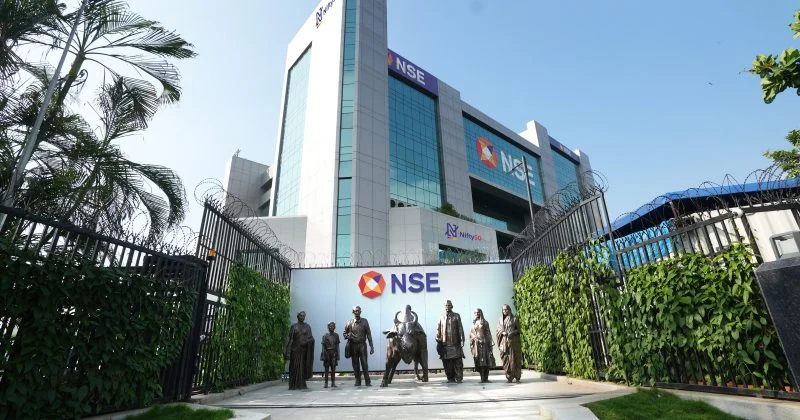
The National Stock Exchange of India Ltd (NSE) on Wednesday night filed its draft red herring prospectus with the market regulator for what could be the biggest initial public offering (IPO) in India.Based on indicative grey market prices of at least ₹2,000, the IPO is expected to value NSE at approximately ₹29,780 crore (over $3 billion), with a valuation of over ₹5 trillion. (REUTERS)The IPO consists entirely of an offer for sale of up to 149 million equity shares by existing institutional shareholders, the document filed with the Securities and Exchange Board of India (Sebi) showed. This means a total 6% of NSE’s paid-up capital is being offered to new investors. No fresh equity capital will be issued as part of the transaction.Proceeds from the transaction will go entirely to the selling shareholders, which include State Bank of India, Canada Pension Plan Investment Board, affiliates of Morgan Stanley, Temasek, Bank of Baroda, Stock Holding Corp. of India, General Insurance Corp of India, The New India Assurance Co, National Insurance Co and United India Insurance Co.As per the DRHP, SBI is the largest selling shareholder, offering up to 24.75 million shares. Morgan Stanley’s MS Strategic (Mauritius) Ltd is offering up to 16 million of its own shares, while the Canada Pension Plan Investment Board is set to sell up to 11.87 million shares in the IPO.Temasek’s Aranda Investments (Mauritius) Pte Ltd is selling up to 11.24 million shares, while Bank of Baroda, Stock Holding Corp, and public sector insurers GIC Re and The New India Assurance Company have offered around 11 million shares each. National Insurance Co and United India Insurance Co are each divesting around 6 million shares.Meanwhile, LIC, the exchange’s single-largest shareholder with a 10.72% stake, will hold on. On 15 June, Mint reported that the insurer will retain its stake, while several others partially sell their shares. Premji Invest with 2.35% holding and Radhakishan Damani with 1.58% stake too are not selling their shares, the DRHP showed.Under market regulations, an Indian stock exchange cannot list its shares on its own platform, which means NSE will list its shares on rival BSE.In the syndicate of its 20 investment bankers, Kotak Mahindra Capital Co. and Morgan Stanley India Co. are among the book-running lead managers for the share sale.Based on indicative grey market prices of at least ₹2,000, the IPO is expected to value NSE at approximately ₹29,780 crore (over $3 billion), with a valuation of over ₹5 trillion. At this price point, NSE’s IPO will become the country’s biggest public offering, surpassing the likes of Hyundai Motor India Ltd’s ₹27,859 crore IPO, and LIC’s ₹20,557-crore offer.To be sure, grey market prices are not mathematically calculated, and final price bands are set by merchant banks after accounting for multiple factors.“The stock exchange business globally is a unique and highly resilient market infrastructure business, and the listing of an institution of NSE’s calibre will allow small investors to own a stake in one of India’s most important financial institutions,” said Dinesh Thakkar, chairman and managing director of leading broking company Angel One.NSE first filed its IPO papers in 2016, after which it was caught up in the so-called co-location scandal. As the case dragged on, the IPO was shelved. In January 2026, under a new management, NSE reached a ₹1,300 crore settlement with Sebi and received the go-ahead to refile its papers.
Biggest public offering in India: NSE to file for IPO at nearly ₹30,000 crore; LIC to stay put
The share sale for the national Stock Exchange (NSE), likely at ₹30,000 crore, may be India’s biggest yet. | Business News
561 words~3 min read