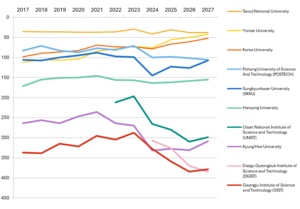
QS says Korea posted Asia’s third-strongest net performance, with gains in employability, internationalization and sustainability A graph provided by Quacquarelli Symonds tracking the performance of Korea's top 10 universities. (Quacquarelli Symonds) The gap between South Korea’s top three universities narrowed in the latest QS World University Rankings, with Yonsei University and Korea University reaching their highest-ever positions, according to the 2027 report released by Quacquarelli Symonds.Seoul National University, the country’s highest-ranked institution, retained its global position at No. 38, remaining within the top 50, according to the global higher education analytics firm. Yonsei University climbed from No. 50 last year to No. 42, while Korea University rose from No. 61 to No. 52.The Korea Advanced Institute of Science and Technology ranked fourth among Korean universities and No. 65 globally, followed by Pohang University of Science and Technology at No. 106, Sungkyunkwan University at No. 108, Hanyang University at No. 155 and Kyung Hee University at No. 309.The London-based ranking provider said South Korea recorded the third-strongest net performance among Asian countries in the 2027 rankings, with 53 percent of its universities rising and 18 percent falling. Only Hong Kong and China posted stronger gains.“South Korea is one of the clearest cases in this year’s data of reform translating into results,” said QS CEO Jessica Turner. “Its universities are rising fastest where the country has invested, in employability, internationalisation and sustainability, and Seoul has just been named the world’s best city for students.“The task now is to convert that momentum into the research influence and academic standing that define the very top of global higher education,” she added.Four Korean universities placed within the global top 100, while seven ranked within the top 200, giving the country one of the deepest concentrations of highly ranked universities in Asia, the firm said.The gains were most visible in employability, internationalization and sustainability, according to the report.According to QS, Korean universities’ employer reputation scores have more than doubled since 2020, while their international student ratio has also doubled over the past decade.Seoul was also named the world’s best city for students in the latest QS Best Student Cities ranking.The report said government efforts to attract more international students had helped improve universities’ internationalization scores, citing the Study Korea 300K initiative and artificial intelligence-driven reforms.QS also said Yonsei University ranked first globally for international student ratio.However, the firm noted that Korea’s academic reputation has softened over the past decade and that its research impact remains mixed.While the country continues to have four universities in the global top 40 for citations per faculty, such performance has become more concentrated in specialist science and technology institutions and has not improved at the same pace as other metrics.Seoul National University ranked highest among Korean institutions in academic reputation, placing 18th globally in the indicator.Postech ranked highest among Korean universities for faculty-student ratio, at No. 31, while four Korean universities, led by Daegu Gyeongbuk Institute of Science and Technology, ranked in the top 40 for citations per faculty.The firm also said Sungkyunkwan University, Postech, Hanyang University and Ulsan National Institute of Science and Technology have established themselves as globally competitive institutions.Regional universities also gained ground.Kyungpook National University climbed to No. 481, its highest position yet, after ranking around No. 695 a decade ago. Chonnam National University was Korea’s single biggest riser this year.The report described the trend as significant because it aligns with President Lee Jae Myung's initiative to create "10 Seoul National Universities," which seeks to strengthen regional higher education ecosystems and foster globally competitive universities outside Seoul.
Korea, Yonsei universities hit record highs as gap narrows in QS global rankings
The gap between South Korea’s top three universities narrowed in the latest QS World University Rankings, with Yonsei University and Korea University reaching t
590 words~3 min read