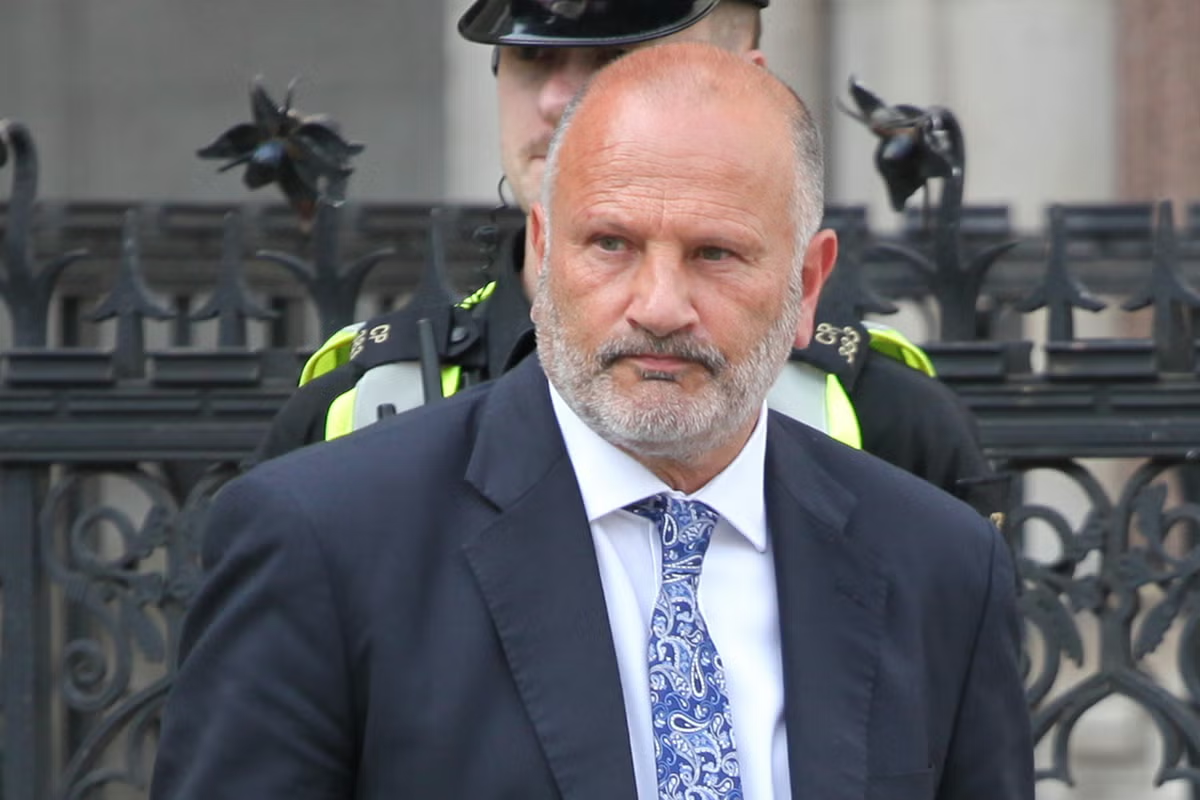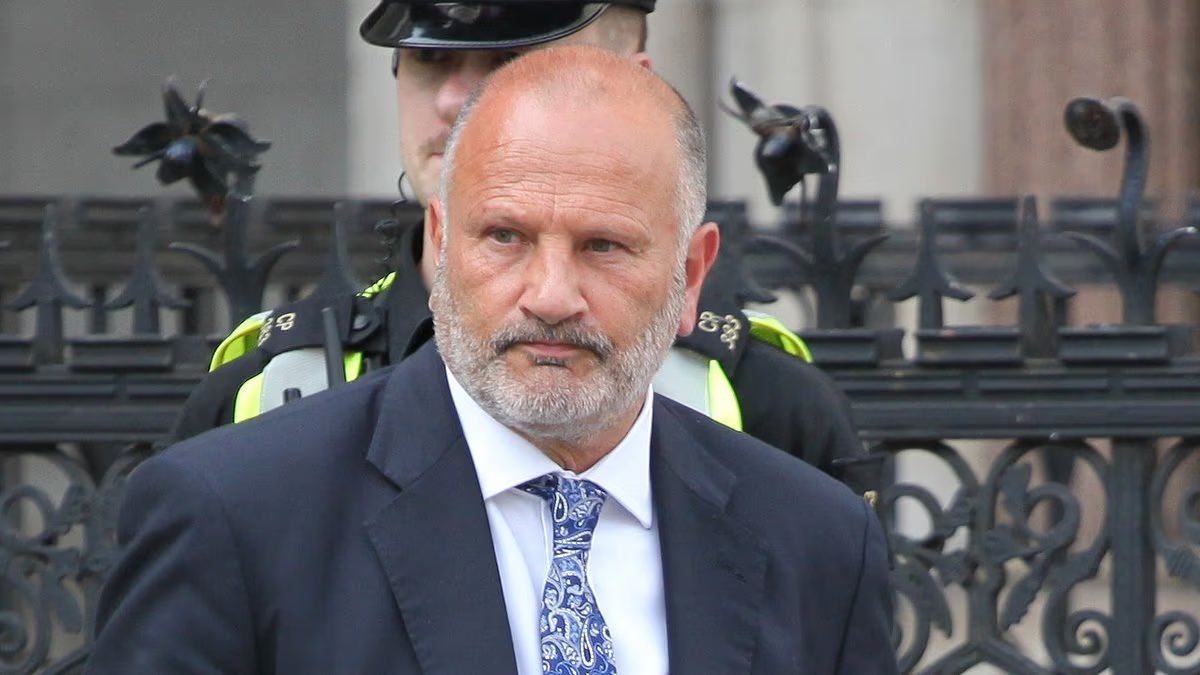
A millionaire property tycoon is suing Britain's biggest water company for more than £1million after a moorland fire he claims started on its land wiped out prized grouse shooting grounds and years of conservation work at his country estate.David Livesey, the former chief executive of £1billion-turnover estate agency giant Connells Group, alleges United Utilities failed to stop a blaze spreading from its land during a heatwave in May 2020, allowing it to engulf hundreds of acres of his neighbouring estate in Lancashire.The businessman claims the utility giant had both the manpower and specialist equipment needed to halt the advancing flames but instead 'irresponsibly' concentrated on protecting its own land while leaving his 300-acre Lords Hall Estate exposed.He is now seeking £1,034,600 in damages at the High Court, claiming the fire destroyed valuable red grouse breeding grounds and wiped out extensive habitat restoration projects.The inferno broke out after two local men lit a disposable barbecue on Darwen Moor on the evening of May 30 2020, during exceptionally dry conditions.Harry Wright, representing Mr Livesey, told Judge Charles Bagot KC: 'At some point, the barbecue ignited dry vegetation and this began to spread. The fire service received a 999 call from the men who lit the barbecue at 6.46pm.'He said Mr Livesey had purchased the estate in 2017 as both a conservation project and sporting estate.'He bought the land as a conservation project and sporting estate in 2017. He wants to restore the moorland habitat. David Livesey, the former chief executive of £1billion-turnover estate agency giant Connells Group, alleges United Utilities failed to stop a blaze spreading from its land during a heatwave in May 2020, allowing it to engulf hundreds of acres of his neighbouring estate in Lancashire The inferno broke out after two local men lit a disposable barbecue on Darwen Moor on the evening of May 30 2020, during exceptionally dry conditions'Before the fire, he had done a great deal of restoration and conservation work, like planting thousands of native plants, and rewetting the moor with hundreds of dams and pools. Most of this work was destroyed in the fire.'The barrister claimed the disaster could have been avoided had United Utilities taken proper action both before and during the blaze.'The fire would not have harmed Mr Livesey's property if United Utilities had not permitted its land to become a tinderbox; and taken basic and obvious steps to prevent the fire from spreading.'Not for the first time, United Utilities behaved irresponsibly. This resulted in the destruction of some 630 acres in a Site of Special Scientific Interest. This should never have happened.'United Utilities had extensive if not total control over fire risks on its land, so it was an 'occupier' on clear and binding authority. The notion that it had no duty in relation to fire risk is ridiculous.'It did nothing to prevent the fire from spreading onto Mr Livesey's land. Despite the wealth of firefighting capabilities which it and its contractors had, it created not a single firebreak which would have protected his land; and undertook no firefighting on the north flank of the fire, which spread to Mr Livesey's land.'Rather than taking responsibility for this, United Utilities asserts ad nauseam, and in vague and sweeping terms, that the fire service was 'in control' of the response to the fire, apparently in the belief that this immunises United Utilities from any liability.'This is wrong. United Utilities had extensive firefighting resources which it could and should have deployed to protect Mr Livesey's land, as well as its own. It failed to do so.'It cannot blame this on the fire service, because the fire service did not force United Utilities to breach its duty to Mr Livesey. The reality is that, one way or another, United Utilities chose to protect its own property, not Mr Livesey's. It must live with the consequences of its actions.'In a statement submitted to Blackburn Council after what he described as the 'traumatic' blaze, Mr Livesey said: 'in all, 630 acres of SSSI moorland was ravaged by the fire,' adding that 'millions of small animals, mammals, invertebrates, frogs etc… perished,' as well as 300 red grouse nests / broods, 'probably containing over 1,200 young,' which had 'a significant financial value, as breeding stock for future years.'The blaze burned for seven days, stretching across three miles of moorland, with firefighters battling around the clock to contain it. He is now seeking £1,034,600 in damages at the High Court, claiming the fire destroyed valuable red grouse breeding grounds and wiped out extensive habitat restoration projectsUnited Utilities is contesting the claim in its entirety, insisting it was neither legally responsible for the land where the fire started nor negligent in its response once the blaze took hold.Brooke Lyne, representing the company, told the court: 'United Utilities is a utilities company. The Darwen Moor is part of the water catchment land for reservoirs at Entwistle and Wayoh.'It is David Livesey's case that United Utilities Water Limited is liable in negligence for various actions / omissions before and during the fire to prevent it from occurring and then spreading to his land.'The defendant's primary case is straightforward: it was not an occupier of the Darwen Moor….All relevant areas of the Darwen Moor were subject to agricultural tenancies.'Setting out the company's alternative case, she said: 'It is common ground that the defendant did not construct a north western fire break or hard edge in the location where the claimant says one should have been constructed.'The claimant…says that the defendant wrongly diverted its resources to creating the 'Constructed Firebreaks' to protect its own land, which were unnecessary.'The defendant's position is that it was not possible or safe for the defendant to construct the north western firebreak on 30 May 2020 [and] the location of firebreaks was a decision taken by Lancashire Fire and Rescue Service, not the defendant.'Lancashire Fire and Rescue Service were in control of the fire response before the defendant's personnel arrived. The defendant's personnel provided assistance, but it was Lancashire Fire and Rescue Service that decided how and where resources should be deployed. Steps taken by the defendant's staff were at the direction of Lancashire Fire and Rescue Service.'After the fire broke out on 30 May 2020, the defendant's employees…took all reasonable steps to respond to the fire.'As part of his case, the claimant alleges that the defendant failed to take the fire mitigation steps to prevent fires being started on its land.'Some of the fire mitigation steps required by the claimant are unrealistic, in particular, the proposal that the defendant should have 'required any visitors formally to agree that they would not light fires'.'The Darwen Moor is a substantial area of moorland with hundreds of public rights of way running through it - the idea that the defendant could require every member of public to enter into an agreement of this sort, particularly during a pandemic, is absurd.'There can be no real dispute that the defendant did take reasonable steps to mitigate the risks of fire on land that it owned.'The court heard the two men whose disposable barbecue sparked the blaze, Jack Birtwistle and Henry Clark, who were both 25 at the time, received conditional cautions at Blackburn Magistrates' Court.They were ordered to complete 150 hours of restoration work on the damaged moorland, including removing burnt fencing and footbridges, repairing dry stone walls and planting rare native species.The High Court hearing continues.
Property tycoon sues Britain's biggest water company for £1m
David Livesey, the former chief executive of £1billion-turnover estate agency giant Connells Group, alleges United Utilities failed to stop a blaze that spread onto his land.
1,233 words~6 min read