“The future is certain, it is only the past that is unpredictable.” This old Soviet aphorism seems to resonate with Turkey’s national past as it is being revised in contemporary history textbooks. Over the past two years, the national narrative in these textbooks has undergone notable change, designed to serve the ambitious educational vision known as the “Century of Turkiye.”
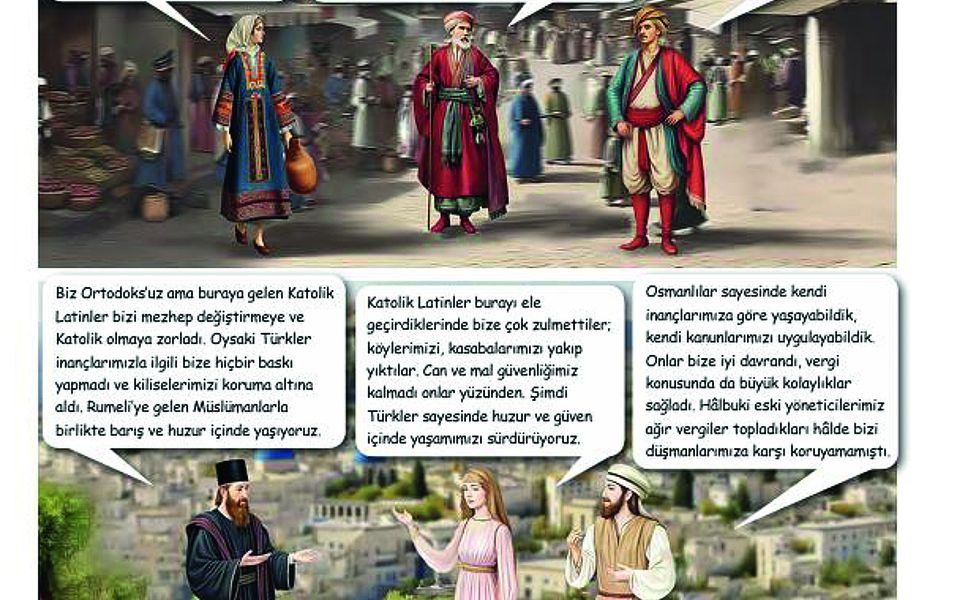
What emerges is a distinctive ideological synthesis in which the “sanctification” of Mustafa Kemal Ataturk coexists with a renewed emphasis on the Ottoman past, often infused with contemporary geopolitical undertones. The nation is portrayed as sacred, and students are expected to internalize a singular vision: that of a Greater Turkey secured through military strength. This objective appears to be a central priority of the current political establishment. Within this framework, the “Blue Homeland” doctrine is rooted in the era of Suleiman the Magnificent.
As one scholar notes, “Historical knowledge functions not only as a mechanism of political and cultural continuity, but also as a tool of moral education that shapes the values and consciousness of tomorrow’s Turkish society.” The observation is made by Stella Mavrou, teacher of Greek language and history at Leonteios School, and a researcher in the field of history education at Democritus University of Thrace (DUTH), who studies transformations in Turkish history textbooks.