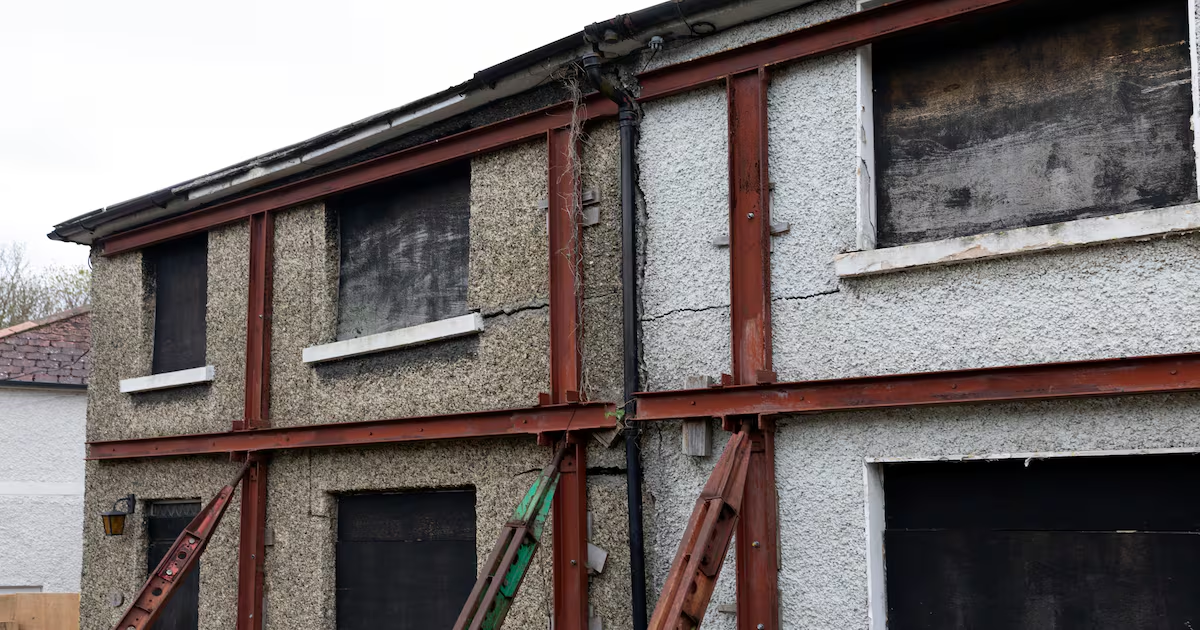
Few politicians are as fond of serially announcing eye-catching policies as Simon Harris. The Tánaiste and Fine Gael leader’s investment accounts for the middle classes are the best example of his habit of prioritising activity over action. This week, he reannounced that the Revenue Commissioners are to take over the job of pursuing the owners of derelict sites. It follows years of halfhearted and ineffectual efforts to collect the annual tax – 7 per cent of the properties market value – by local authorities who have €32 million in uncollected derelict site levies on their books.The involvement of the Revenue Commissioners was first announced in the budget last September, but the memorandum brought to Cabinet by Harris this week is meant to set out the details and the necessary legislation. Expect several more announcements before anything happens.‘No profit and crap governance’ – is Elon Musk’s SpaceX actually worth $1.75 trillion? Listen | 41:54The idea of sending in the Revenue Commissioners to sort out the mess seems inspired. Collecting money owed to the State is what they do and they have a deservedly fearsome reputation for doing it. They are also rather busy; and one can only imagine the collective head shaking in Dublin Castle when the initiative was announced – for the first time – last September. It will be interesting to see whether the Revenue Commissioners’ skill set will be any match for the collective action of 949 councillors spread across 31 local authorities. There are many reasons for the shambles that is the current derelict site levy and one of them is the lack of any sort of enthusiasm on the part of some local authorities to collect them. As former US speaker of the House of Representatives Tip O’Neill famously put it: “All politics is local.” There are not many votes to be gained for slapping a tax on local businesses and landowners. Or hitting someone for 7 per cent of the market value of a run-down cottage at the bottom of their field. The approach proposed by the Revenue Commissioners aims to sidestep the foot-dragging and seeming incompetence displayed by local authorities. The best example of this was the revelation that Kerry County Council had to remove all 64 properties from its register and write off €655,000 in unpaid levies, mainly due to clerical errors.It also deals with the wider issue, which is that nobody seems to know how many derelict sites there actually are countrywide. GeoDirectory suggests there were almost 19,500 residential derelict properties across the State at the end of 2025, although only about 2,100 are listed on official derelict property registers.Rather than going looking for derelict sites, the Revenue Commissioners have turned the process on its head and the obligation will be on the owners of derelict properties to declare them to the Revenue Commissioners and pay the levy. If they don’t, they will face the same consequences that would ensue if they did not pay any other tax. Penalties, interest and the prospect of being put on the tax defaulters list.[ Dublin’s derelict property owners face crackdown as council plans to treble sites facing leviesOpens in new window ]The self-declarations will be cross-checked against a new register of derelict sites that is being drawn up from a range of sources, including private individuals. If no owner can be identified, the Revenue can put a charge on the property and, ultimately, it can be compulsorily purchased.It seems pretty ironclad. However, there is one obvious flaw in the scheme. The job of putting together the new register is being left to the same local authorities whose lack of enthusiasm scuppered the previous scheme.The same factors that seemed to stay their hand when it came to pursuing the owners of properties under the old scheme will still be there.Ronan McGreevy visits 20 Dublin properties highlighted as derelict by The Irish Times in 2025 to see what, if any, progress has been made. Video: Ronan McGreevy Local authorities claim they don’t have the resources to administer the levy. Minister for Housing James Browne has dismissed their argument, noting that collecting the €32 million outstanding would be self-financing.Browne kept his counsel, however, when it came to what he thought was really holding back the local authorities. But the obvious inference was that local political issues trumped the imperative to collect the tax.Although Harris came a bit closer to belling the cat this week. “We’re going to have to take this over, because we can’t leave it to the local authorities, because they failed in their job to administer the derelict sites. They’ve badly failed, with a few notable exceptions, by the way.“I’ve sat in front of far too many chief executives of far too many councils ... and they eyeball us and say they’ve done enough, and they haven’t. They’re letting young people down.” Others he chided.Most odd then that he seems to be happy to leave the decision as to who will be in the new scheme to the selfsame bodies. They will deal with exemptions, appeals mechanisms and ownership verification arrangements. Tip O’Neill would approve.
The Revenue Commissioners taking on local politics won’t end well
Local politicians will still have a say in who get gets subjected to the derelict site tax
850 words~4 min read