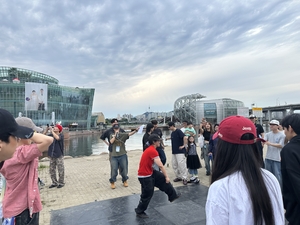
As K-pop and TV propel street dance into the mainstream, Korean dancers try to keep its grassroots culture alive A dance battle is underway at Banpo Hangang Park in Seoul on June 6. (Tammy Park/The Korea Herald) As music blasted across the Han River on a recent breezy Saturday afternoon, a crowd formed a circle beneath the open sky.Dancers took turns stepping into the center, testing their skills in battles in front of peers and spectators. The atmosphere was unmistakably competitive. Cheers erupted after particularly creative exchanges. Participants hyped each other up from the sidelines. Passersby stopped to watch.Yet unlike many formal dance competitions, the boundary between dancer and audience felt surprisingly thin.Some onlookers lingered for hours. Others found themselves chatting with participants. Later, members of the public were even invited to help judge battles.Known as Hangang Jam, the June 6 gathering, which marked the event’s sixth edition since its launch in 2023, reflected a growing ambition among some younger dancers in Korea to bring street dance beyond studios and competition venues and back into public spaces.The day began with an open freestyle session, allowing both preregistered participants and walk-in visitors to join the circle. Later, organizers held a team battle for preregistered participants. A b-boy performs during a battle at the Hangang Jam on June 6. The three people seated in the center are members of the general public who volunteered to serve as judges, blurring the line between participants and spectators. (Tammy Park/The Korea Herald) Kwon Yu-kyung, a 27-year-old producer, designer and street dancer who has organized the gathering for the past three years using her dance community account, Onlit, said the idea began with a simple desire to clear her mind and dance with friends in an open space."A studio is great but sometimes people end up trapping themselves within certain standards because of the pressure to improve or achieve results. Without mirrors or stage lighting, dancers are less focused on scrutinizing their shortcomings and more focused on being in the moment," she told The Korea Herald.Street dance is attracting renewed public attention in South Korea. Mnet's "Street Woman Fighter" franchise helped propel Korea's dance scene into the mainstream, while major battles and competitions such as the annual "Gwangju Battle Lineup" and "Red Bull Dance Your Style Korea" continue to draw participants from across the country and abroad.But for some dancers, the rapid growth of the scene has brought new pressures — to improve faster, perform better and constantly prove themselves. Hangang Jam seeks to ease that pressure while encouraging more people to see dance as something that can be enjoyed by anyone."There isn't a separate category of people who are allowed to dance, and yet many people still hesitate to move," Kwon said. "But once the music starts, I find they're often having more fun than anybody else."That philosophy is reflected in Hangang Jam's slogan, "Anyone Can Dance.""I hope people leave realizing that dance isn’t just for those who are technically skilled,” Kwon said. “Anyone who loves to dance can be a part of it." A young dancer freestyles during the open session at Hangang Jam. The person in the center holding a microphone is Kwon Yu-kyung, who served as the event’s MC for the first time. (Tammy Park/The Korea Herald) Hong Soon-ho, 27, a university student who started dancing K-pop last year before branching into breaking and other street styles, remembers when Hangang Jam was little more than a group chat among six dancers looking for people to freestyle with by the river.Since then, participation has increased sixfold, with the latest event attracting roughly 200 spectators. Hong, now an active member of the organizing team and working alongside Kwon to grow the event, said he believes in the project’s vision and is passionate about making dance culture more accessible to the general public."One of my favorite memories was when a passerby stopped, joined the circle and started dancing with us," he said. Hong Soon-ho (left) performs with his friends under the team name Pancake during a special performance at Hangang Jam. (Tammy Park/The Korea Herald) As the event grew, Kwon said she became increasingly encouraged by the sense of community forming between dancers and non-dancers, while still reflecting on how to make Korea's dance scene more accessible."Many dancers in Korea are working to strengthen Korea's dance community. But there are still people who want to participate and connect with others, yet don't know where people gather, what events are taking place or whether they're welcome to join in the first place. I hope dance can become more accessible for everyone in everyday life," Kwon said.Hangang Jam has so far been held at several locations along the Han River, including Yeouido, Banpo and Nodeul Island. It is typically held during the milder spring and fall months, and is expected to return for its next edition in September. Passersby stop to watch dancers at Hangang Jam. (Tammy Park/The Korea Herald) Onlookers gather to watch dancers as Hangang Jam gets underway. Some passersby stopped to watch, while others ended up joining the event as participants or volunteer judges. (Ahn Chung-hyun) Organizers and participants pose for a group photo following the sixth edition of Hangang Jam at the Han River on June 6. (Instagram: @be.onlit)
Young dancers seek freedom in Korea's growing street dance scene
As music blasted across the Han River on a recent breezy Saturday afternoon, a crowd formed a circle beneath the open sky. Dancers took turns stepping into the
877 words~4 min read