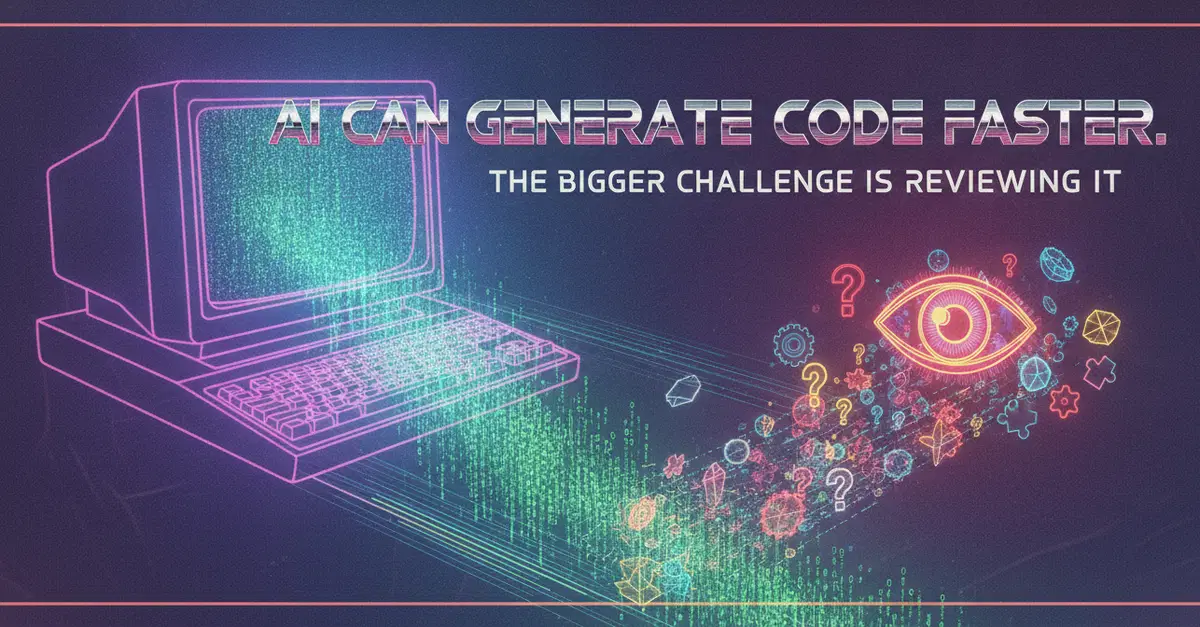
Coding agents draft specs, architecture docs, changelogs, and README updates in seconds — but a human still has to judge the quality of all that output.
The bottleneck shift
A year ago, the typical workflow was: you write a spec, you get comments, you revise, then you implement and get code review. Humans did most of the writing and coding. Now, agents produce first drafts of design docs, API references, runbooks, and onboarding guides — and they do it in seconds.
Code implementation and code review can now be handled by agents, so those are no longer the bottleneck. What surfaced instead is the step right before: document review. A human has to read 2,000 lines of generated markdown and decide what's wrong. The writing part got dramatically faster. LLMs can assist with document review too, but compared to code implementation and code review, the human judgment required is still larger.
This asymmetry compounds fast. Every agent-assisted project now has a stack of "needs human review" documents growing in a shared folder. If you're running multiple agent loops in parallel — one for the spec, one for the implementation plan, one for the test strategy — review becomes a pipeline stall. GitHub PRs remain the right tool when you need third-party review. But the step before that — the fast local self-review loop where you and your agent iterate on a draft — doesn't belong in a PR. Branching, diffing, and assigning reviewers is a lot of process for a first draft the agent wrote in seconds.