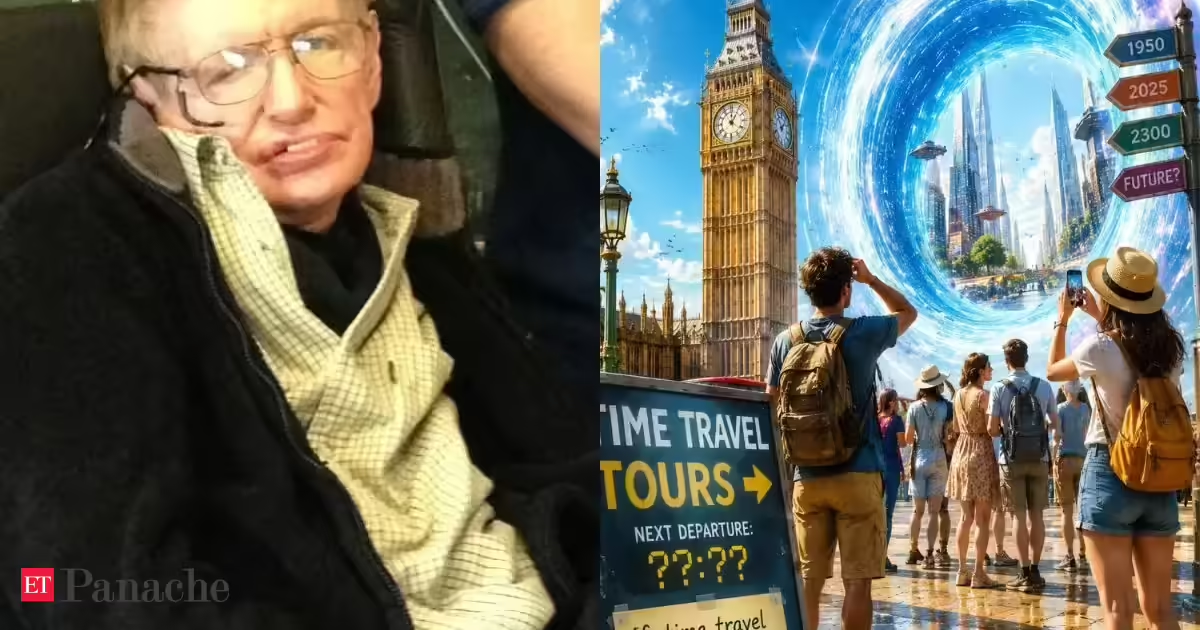
KIM SEONG-KON Since the release of "The Time Machine" in 1960, Hollywood has produced a plethora of films about time travel. Among them, “The Terminator,” “Back to the Future” and “12 Monkeys” immediately come to mind. “The Butterfly Effect,” "The Time Traveler’s Wife" and, more recently, “The Adam Project” also deal with time travel and its merits and problems. These movies open our eyes to both the past and the future of human civilization.The themes of time-travel movies revolve around our desire to fix past mistakes, reconcile our regrets or alter the future to challenge destiny.“The Terminator” series focuses on humanity’s attempt to avoid a dystopian future through time travel. "Back to the Future" explores the possibility of changing the past to create a better future. In “The Adam Project,” Adam travels back to his childhood to reconcile with the past and repair the future.The problem is that even small changes in the past could cause serious consequences, creating the notorious “butterfly effect.” Nevertheless, human beings are not content with the present and continually wish either to return to the past or travel to the future. That is why time-travel movies fascinate viewers.Novels about time travel are intriguing as well. In John Barth’s novella “Perseid,” for example, the Greek hero Perseus experiences a midlife crisis. He decides to return to the past to discover the source of his anxieties.Through his journey, Perseus realizes that he made a grave mistake long ago: He was not supposed to behead Medusa, who actually loved him and wanted him to kiss her. Seizing another chance, Perseus reconciles with Medusa and kisses her. At that moment, they become everlasting constellations in the sky.Time travel enables us to understand our present predicaments more clearly by discovering what went wrong in the past. If we avoid repeating past mistakes, we might create a utopian future. In that sense, the past, the present and the future are closely interconnected and intertwined. Through time travel, we can perceive our lives from a broader perspective.When traveling to various parts of the world today, we encounter not only different cultures but also different time zones due to different stages of social and economic development. Some people appear to suffer as though they were still living in the 19th century, while others enjoy the full benefits of the 21st century, depending on their countries’ wealth and power.The world is divided into developed and developing countries, or advanced and less developed nations.In poor countries ruled by dictators, the social clock seems stuck in the 19th or 20th century, causing people to live under harsh conditions reminiscent of the past. By contrast, in wealthy and powerful countries, society continues to advance rapidly, and the people seem to be living in the future.Indeed, by traveling to various countries today, we can witness and experience the past and the future, depending on where we go. In this sense, we become “mental time travelers” who metaphorically journey either into the past or into the future. In some countries, we might experience deja vu of our own nation’s past, while in others, we might glimpse our country’s future.It is intriguing, and even mysterious, that the past, present and future seem to coexist on Earth.Even when we travel across Europe, America or Asia, crossing the International Date Line gives us the brief sensation of time travel. Perhaps such experiences exist to teach humanity valuable lessons. Unfortunately, however, we often fail to learn from the past and therefore continue to live in a troubled present while stumbling toward a dystopian future.It is remarkable that a small country such as Korea has overcome postwar poverty and transformed itself into an affluent and advanced nation within such a short period of time.Koreans may feel like time travelers when visiting other countries. In some places, Korean travelers are reminded of Korea in the 1950s and 1960s. In other places, they can foresee their country’s future.Even within Korea itself, the past and the present coexist — sometimes peacefully and sometimes controversially — reflecting the nation’s turbulent yet remarkably successful history.Koreans constructed the 63-story 63 Building in Yeouido in 1985. Today, Yeouido contains several more skyscrapers, creating a spectacular skyline. In 2016, the Lotte Group completed the 123-story Lotte World Tower in Jamsil, which surpasses the 102-story Empire State Building in height. In the past, there were only a few bridges on the Han River. Today, there are 32.When we visit other countries, we become time travelers who can relive the past and preview the future. Such experiences broaden our minds and help us envision a brighter future. Perhaps that is why we like movies on time travel, which show us a journey to the past and a way back to the future.- - -Kim Seong-konKim Seong-kon is a professor emeritus of English at Seoul National University and a visiting scholar at Dartmouth College. The views expressed here are the writer's own. — Ed
[Kim Seong-kon] Time Travelers to the past and the future
Since the release of "The Time Machine" in 1960, Hollywood has produced a plethora of films about time travel. Among them, “The Terminator,” “Back to the Future
820 words~4 min read