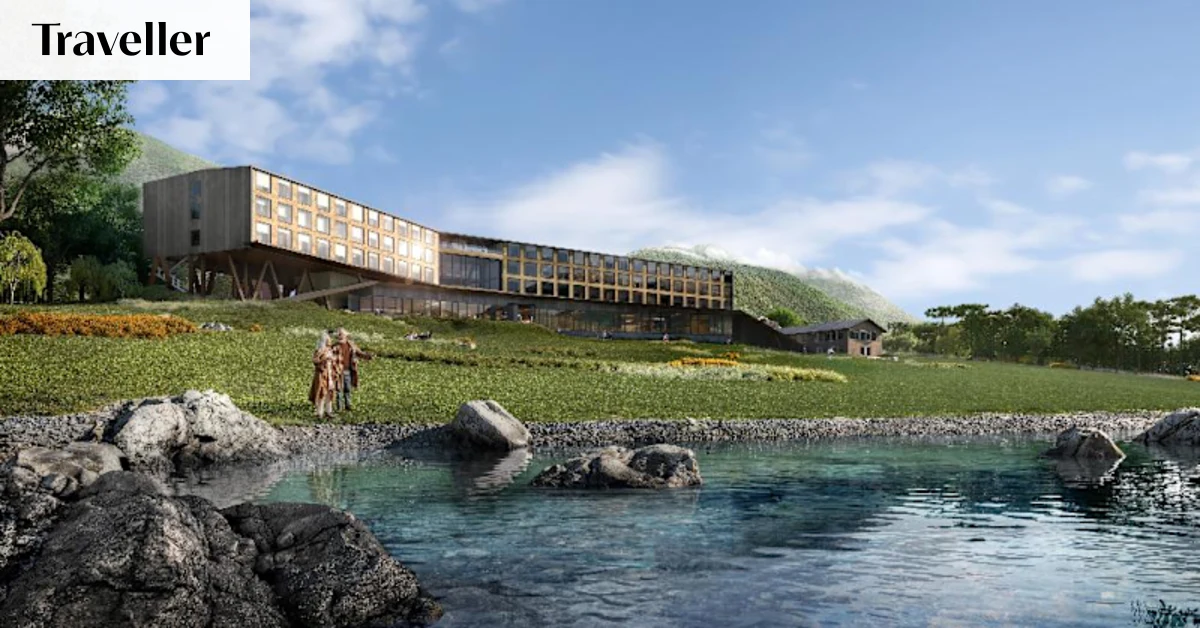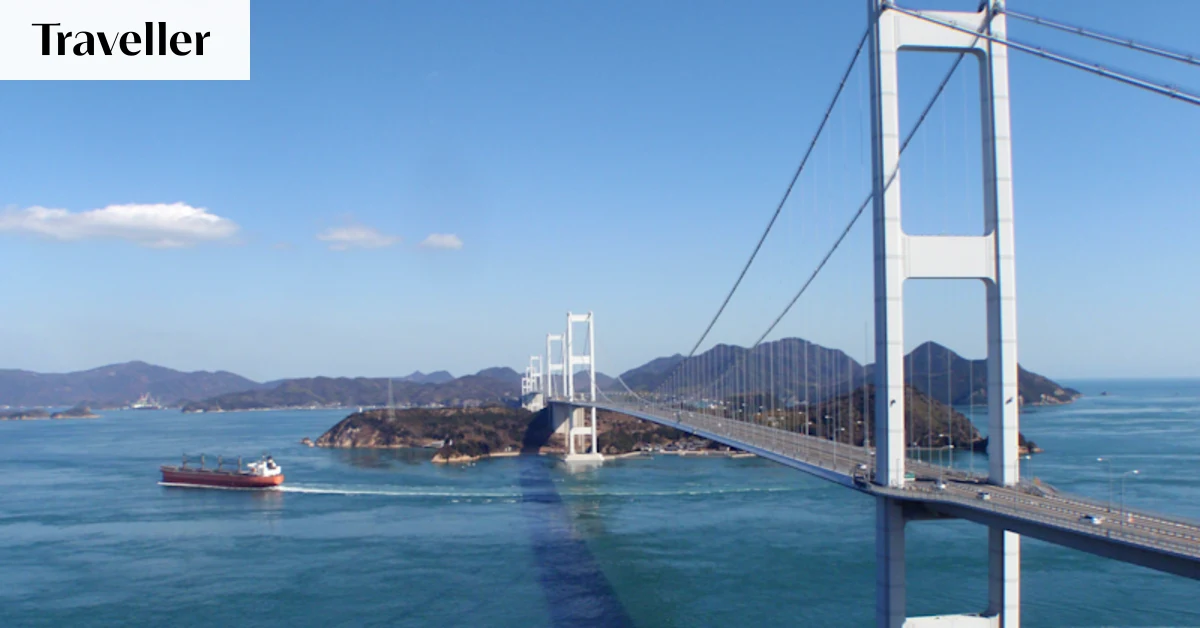
June 17, 2026 — 5:00amAll Lycra-clad and hairless legged, cycling’s adherents pedal the belief that it is one of the world’s coolest pastimes and, as my electric bike and I glide almost effortlessly across Japan’s Kurushima Kaikyo Bridge, I can only concur.The Kurushima-Kaikyo Bridge, surrounded by the spectacular Seto Inland Sea, forms part of the route for Japan’s Shimanami Kaido.iStockI’m cycling outside the peak seasons, and it’s not merely cool but rather cold as I cross three suspension bridges with a total length of 4.1 kilometres – longer than the Sydney Harbour and West Gate bridges combined – which span the four kilometre-wide, island-dotted Kurushima Strait.But if anything, here on the Shimanami Kaido, one of the most spectacularly scenic cycling routes in Japan, if not the world, the big chill only adds to the pure exhilaration of this ride across the bridge.It’s a sparkling blue day – bluer than even the painted blue line that guides the Shimanami Kaido from start to finish – blue on either side, and for that matter, below, with the Inland Sea dividing Honshu from Shikoku, respectively the biggest and fourth-largest of the islands that comprise the nation of Japan.Hang the Lycra and exposed shaved appendages, I’m wearing more layers on this day than a billionaire’s wedding cake, with virtually the whole dedicated cycle lane, safely separated from the stream of vehicles beside me, to myself.Sign up for the Traveller Deals newsletterGet exclusive travel deals delivered straight to your inbox. Sign up now.Here in Japan on the penultimate day of a week-long visit to Ehime, one of the four largely under-visited prefectures, or provinces, of Shikoku, I’ve allowed a day and two nights to ride 30 kilometres of the total 70-kilometre length of the Shimanami Kaido.The name of the route translates rather wonderfully, and entirely accurately, as “island-studded sea road” since it traverses six of them in all, each connected by yet more magnificent modern suspension bridges.The Shimanami Kaido cycle route traverses a number of bridges linking a series of islands between Shikoku and Honshu. Foreshadowing the global boom in bicycle tourism and extending between the cities of Imabari, in Ehime, and Onomichi, in the prefecture of Hiroshima on Honshu, the Shimanami Kaido was made possible in 1999 by the completion of the Nishi-Seto Expressway and its network of engineering marvel bridges.Along the way across the Kurushima Kaikyo Bridge there are lookout spots where you can dismount, pause for a swill of water and admire the panoramic views, including all manner of craft passing at varying knots below.Bicycles, including electrically propelled, hill-defying versions, can easily be rented at the start of the route. Up here, the Kurushima Strait, with the bridge nearly 80 metres above the water, forms one section of the vast Seto Inland Sea, home to as many as 3000 islands, with more than 170 permanently inhabited.The temperature here on the Kurushima Kaikyo Bridge isn’t the only cool aspect of the rather cool Shimanami Kaido. Beyond the bridge you can cycle back down to Seto Inland Sea level and pause for lunch at an inexpensive waterfront seafood restaurant, then remount for the ride that takes you through serene, bucolic villages interspersed with lemon orchards.The Shimanami Kaido route passes lemon orchards in a corner of Japan that’s famed for its citrus.iStockMy ride is bookended by two stylish Ehime-based hotels designed by the cycling fraternity that flocks to the Shimanami Kaido in its peak seasons of spring (mid-March to May) and autumn (September to mid-December), with each offering perfect-for-cycling cool to mild temperatures (unlike the scorching Japanese summer months).First, there’s the 50-room Itomachi Hotel 0 in Saijo City, touted as Japan’s first zero-energy hotel and designed by the renowned Japanese architect Kengo Kuma. A winner of the coveted Pritzker Architecture Prize, Kuma designed the Tokyo 2020 Summer Olympics stadium.Itomachi Hotel 0, like most if not all of Kuma’s works, primarily features timber as its main material, something evident in the striking, angular roof inspired by Mount Ishizuchi, a spiritual landmark in the area, blending into the natural surroundings.Designed by an award-winning Japanese architect, Itomachi Hotel 0 is claimed to be Japan’s first zero-energy hotel. What truly sets Itomachi apart is its strong commitment to sustainability, a key characteristic, of course, of cycling itself. Utilising innovative, energy-saving technologies, the hotel achieves near-zero energy consumption, establishing a remarkable standard for eco-friendly travel.The hotel’s not the only example of Kuma’s works in these parts, with the architect’s Kirosan Observatory Park an hour by road from Saijo City. It is located atop the more than 300-metre-high Mount Kiro, the southernmost point of Oshima Island.Some of the more luxurious rooms of Itomachi Hotel 0 include semi-outdoor blue stone onsen-stye baths. The sublime views from this vantage point, carefully designed to blend into the natural setting, include the nearly 2000-metre-high Mount Ishizuchi and the Kurushima Kaikyo Bridge.Of course, the fittest cyclists make a detour from the Shimanami Kaido for the strenuous ride up Mount Kiro (even with an e-bike, I leave that act to the Lycra-lovers and visit by car before I begin my ride).Closer to Onomichi, the end of the route in Hiroshima prefecture, the second cool digs I’m booked to stay at for a night is WAKKA (meaning “wheel” in Japanese). A sanctuary for the saddle sore if ever there was one, this hotel-cum-glamping site revolves, as it were, around cycling and cycling.One of the luxurious seaside villas at the WAKKA cycling hotel along the Shimanami Kaido. It comes with five unique room types, all with views of the Seto Inland Sea, the Shimanami Kaido and, notably, the striking, cable-stayed 1480-metre-long Tatara Bridge, which connects the island of Omishima to neighbouring Ikuchijima.Showcasing the abundant local seafood of the adjacent Seto Inland Sea, guests at WAKKA are served Japanese-style bouillabaisse featuring spiny lobster, a prized crustacean in Japan.At the restaurant at the WAKKA cycling hotel, guests are treated to the full bounty of the Seto Inland Sea. For those eager to explore the local island culture, WAKKA also organises guided tours, including visits to nearby citrus orchards, and provides customised transportation services by car, bus and even boat.It offers a “rescue service” too, in the event of mechanical problems or, unlikely as it would be on such a route where safety is paramount, a prang.Something that is no accident, and good news for Australians, is the fact that there’s a brilliant beachside-style cafe named Blue Rose, which could be straight out of Byron or Torquay. It’s run by a young couple who used to work at WAKKA.After riding flat out, pause for a flat white (and doughnut) at the Blue Rose Cafe near the WAKKA cycling hotel. If there’s something the serious Lycra, hairless leg cycling crowd are unhappy about in relation to the Shimanami Kaido, it’s that even at 70 kilometres it’s much too short.To me, as someone determined to spare an already troubled world from the sight of my limbs bound in elastic-style fabric, that sounds perfectly long enough, but consideration is apparently being given to its extension.Sounds totally cool to me.THE DETAILSRIDEHire a bicycle, including a range of e-bikes and preferably reserved in advance, from Sunrise Itoyama at the Ehime end of Shimanami Kaido. It’s about seven kilometres from Imabari and close to the start of the Kurushima Kaikyo Bridge (look out for the big and Insta-worthy Shimanami sign overlooking the Kurushima Straits). See sunrise-itoyama.jpPACKIn between accommodations, use one of the excellent luggage forwarding or “cycle without baggage” services, such as Yamato Transport, famous for its classic black cat logo. See global-yamato.comSTAYRooms from $A325 a night at Itomachi Hotel 0, Saijo (itomachihotel-0.com); and from $A370 a night at Shimanami Omishima Wakka (wakka.site).FLYJetstar (jetstar.com) operates regular flights from Sydney and Melbourne to Osaka’s Kansai Airport, where you can connect by train to Matsuyama, the capital of Ehime province on the island of Shikoku. Alternatively, fly Qantas (qantas.com) to Tokyo’s Narita or Haneda Airports and connect with a domestic flight to Matsuyama.MOREvisitehimejapan.com/en/The writer travelled as a guest of Visit Ehime.From our partners
One of the world’s most spectacular rides is surprisingly easy
The cycling route can be done in just a couple of days and traverses six islands joined by magnificent modern suspension bridges it’s a thrill to cross.
1,333 words~6 min read