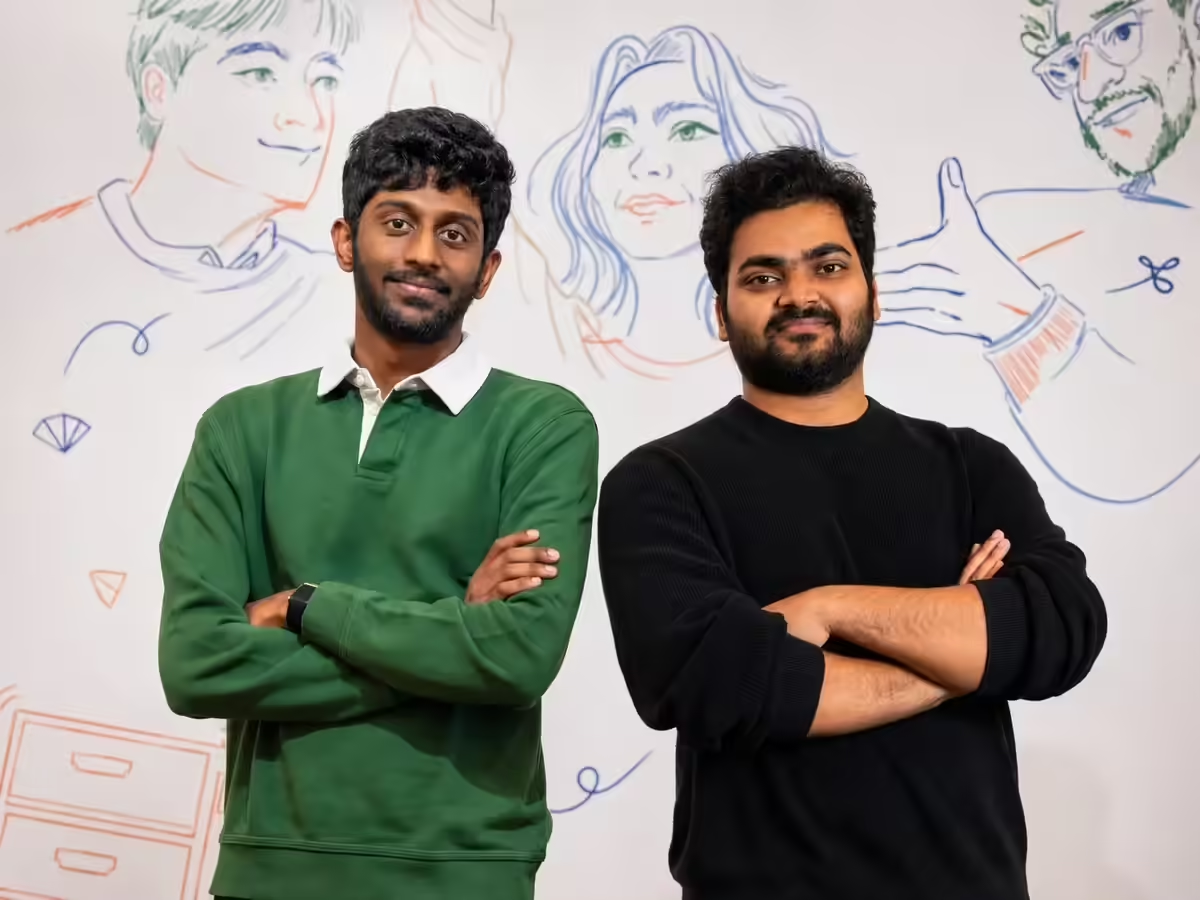
For most AI companies, voice remains a layer built on top of text. Users speak, a large language model generates a response, and a text-to-speech engine reads it back. However, Bengaluru- and San Francisco-based Maya Research believes that approach misses the larger opportunity.Founded by New York University graduates Dheemanth Reddy and Bharath Kumar Kakumani in 2025, the startup is building what it calls a "voice interface for the majority of the world" - conversational AI models designed to speak, think and respond like native speakers across languages, dialects and cultural contexts."The next four to five billion people will not use AI the way today's power users do," cofounder and chief executive Dheemanth Reddy told ET. "For them, voice is not a feature. It is how they live. The interface has to think and speak like them."The startup is entering a crowded voice AI market that includes startups including ElevenLabs and Cartesia, and Indian companies such as Gnani.ai, Skit.ai and Yellow.ai. But Reddy argues that the industry remains focused on speech generation rather than conversation itself."Models today know how to talk, but they don't know what to talk about," said Reddy. "Humans carry hesitation, affirmation, uncertainty and emotion inside conversations. The challenge is not generating speech. The challenge is deciding what to say, when to say it and how to say it."The cofounder’s comments come in the backdrop of the startup raising $1.9 million in a funding round led by South Park Commons.The company plans to use the capital to train larger conversational models, expand deployment infrastructure and deepen its understanding of how users in voice-first markets interact with AI systems. The founders' thinking was shaped by their time at NYC and under AI pioneer Yann LeCun. "One thing Yann often says is that we haven't achieved much yet," Reddy said. "People think AI has solved everything because models can generate text, but that's only a small part of intelligence."Voice in tier-II, III townsMaya operates both a model platform and a consumer application. Its models are commercially available through FAL, while its consumer app acts as a feedback loop that allows the company to observe how users interact with conversational AI across different languages and regions.The startup says its models have crossed more than 440,000 downloads on Hugging Face, while its consumer application has surpassed 3 million downloads across India, Southeast Asia and the Middle East and North Africa region.According to Reddy, Telugu-speaking users form Maya's largest market today, followed by users in Uttar Pradesh and West Bengal. The company has also seen wide usage among women discussing topics ranging from “shopping and family life to devotion and parenting.”"The biggest enemy we have today is internet quality," Reddy said. "Voice experiences are extremely sensitive to latency. If the internet connection is poor, the conversation breaks."Taking on larger AI modelsMaya 1, its emotive voice model, currently ranks sixth globally among open-weight models on Speech Arena, a benchmark used to evaluate conversational speech systems. Maya says it is the only Indian company represented on the leaderboard.The model holds a Quality Elo score of 1,051 on Speech Arena, which the company says places it on par with OpenAI's GPT-Realtime-2."The internet was built around English and text, which quietly left most of the world outside the interface," said Prateek Mehta, general partner at South Park Commons. "As voice becomes the way billions of people interact with technology, the company with the richest multilingual speech data and the strongest conversational models will have a defining advantage."Reddy said the company employs people to travel to villages and towns across India to record conversations and understand how people naturally speak.The company collects regional variations and dialects rather than relying on standardised language datasets. Reddy said the strategy reflects a broader belief that voice AI adoption in emerging markets will depend as much on cultural familiarity as technological capability."We first wanted the model to speak like a local," he said. "That creates trust."On the business model, while many consumer AI companies are experimenting with subscription models Reddy said the larger opportunity lies in becoming a discovery and navigation layer that helps users access products, services and information they may not otherwise find."There are so many things people still need to discover," he said. "Technology has to help them navigate."The company eventually expects to generate revenue by helping users discover relevant financial products, government schemes, healthcare services, commerce offerings and other digital services.
South Park Commons backed Maya Research wants to build a voice interface that speaks like a local - The Economic Times
Maya Research is developing conversational AI models designed to speak and respond like native speakers across languages and cultural contexts, aiming to serve the next four to five billion internet users. The startup, which raised $1.
733 words~3 min read