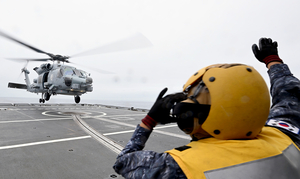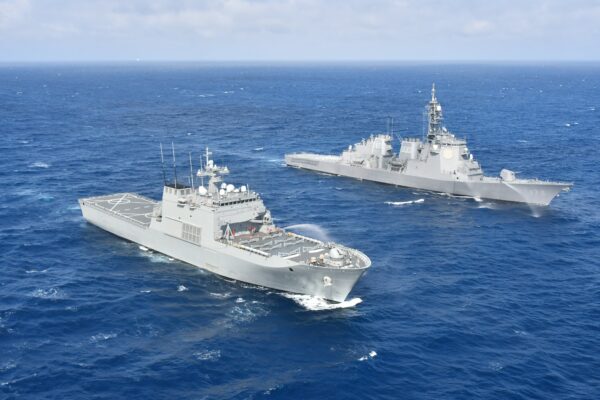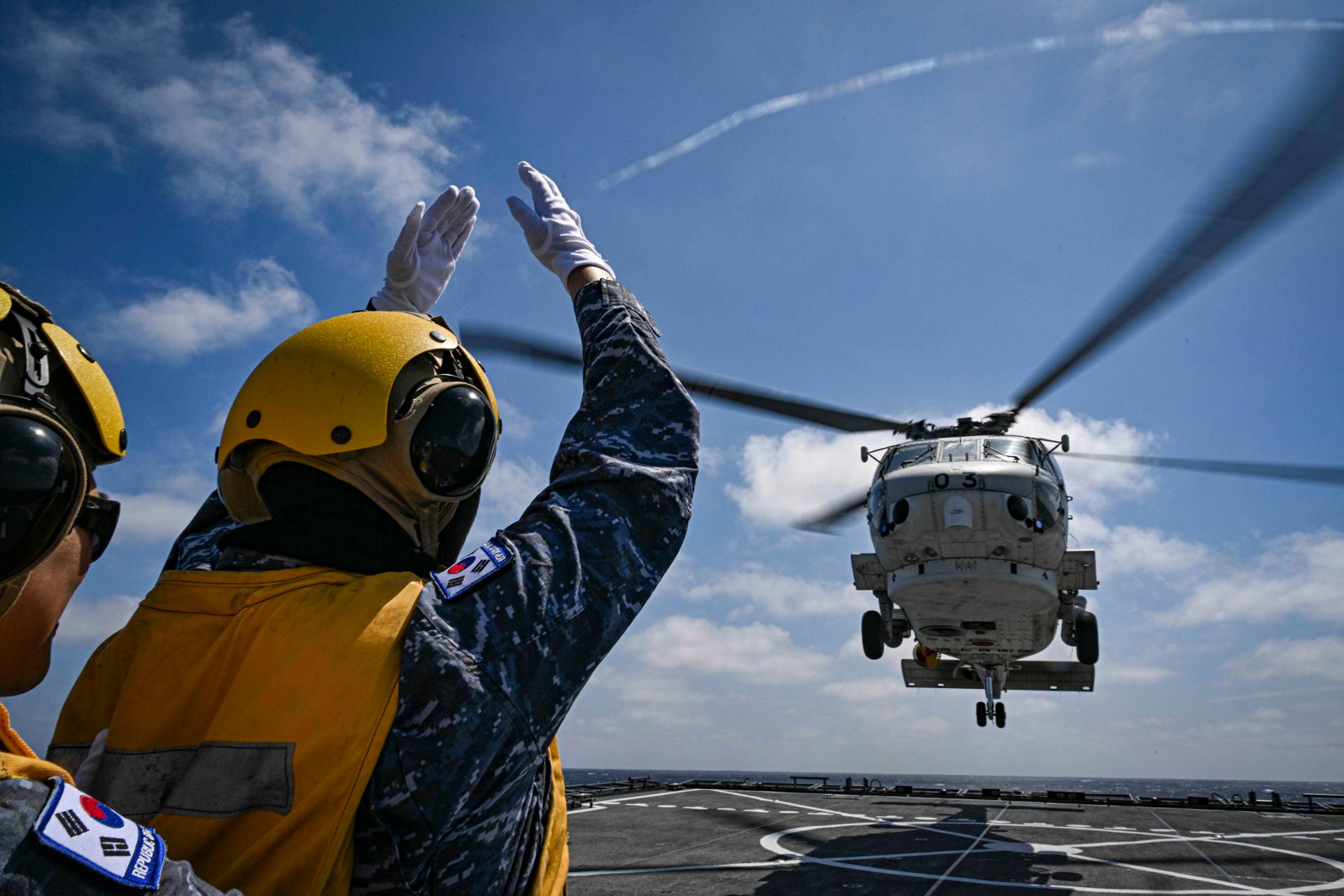
A Japanese Maritime Self-Defense Forces maritime patrol helicopter (SH-60K) drills landing and take-off from a South Korean Cheonwangbong-class landing ship during the two countries’ naval search and rescue exercise (SAREX) conducted on June 7, 2026, in international waters southeast of Jeju Island. (courtesy ROK Navy)
During a press conference marking his first year in office last week, South Korea’s President Lee Jae Myung acknowledged “a realistic need” for a proposed acquisition and cross-servicing agreement (ACSA) with Japan, but said public sentiment in Korea makes it difficult to accept such a deal at this time. Lee said he conveyed this position to Japanese Prime Minister Sanae Takaichi. Tokyo very much wants to establish an ACSA with Seoul, but the latter is keeping its distance or taking a cautious stance on the matter. We’ve rounded up common questions about what the agreement is, and why Japan is angling for one with Korea to bring you up to speed. Q. What exactly is an ACSA?A. Simply put, an ACSA is an agreement between two countries to provide military supplies to each other. Both militaries agree to provide supplies and services within available limits to ensure fast and efficient logistical support during wartime and peacetime military activities, with settlement made afterward. Global logistics cooperation is based on such an accord, so Korea continues to establish new military logistics-sharing agreements or revise ones in effect to facilitate efficient mutual logistics support.Q. How many agreements of this kind does Korea have with other countries?A. A 2022 white paper of the Ministry of National Defense showed that Seoul has such accords with 17 countries: the US (signed in 1988), Thailand (1991), New Zealand (2007), Turkey (2008), the Philippines (2009), Israel, Australia and Canada (2010), Indonesia and Singapore (2011), Cambodia, Spain and the UK (2012), Mongolia (2013), Germany (2016), Vietnam (2018) and France (2019).