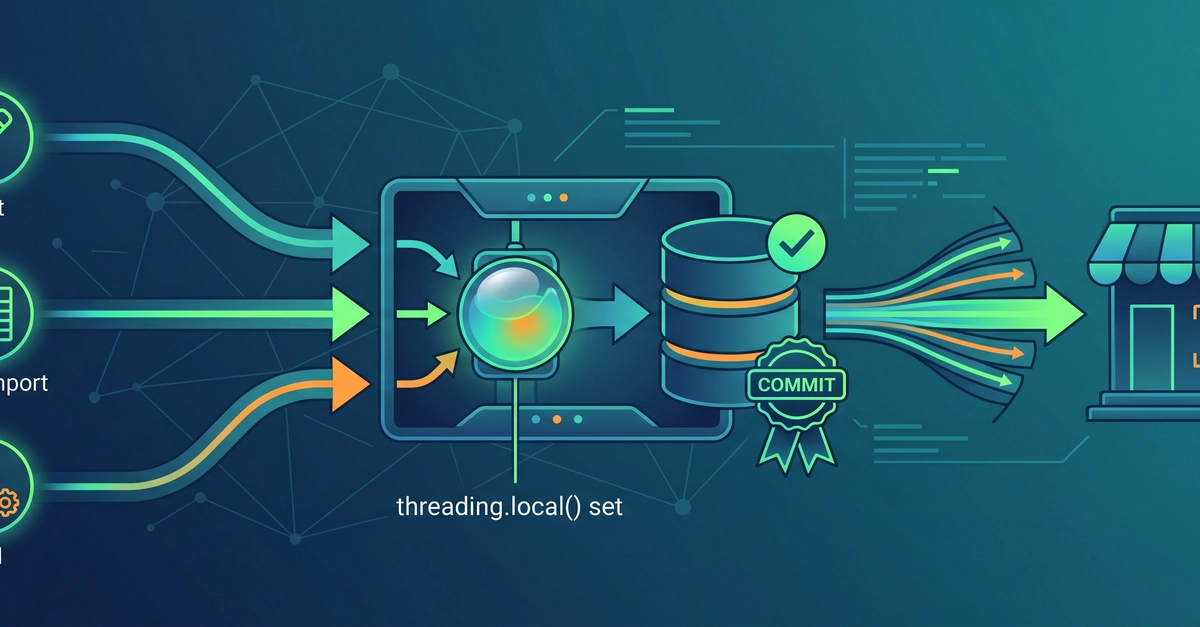
Change a product's price anywhere in your app, and it instantly syncs to a third-party marketplace. No manual triggers, no polling, no fragile save() overrides. Here's the signal pattern that powers it.
The Problem
In our app, a product's name or price can change from eight different places. The edit page. Bulk import. The variant editor. A pricing rule engine. An API endpoint that processes webhooks from suppliers. Every few weeks, someone adds a new feature and creates yet another code path that mutates a product.
We needed every one of those changes, no matter where they came from, to sync to an external marketplace. The naive approach would be to add a sync call to each code path. That's eight places to maintain (and counting), eight chances to forget, and eight places that break if the sync API changes.
Django's post_save signals solve the discovery problem: hook into a model's save event and you catch every change, from every code path, in one place. Signals get a bad rap — fairly, they make control flow hard to trace. But when you need to react to changes from everywhere without touching anywhere, this specific discovery problem is exactly what they were designed for.