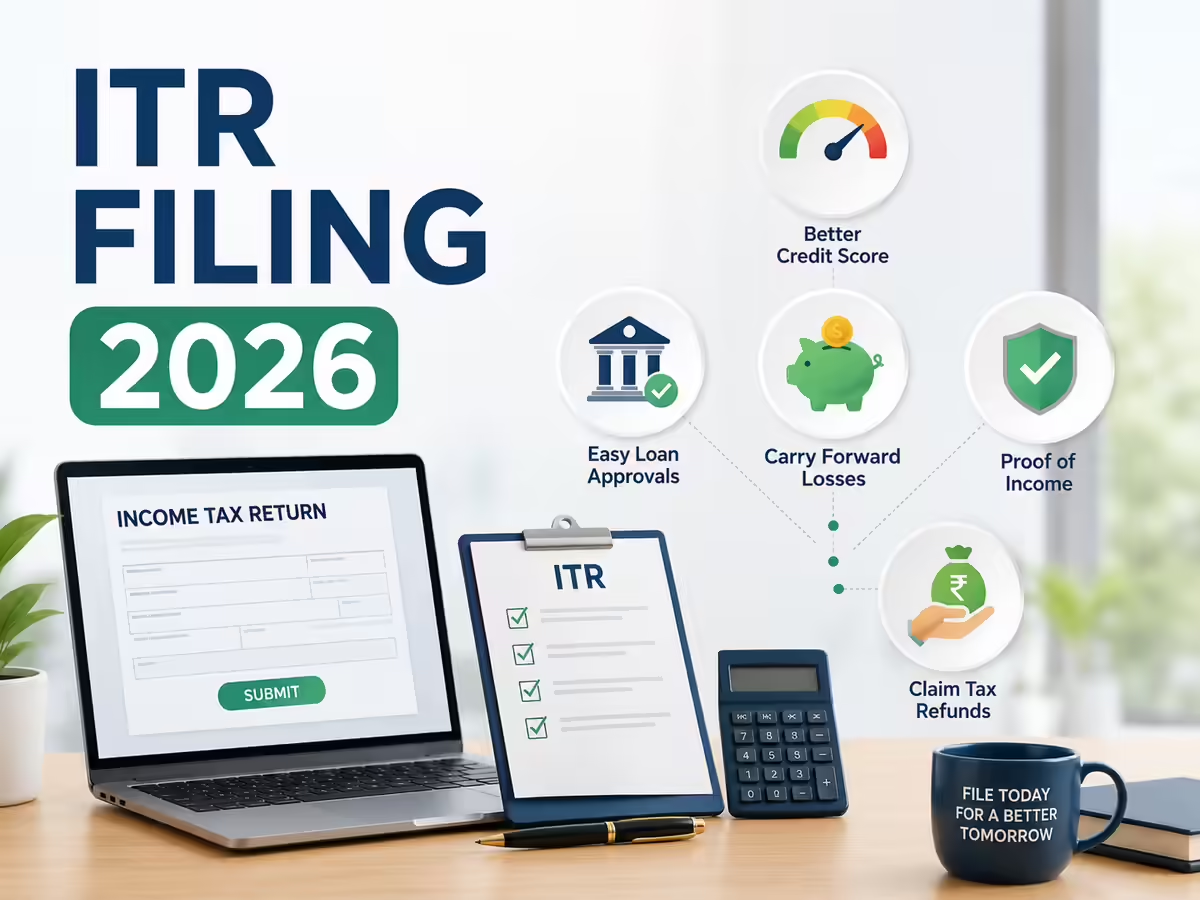
The basic exemption limit is Rs 2.5 lakh under the old tax regime and Rs 4 lakh under the new tax regime for individuals under 60 years. This means that if your total income is at or below this amount, you don't have to file ITR. But, there are some exceptions, like if you pay a credit card bill over a certain limit, or travel abroad, then you must file an ITR regardless of your income level.Another question that comes to mind is about special rate income like capital gains. For instance, if you are a student getting some pocket money from your parents or working part-time and decide to invest in listed equity shares but end up with a loss, you will need to file an ITR, even if your total income is below Rs 2.5 lakh (old regime) or Rs 4 lakh (new) regime if you want to carry-forward this loss to be set-off in future years. Otherwise, you generally don't have to file subject to certain conditions.Also, keep in mind that if you have losses from Future and Options (F&O), then you need to file ITR for reporting purposes.Keep reading to know more about this concept.Also read: Income tax alert: These taxpayers could receive scrutiny notices by June 30, 2026 under Section 143(2)If you have short-term capital loss and total income is below the basic exemption limit , do you still need to file ITR even if you don't want to carry-forward or set-off any loss?Chartered Accountant Varun Singhal told ET Wealth Online that if an individual's total income is below the basic exemption limit and they have incurred a short-term capital loss which they do not intend to carry forward or set off in future years, filing an Income Tax Return (ITR) is generally not mandatory.Singhal says that under the Income-tax Act, filing of ITR is compulsory for individuals only when their total income exceeds the maximum amount not chargeable to tax. For FY 2025-26, the basic exemption limit is Rs 4 lakh under the New Tax Regime and Rs 2.5 lakh under the Old Tax Regime.Also, the provisions relating to mandatory filing for capital losses apply specifically in cases where the taxpayer intends to carry forward such losses for future set-off. Singhal says: "Therefore, if the taxpayer neither wishes to carry forward the short-term capital loss nor has income exceeding the prescribed exemption limit, there is ordinarily no mandatory requirement to file the ITR."However, voluntary filing may still be advisable in certain situations, such as maintaining financial records, facilitating future scrutiny responses, or supporting loan and visa applications.What about LTCG from listed equities below Rs 1.25 lakh?Long term capital gains up to Rs 1.25 lakh from listed equities including equity mutual funds is exempt from income tax. Chartered Accountant Abhishek Soni, co-founder, Tax2Win says: "Even if Long-Term Capital Gain (LTCG) under Section 112A is below Rs 1.25 lakh and no tax is payable, such gains should still be disclosed in the ITR. The exemption limit only means the gain may not be taxable. It does not remove the reporting requirement."How to disclose LTCG below Rs 1.25 lakh in the ITRSinghal explains:Report under Schedule CG:The capital gains must be disclosed under the "Capital Gains" schedule (Schedule CG) of the applicable ITR form.Computation of gains:The taxpayer should compute LTCG by deducting the cost of acquisition and eligible transfer-related expenses from the sale consideration.Tax calculation:Even where the LTCG is below Rs 1.25 lakh and exempt from tax, the details should still be appropriately reported in the return. The ITR utility will automatically grant the exemption threshold and compute tax only on the amount exceeding Rs 1.25 lakh, if any.
Do you need to file ITR if you only incurred losses from equities or mutual funds? Check the details - The Economic Times
No profit, only loss from equity or mutual funds? Check if ITR filing is mandatory
611 words~3 min read