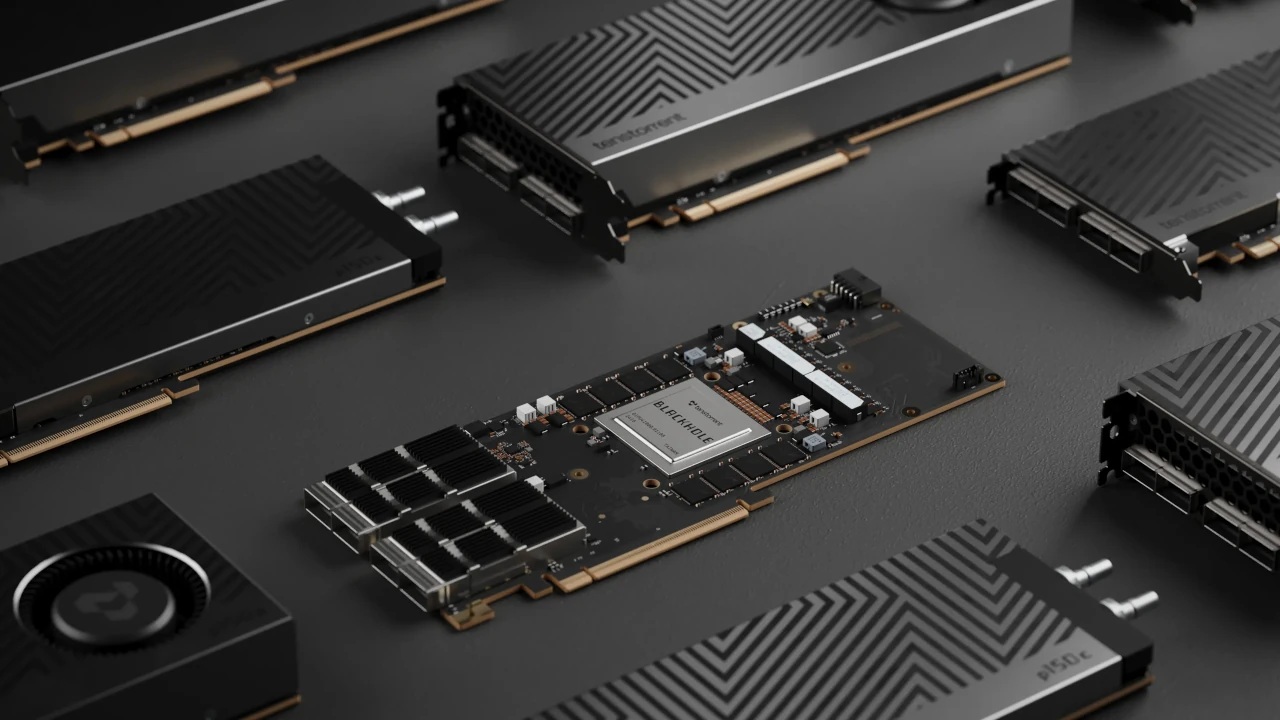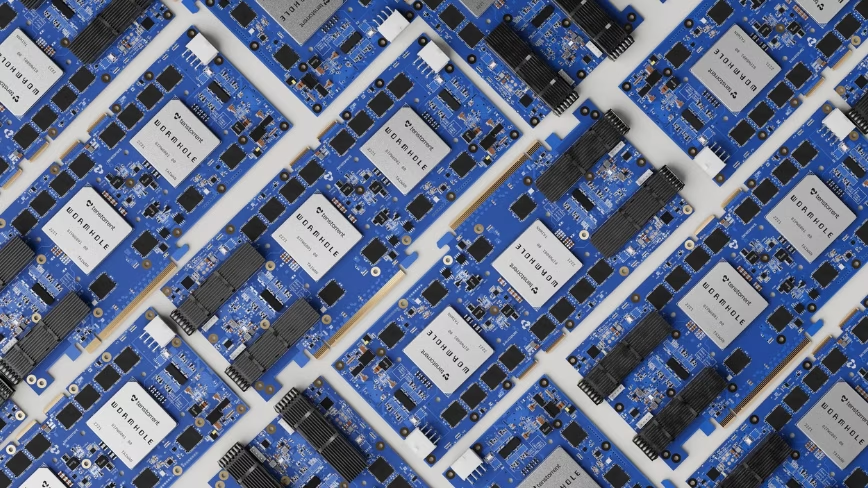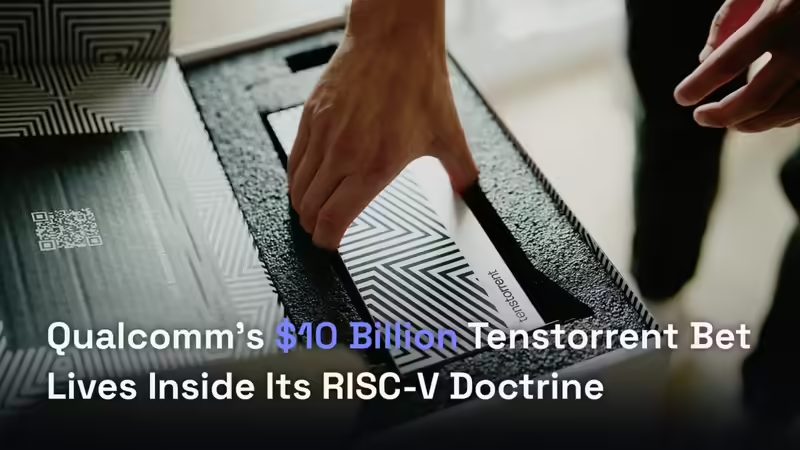
Qualcomm wants to spend as much as $10 billion on a company that builds chips around an instruction set anyone can use for free. Hold those two facts together — the ten-figure cheque and the word "free" — because they make sense only once you know what the San Diego company has spent months telling people.On 15 June, The Information reported that Qualcomm has been in talks to buy Tenstorrent, the RISC-V AI chip startup run by Jim Keller, at a price between $8 billion and $10 billion, citing a person with direct knowledge of the discussions. Reuters relayed the report and attributed it to that single source. Qualcomm and Tenstorrent stayed silent. The stock slipped about 1 per cent in extended trading, the market's reflex discount for deal risk.Four months earlier, between two keynotes at the India AI Impact Summit at Bharat Mandapam, Qualcomm's de facto chief technologist handed me the whole rationale for a deal that had yet to leak. He was discussing a smaller RISC-V purchase at the time. The logic transfers whole.Key TakeawaysQualcomm is in talks to buy Tenstorrent, Jim Keller's RISC-V AI chip startup, for $8 billion to $10 billion, The Information reported on 15 June 2026. Both companies have stayed silent, and the discussions remain early.The move would mark Qualcomm's second RISC-V acquisition in roughly six months, after its reported $200–600 million purchase of Ventana Micro Systems in December 2025.Tenstorrent widens the bet from CPUs into AI compute: its Ascalon cores are RISC-V CPUs, its Tensix cores handle AI training and inference — the workload Qualcomm's AI200 and AI250 leave on the table.At the India AI Impact Summit in February, Qualcomm EVP Durga Malladi described RISC-V as a generational bet timed to a once-in-30-years architecture shift. A Tenstorrent deal scales that doctrine more than ten times over.The interview that reads like a forecastDurga Malladi has steered Qualcomm's silicon strategy since 1998 and holds more than 580 US patents. When he explains a decision, he reaches for the longest arc available. Sitting down with me in February, he set the company's RISC-V push inside a 30-year clock. "Instruction Set Architecture transitions occur only once every 20 years or so," he said, tracing the line from x86 in the early 1980s to Arm in the 1990s. By his arithmetic, about 30 years on, the window for the next shift stands open.He sold the open standard as opportunity. RISC-V was "a clean start that brings benefits," Malladi explained, with "the right attributes in some market segments that are still relatively greenfield." One phrase lands harder in hindsight. Qualcomm had found "a couple of segments" where the architecture made its strongest case, he said. In February he was buying Ventana, a RISC-V CPU outfit. A couple of segments left room for a second.Pressed on whether performance or efficiency drove the decision, he gave a clean answer. "The answer is both," Malladi said, describing power-performance curves that came back "very competitive" across the board. Asked whether Qualcomm might one day ship two instruction sets side by side, he declined the bait — predictions beyond a year were a fool's errand, he said, and the matter would "just play itself out." On the Arm dispute hanging over all of it, he closed the door: "I have no comments on the Arm situation. You would need to talk to our legal counterparts on that one."Malladi was describing Ventana. He spoke about Ventana alone; Tenstorrent had yet to surface as a target. The bridge from February's doctrine to June's reported $10 billion is mine to build, and worth building with care.What does Qualcomm get for $10 billion?Tenstorrent hands Qualcomm a training-grade AI architecture and a RISC-V CPU bench it lacks today. Founded in 2016 and headquartered in Toronto, with design centres in Austin, Silicon Valley and Bengaluru, the company sells two things — Ascalon RISC-V CPU cores and Tensix AI cores — both as finished silicon and as licensable IP. Keller, architect of Apple's A4 and A5, AMD's Zen and Tesla's self-driving chip, joined around 2020 and took the chief executive's chair in early 2023.The valuation maths explain the market's flinch. Tenstorrent was last reported, in November 2025, to be raising $800 million at a $3.2 billion pre-money valuation led by Fidelity — up from the $2.6 billion it carried after its December 2024 Series D. A purchase at $8–10 billion would pay roughly two-and-a-half to three times that mark. Treat the multiple as rough: both the price and the last valuation rest on reporting rather than filings.Two buys, six months, one directionDetailVentana Micro SystemsTenstorrentStatusAcquired, December 2025Talks reported, 15 June 2026Reported price$200m–$600m (undisclosed)$8bn–$10bnFounded, base2018, Cupertino2016, TorontoRISC-V CPUVeyron lineAscalon coresAI acceleratorCPU-focusedTensix coresChief executiveBalaji BakthaJim KellerVentana cost Qualcomm the price of a mid-size startup and added CPU talent beside the Arm-based Oryon line. Tenstorrent would cost more than ten times as much and carry the open-standard bet into AI compute — the slice of the data centre where Nvidia prints money. The compass needle points one way.A throne, a claimant, and the lawsuit underneathThree houses have held the compute throne in living memory. x86 ruled the data centre for a generation. Arm seized the mobile world in the 1990s and later marched on the server room. RISC-V is the claimant of common birth — an open standard any house may swear to, its loyalty owed toll-free.Qualcomm's quarrel with the sitting house is a matter of record. Its Oryon cores came out of the 2021 purchase of Nuvia; Arm sued over the licensing terms; Qualcomm won the case outright in January 2025, with a countersuit still grinding through the courts. Malladi's "talk to our legal counterparts" was the line of a man who has read the room.Buy Ventana and you have hired a few skilled bannermen. Buy Tenstorrent on top and you have raised an army sworn to a rival crown. Two RISC-V houses brought under one banner inside six months, while the suit with Arm still drags — that reads as a campaign, whatever the official word about a "technology bet."Two engines, one bonnetUnderneath the corporate chess sits an engineering question. Qualcomm's Oryon CPU runs on Arm. Tenstorrent's Ascalon runs on RISC-V. Carmakers settled this argument long ago: you fit one engine architecture to a platform and build every mount, gearbox and control unit around it.Qualcomm now proposes the opposite — a parallel powertrain programme, Arm under the bonnet for Snapdragon, RISC-V for stretches of the data centre. Tensix adds a second motor of a different kind: an AI accelerator built for training as well as inference, the heavy workload Qualcomm's own AI200 and AI250 leave on the table, tuned as they are for inference alone. You buy Tenstorrent for the engine the chassis lacks.Dragonfly's other halfWatch Qualcomm's data-centre pitch take shape and the gap shows itself. At Computex in Taipei this June, Cristiano Amon walked on stage and gave the entire data-centre effort a name: Dragonfly. The AI200 ships this year, the AI250 in 2027, both built for inference — running trained models rather than creating them. Amon called 2026 the year of AI agents and pointed to signed business: a 200-megawatt deployment with Saudi-backed Humain, and a second cloud provider, still unnamed, with custom shipments due in December.Inference is one half of the data centre. Training is the other half, and the richer one — the reason Nvidia's order book reads the way it does. Tenstorrent's Tensix cores aim at that half. Set against Dragonfly, an $8–10 billion bid stops looking like a splurge and starts looking like a company buying the wing it forgot to design.Bengaluru's quiet stakeTwo threads run home to India. Tenstorrent keeps a design centre in Bengaluru, so a Qualcomm purchase would fold an India-based RISC-V team into the firm that already runs its largest engineering base outside the United States across Bengaluru, Chennai and Hyderabad — the same teams that taped out Qualcomm's 2-nanometer silicon. RISC-V roadmaps could land on those desks.Policy runs through the second thread. India has backed RISC-V through its home-grown DIR-V programme because the open standard carries licence fees of zero — sovereign silicon free of tribute to a foreign owner. A Qualcomm that holds both Ventana and Tenstorrent would hold a commanding share of the world's finest RISC-V CPU talent. For India's own ambitions, that reads differently from a field of independent suppliers — worth watching as the country weighs how much of its chip future to build on an architecture a US giant is busy consolidating.Malladi told me in February that RISC-V was a technology bet, and said it twice. One acquisition supports that reading. Two acquisitions in six months, worth a combined order of $10 billion, struck while the company is still in court with Arm, support a sharper one. Qualcomm is building its exit from Arm. Whether it ever says the words, the cheque to Tenstorrent would be the plainest sentence in the argument.Frequently askedHas Qualcomm confirmed the Tenstorrent deal?The talks remain unconfirmed. The Information reported active discussions on 15 June 2026 at $8–10 billion; Reuters relayed the report and left verification to that single source, while both companies stayed silent. Terms could shift, or the talks could end.Who is Jim Keller?Keller ranks among the most decorated chip architects working today, with credits on Apple's A4 and A5, AMD's K8 and Zen, Tesla's self-driving silicon and a spell at Intel. He joined Tenstorrent around 2020 and became chief executive in early 2023.What is RISC-V, and why does it matter here?RISC-V is an open instruction set architecture that any company can use free of licence fees, unlike the proprietary Arm and x86. For Qualcomm it offers a CPU path independent of Arm's terms — pointed, given the two companies' continuing legal fight.How does this differ from the Ventana deal?Ventana Micro Systems, bought for a reported $200–600 million in December 2025, brought RISC-V CPU expertise. Tenstorrent runs far larger and adds AI accelerators in its Tensix cores, carrying the bet from processors into AI compute.What happens next?Qualcomm's investor day on 24 June is the next hard date. Watch for any comment on the reports, a possible counter-bid from Intel — which circled Tenstorrent in May — and word on whether Tenstorrent's own funding round closes in place of a sale.end of article
Why Qualcomm Wants Tenstorrent: A $10 Billion RISC-V Bet, Foretold
Qualcomm is reportedly in talks to buy Tenstorrent for up to ten billion dollars. This move follows a smaller RISC-V acquisition and signals a major bet on open-standard chips for AI. Tenstorrent brings advanced AI accelerators, a key area where Qualcomm's current offerings are limited. The deal would significantly bolster Qualcomm's position in the competitive AI chip market.
1,711 words~8 min read