Business Agreements Signed with Eight Companies On-Site Verification of Real-Life Digital Services
On June 1, Gangnam District in Seoul announced that it will begin fully implementing real-life pilot projects utilizing artificial intelligence (AI) and digital technologies at the district office’s civil service counters, community centers, bus stops, welfare facilities, and the Yangjaecheon area starting this month.
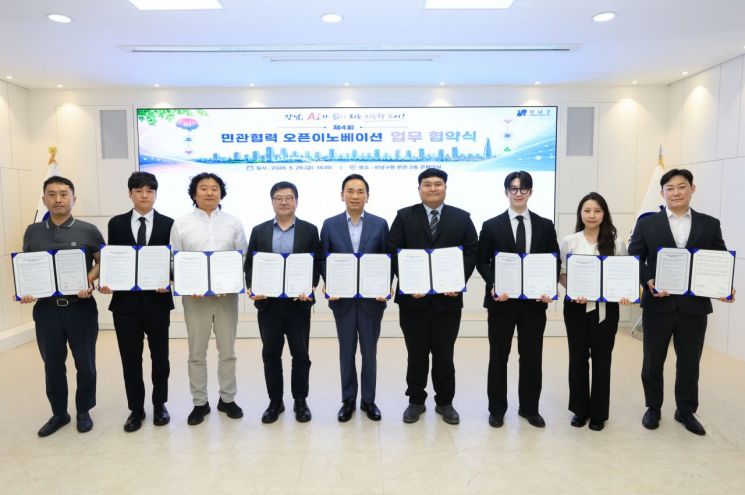
On May 29, at the business agreement ceremony held at the district office, Seongmyung Cho, Mayor of Gangnam District (center), and company representatives. Provided by Gangnam District Office.
View original image
Gangnam District has selected eight companies through the 4th “Gangnam, An Intelligent City Where AI Becomes Life!” public-private open innovation initiative, and signed a business agreement on May 29. Five companies—including WDS, Rainbow Company, Zerolabs Korea, Byeoldareogaja, and BIC&S—will receive subsidies, while three companies—Inferra, Filerneer, and Preventer—will be given opportunities to use pilot sites. The pilot projects will span various fields including administration, civil affairs, transportation, welfare, safety, energy, and the environment.At the civil service counters, transparent OLED screens will be used to transform traditional partitions into real-time communication displays. Conversations between visitors and staff will be shown as text on the screens, and instant foreign language translation will also be supported. In the first-floor lobby of the district office, an AI hologram guide will provide information on department locations, civil petition procedures, and offer multilingual voice guidance. At community centers, a generative AI-based work assistant will support resident registration and integrated civil affairs operations.In local smart shelters, AI voice recognition kiosks will be installed, allowing seniors, visually impaired individuals, and foreigners to check bus and subway information and call taxis using voice commands. At the Gangnam Welfare Center for the Disabled and other facilities, an AIoT sensor attached to powered wheelchairs will automatically detect rollovers or collisions and send alerts—a system that will be tested as part of the pilot project.At the Employment Support Center and the mechanical room of Nonhyeon 1-dong Community Center, AI and IIoT sensors will be used to detect anomalies in air handling units, pumps, and electrical equipment in real time. At the Myeonghwa Welfare Center, an energy-saving plan will be verified using a smart power management system. Around the Metasequoia Road near Yangjaecheon, a smart park management system will be introduced to store and reuse rainwater. The district plans to review whether to further expand administrative services based on the results of the pilot projects.