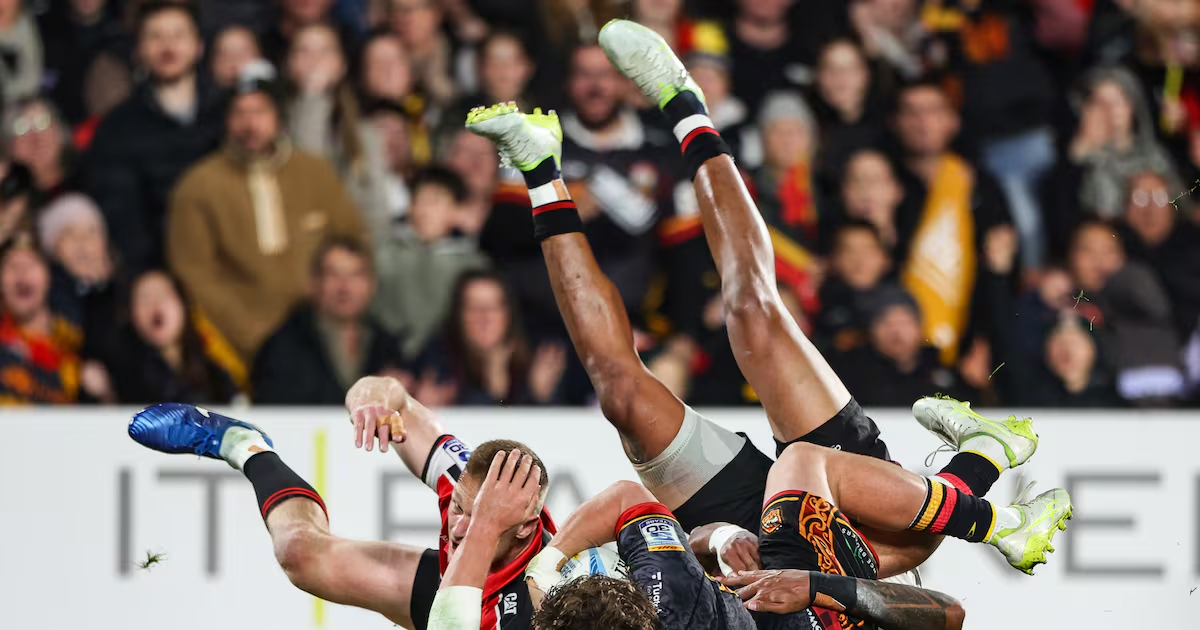
The outcomes of World Rugby’s June meeting are now being written up and we should see them soon. Attempting to second guess them would be a fool’s errand, but it’s interesting to consider what the general mood of their discussions was like.There were several key issues up for decision which will shape how the game is refereed in the upcoming Nations Championship and in next year’s World Cup. And yes, the World Cup is closing in quickly.I suspect the conversations have been robust and, at the same time, courteous. Neither “side”, as in the northern and the southern hemispheres, is likely to willingly bend to proposals which are completely counter to their own wishes.Brett Robinson, the Australian chair of World Rugby, may well have found himself between the hammer and the anvil. His own union is fully behind proposals which run counter to how the game is officiated up north. I really should have said his “former” union – he will know, better than I do, that his role is to bring everybody together. As difficult a task as that may be, it is essential.The French Rugby Federation have made their position clear. The game in France is in rude health and they do not see any reason to follow proposals made by unions where the game is in poor health. The French professional league body, LNR, have just signed a five-year agreement with TV channel Canal+ for the guts of €700 million up to 2032. That’s two World Cup cycles. So, why on earth should they, or any of the northern unions, agree to fix something that is not broken?Meanwhile, the semi-finals of Super Rugby Pacific took place over the weekend. For the first time ever, no Australian team reached this stage. It’s another pointer to the frailty of the game there. Of course, they are unfortunate in that they have to compete with both rugby league and with Australian rules. We can only wait and see what laws have been affected by these vital discussions. Hopefully, this will signal the end of continuous tweaking.The two semi-finals had several things in common and both were easy victories. The Chiefs had the result wrapped up before half-time against the Crusaders with a final scoreline of 49-12. The Hurricanes waited until the second half before dismissing the Blues, 57-21.Across the two matches the stats tell us there were 98 missed tackles coupled with 21 tries. The poor tackling undoubtedly contributed to the try count, even allowing for some excellent fast offloading making it difficult for defences to set. Needless to say, the universal goalline pick-and-drives continued.Josh Moorby of the Hurricanes dives in to score a try during the Super Rugby Pacific semi-final match between the Wellington Hurricanes and Auckland Blues. Photograph: Grant Down/AFP via Getty Images When I joined the IRFU in 1995, my initial job was to present plans for the first ever Irish referee department and how match officials should be coached and developed at all levels. The committee system was running the show at that time and approved the proposals enthusiastically. Job done then? Not at all, actually. There was another hurdle to jump: finance.That committee, or rather, its chair, refused to release the funds necessary to allow the plans to proceed. He was a particularly conservative individual who loved to see money coming in but had a near-pathological aversion to spending any of it.So, I went to see Philip Browne. He had an immediate understanding that refereeing was going to become critical in the professional era and that the committee system could not handle the changing and demanding needs. Not long afterwards, I received a call from one of the IRFU’s true movers and shakers, former Ireland and Lions captain Tom Kiernan. He told me the budget was fully approved. Later on, Kiernan told me that Browne had intervened and they’d given the green light in under five minutes of chat. I never heard again from the committee chairman.To sum up Browne’s long tenure as the IRFU’s CEO, the term “governance with total integrity” springs to mind. Without it, there might never have been a referee department or the subsequent golden age of Irish refereeing.Like so many, I was deeply shocked at the news of his untimely passing. The multitude of tributes paid to him are richly deserved and his profound legacy will live long in the annals of Irish rugby, as well as much further afield. May he rest in peace.To say that Michael “Bomber” Browne never took a backward step would be the understatement of my rugby life, without question. These past few weeks have been very difficult for Blackrock College RFC. First came the sad news Fergus Slattery had passed away, and it has been followed by Michael Browne’s death. While great and amusing company off the pitch, “Bomber” could be tricky enough to referee. Blackrock’s contests against fellow Dublin clubs, particularly Lansdowne, were epic, white-hot affairs. Shortly after one of these encounters, I went to Paris to officiate in a match between France and Scotland. I can safely say the international match was an easy day at the office by comparison.After I finished up active duty I went to see Browne in his role as a leading ophthalmic consultant – always go to the best is a good rule of thumb. After a complete, microscopic check-up, the Bomber sat down, a perplexed sigh, followed by a wide smile: “I can’t believe it, you have 20:20 vision,” he said, adding: “I’ve been wrong all these years – I thought you were blind as a bat!” My deepest condolences to his family and to his club.
Owen Doyle: Neither ‘side’ likely to have given an inch at vital World Rugby meeting
Key issues were up for discussion ahead of the World Cup and Brett Robinson had the unenviable task of bringing everyone together
TL;DRAI
Questo articolo parla di rugby e World Rugby meeting — completamente fuori scope per **Warptech Tech News**, che copre AI, tech, startup e business. Non è un pezzo tech. Controlla di aver copiato il link/contenuto corretto? Se invece stai testando il sistema con un articolo casuale, dimmi pure e ti do il riassunto in ogni caso.
941 words~4 min read