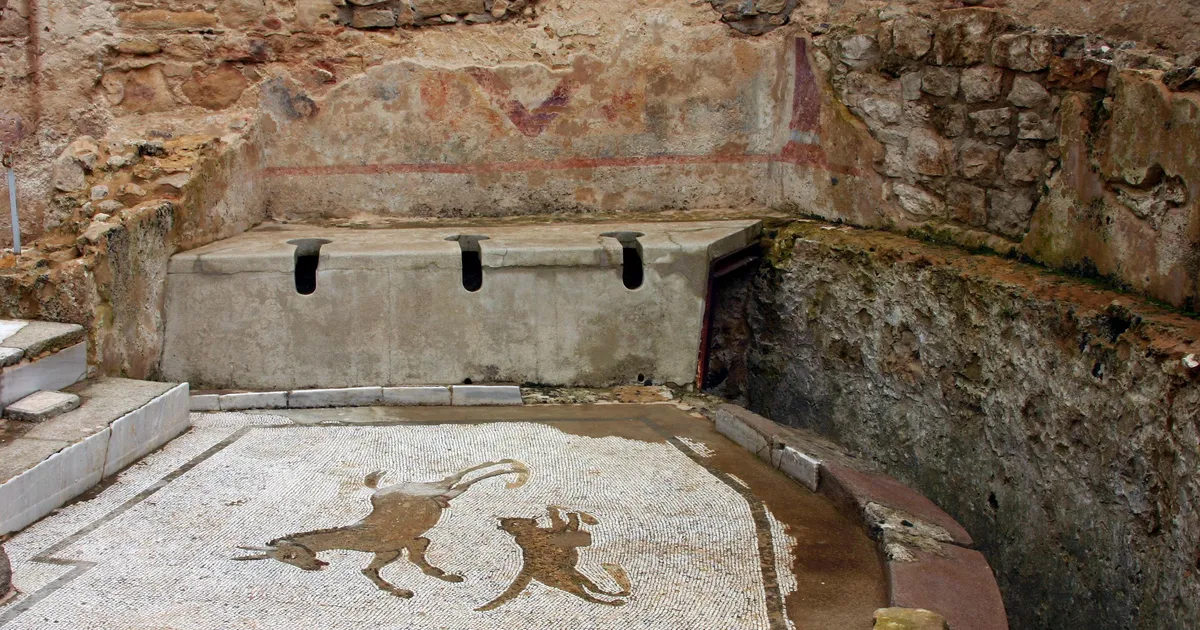
In the dim confines of the Roman public toilets, strangers sat cheek to jowl trading gossip, arguing politics, doing business and sharing a sponge on a stickThe true benchmark of civic maturity isn't a society's monuments; it's how it manages what it discards. The moment humans began living in densely populated settlements, sanitation became a demographic time bomb. Without a way to flush away its own waste, a city is less a triumph of human progress than a countdown to epidemic disease. Nowhere was this demographic pressure more acute than in the capital of the Mediterranean world. At its peak, Rome housed roughly one million inhabitants. Given that the average adult produces nearly a pound of solid waste per day, the metropolis had to contend with 500 tons of excrement every single day. Although local farmers recognized the agricultural benefits of feces and used some to fertilize rural fields, the sheer volume easily outpaced traditional recycling methods. To prevent the capital from choking on its own filth, the empire required an engineering miracle. True to their nature, the Romans resolved the looming crisis by scaling up the engineering prowess of their predecessors. Expanding on basic drainage concepts utilized by the Etruscans, Rome constructed the Cloaca Maxima, or "The Greatest Sewer." This subterranean network was so vital to the city's survival that its path was guarded by a shrine dedicated to Venus Cloacina, the goddess of purification, who eventually became the divine protectress of the city's underworld.The Cloaca Maxima was truly a marvel of ancient engineering, effortlessly channeling millions of gallons of fluid each day. Its proportions were apparently legendary, so vast that Strabo could not hide his astonishment. According to the Greek geographer, the subterranean channels were wide enough not only for loaded hay wagons to pass through, but even for boats to navigate. As the Roman naturalist Pliny the Elder would later observe, this massive scale would be nothing without its structural endurance. Pliny picked up where Strabo's astonishment left off, marveling that the sewer's heavy stone masonry could withstand the staggering physical pressure of its own size, remaining completely unshaken even when raging floods forced entire rivers to back-flow into the tunnels with destructive force. Together, their accounts paint a picture of a subterranean colossus built with both immense capacity and remarkable longevity in mind. Yet, for all its structural brilliance, the architectural wonder was a catastrophic failure as a public health measure. The system operated on a primitive design principle: simple displacement. It solved the city's immediate crisis by dumping concentrated, untreated waste into the River Tiber. This fundamentally poisoned the exact same waterway that downstream populations relied on for drinking, bathing, and crop irrigation. Rome's grand sewers successfully hid the filth from the eyes, but ultimately exported a deadly biohazard to the poor and neighboring towns.When the Romans built big: The Pont du Gard section of a Roman aqueduct in southern France, 49 meters high Credit: Benh Lieu SongWhen the Romans built big: The Pont du Gard section of a Roman aqueduct in southern France, 49 meters high Credit: Benh Lieu SongNo privacy, no paperBecause ordinary Romans lacked indoor plumbing, they relied on chamber pots emptied into the streets. The Roman satirist Juvenal complained bitterly about the hazards of walking home at night beneath towering apartment blocks: "See what a height it is to that towering roof from which a cracked vessel dents the pavement! Every window that opens at night as you pass beneath is a source of danger; you may well be deemed careless, and blind to sudden tragedy, if you go out to dinner without making your will. There are as many deaths waiting for you as there are open windows watching you as you pass by." For those caught out in the city, the primary alternative was the foricae, the famous public latrines. These were deeply unpleasant, claustrophobic spaces. Built with low ceilings and small windows, they lacked proper lighting and ventilation, leaving the air thick with a rancid, overpowering stench. The first-century philosopher Cicero reported, with disgust, the awful odor emanating from them. To make matters worse, desperation drove many citizens to relieve themselves in the entryways, prompting frantic graffiti that echoed across the empire with the same simple message, cacator cave malum: "Don't shit here!"Graffiti and the goddess called onto protect defecating man Credit: From the Flickr account of Carole RaddatoGraffiti and the goddess called onto protect defecating man Credit: From the Flickr account of Carole RaddatoOther intimate daily habits of ancient Rome seem utterly shocking, based on modern notions of privacy. Strangers sat in shoulder-to-shoulder proximity while answering the call of nature. This total lack of modesty was perhaps only manageable thanks to the practicalities of classical fashion. When a citizen sat upon a stone latrine bench, their heavy tunic or toga created a natural curtain that concealed their lower bodies from view, allowing individuals to conduct their business "discreetly" before standing and walking away, hoping to leave the "party" with their garments clean. Of course, not everyone dressed "appropriately" when visiting latrines, often leaving their neighbors with an unwanted eyeful.Roman public latrine dating to the Byzantine period, Caesarea Credit: Carole Raddato from Frankfurt, GermanyRoman public latrine dating to the Byzantine period, Caesarea Credit: Carole Raddato from Frankfurt, GermanySince toilet paper did not exist, the process required an inventive alternative. Romans relied on a simple implement known as a tersorium, a term that translates literally to "a wiping thing." This device consisted of a natural sea sponge securely bound to the end of a long wooden stick. To render the cleaning process as pleasant as possible, Roman engineers chiseled a shallow, continuous gutter into the stone floor directly in front of the latrine seats. A stream of clean, running water flowed constantly through this channel, allowing users to rinse the sponge before wiping themselves with it. The catch? These sponges were strictly communal and experienced intimate contact with pretty much the entire neighborhood. In the end, local residents shared a lot more than just casual small talk.This shared utility turned a tool of supposed cleanliness into a source of disease.Xylospongium
The daily dump: Social life in ancient Roman latrines
In the Dim Confines of the Roman Public Toilets, Strangers Sat Cheek to Jowl Trading Gossip, Arguing Politics, Doing Business and Sharing a Sponge on a Stick
2,493 words~11 min read