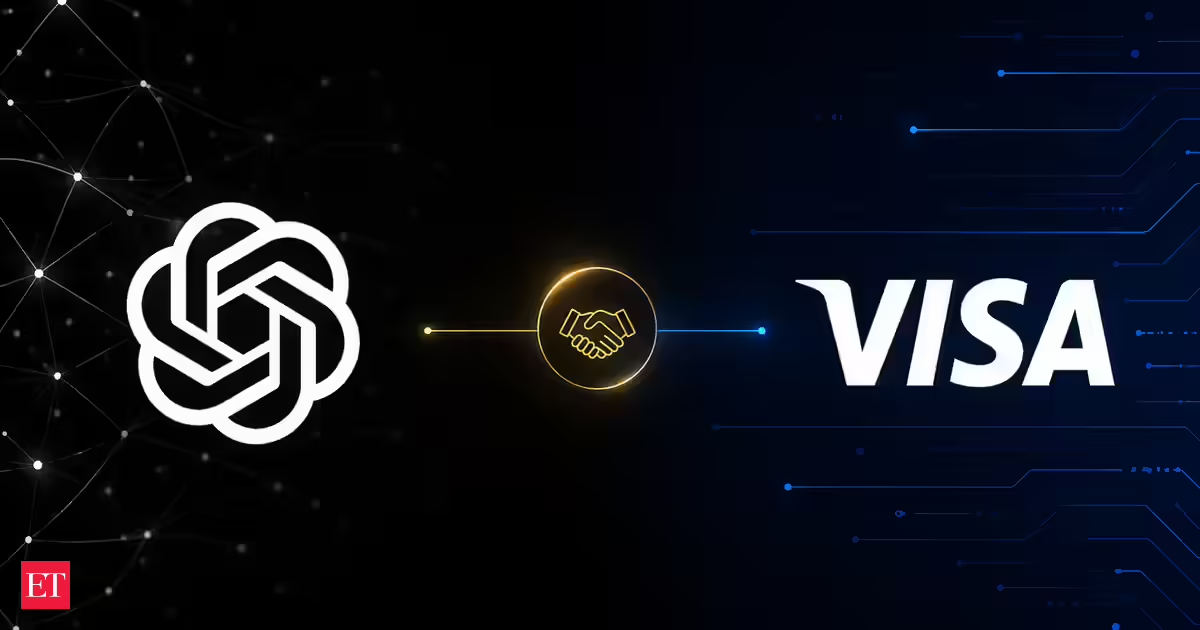
SynopsisVisa's partnership with OpenAI could mark the beginning of a new phase in digital commerce, where AI assistants move beyond product recommendations to actively participate in transactions. As intelligent agents become more involved in purchasing decisions, businesses may need to rethink how products are marketed, discovered, and evaluated in an increasingly AI-driven marketplace.ET OnlineVisa’s partnership with OpenAI aims to bring purchasing capabilities to ChatGPT. It will not just recommend a product, it will search for it, compare options and purchase it, all within the preferred direction and spending limit set by the consumer. This development marks one of the most significant shifts in the E-commerce industry since the arrival of digital payments. It also raises a question that retailers, marketers and businesses cannot afford to ignore. What happens to the sales of a product when its quality, demand and desirability are no longer judged by a human, but a chatbot? The process, however, is simpler than it sounds. The transaction system works on a tokenisation principle that Visa has built specifically for such agentic AI environments. Once ChatGPT finds a product that matches the buyer's said description, instead of sharing the user’s card details, Visa generates a single-use payment token that directly travels to the merchant system and expires the moment the transaction is complete, eliminating any risk of the payment details being misused or exposed. The user’s autonomy remains where it belongs, with the consumer. OpenAI’s ChatGPT has millions of users globally. Visa operates the world’s largest payment network. The integration of a conversational AI system into a well established payment network at this scale, is one of its kind. Agentic AI, where a system not only responds but completes tasks on behalf of a user, is moving from a concept to commercial reality. This partnership signals a global shift in making day-to-day functioning easier for customers. The implications extend well into the broader retail ecosystem. The emergence of AI-assisted shopping won’t be influenced by advertising campaigns, PR or visibility. It will prioritise data. Pricing transparency, reliable delivery, and customer satisfaction will become the deciding factor. Interestingly, for businesses, this is not a setback. In fact it reconfirms the credibility of their product, if the quality was always there to begin with. The shift also changes the way SEO will be understood and integrated by the businesses. It also establishes the difference between the way to reach an AI buyer and a human buyer. A human buyer responds to visibility and emotion. An AI buyer responds to data. For businesses, the next frontier is not search engine optimisation. It is language model optimisation.The collaboration between Visa and OpenAI not only sparks a debate about how a product should be sold but also redefines what a buyer means. For the first time, the buying journey is no longer exclusive to human decision making. Commerce has always evolved around the buyer. Now the buyer is evolving too.Disclaimer Statement: This content is authored by a 3rd party. The views expressed here are that of the respective authors/ entities and do not represent the views of Economic Times (ET). ET does not guarantee, vouch for or endorse any of its contents nor is responsible for them in any manner whatsoever. Please take all steps necessary to ascertain that any information and content provided is correct, updated, and verified. ET hereby disclaims any and all warranties, express or implied, relating to the report and any content therein.Read More News onRead More News on
What happens when ChatGPT can shop for you? Inside Visa and OpenAI's AI commerce vision
Visa's partnership with OpenAI could mark the beginning of a new phase in digital commerce, where AI assistants move beyond product recommendations to actively participate in transactions. As intelligent agents become more involved in purchasing decisions, businesses may need to rethink how products are marketed, discovered, and evaluated in an increasingly AI-driven marketplace.
579 words~3 min read