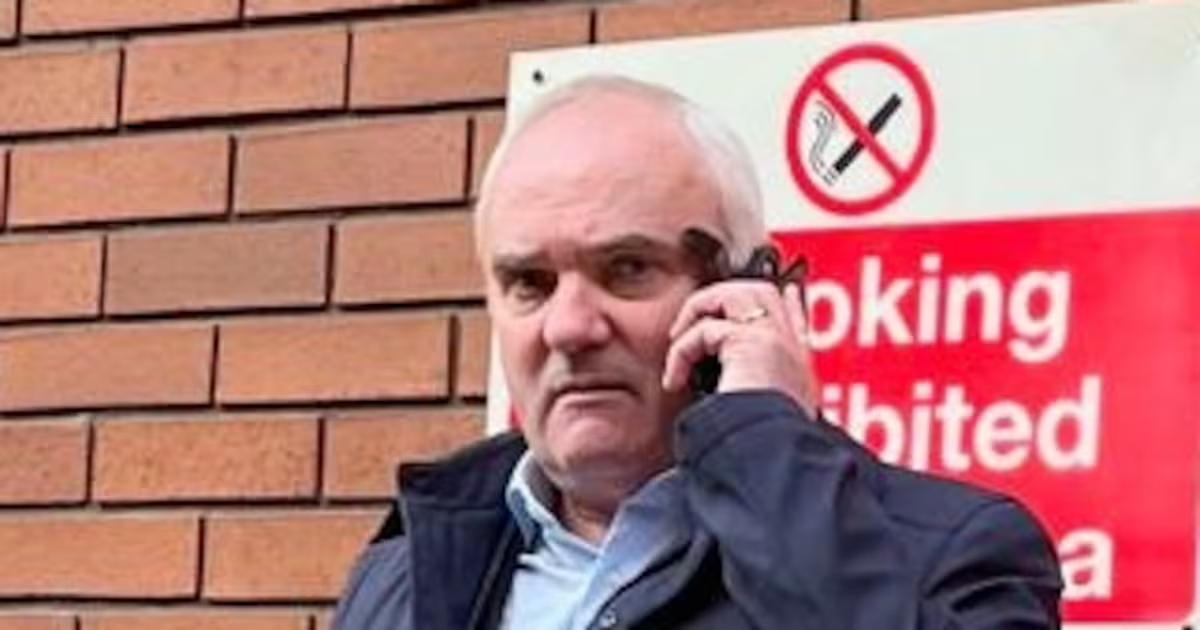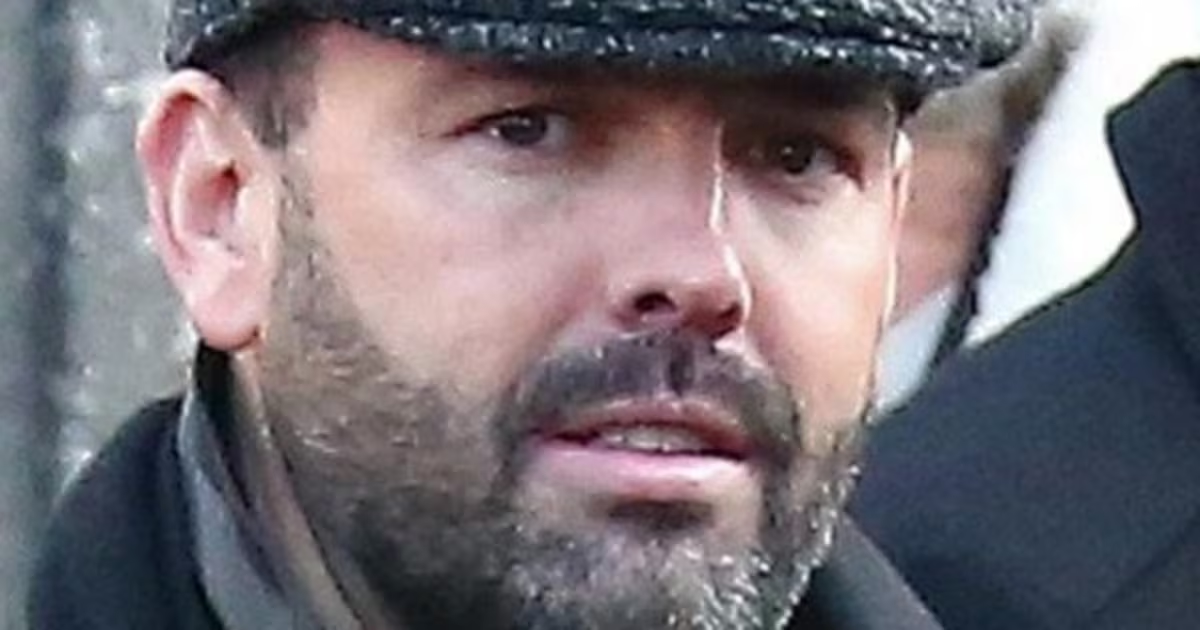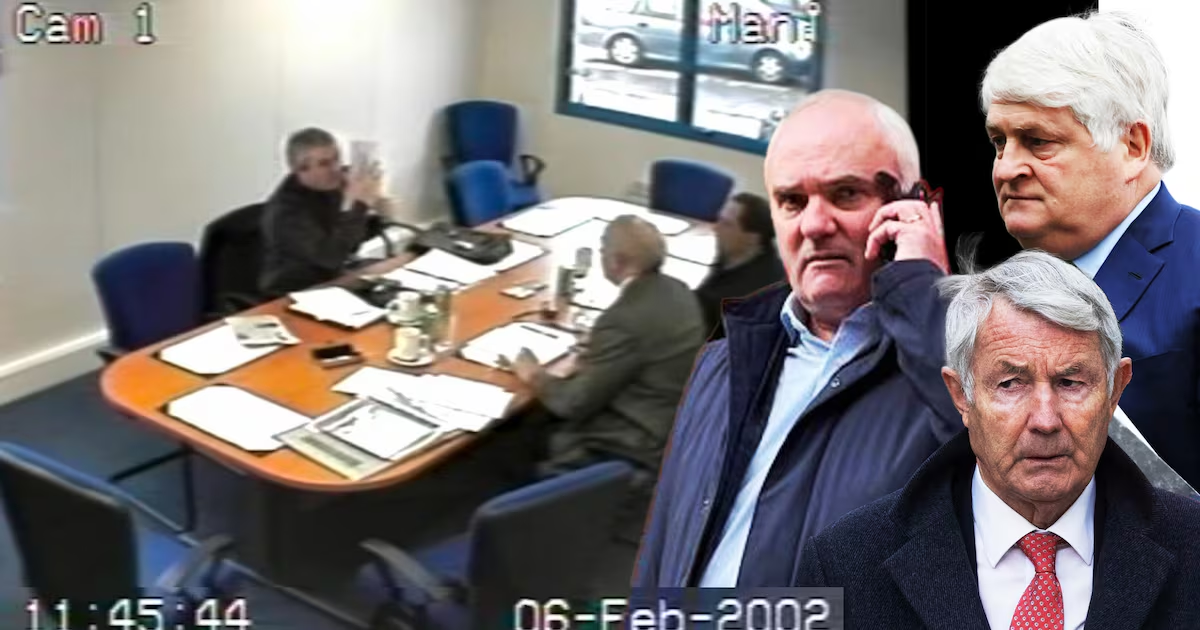
In February 2002, three men met in the English town of York. The purpose of their meeting was to discuss how information of interest to the Moriarty tribunal – established by the Oireachtas to investigate payments to politicians – might be used to squeeze money out of billionaire businessman Denis O’Brien and Tipperary politician Michael Lowry.Unknown to Kevin Phelan, the man who came to outline the plan, the meeting was recorded by the late Ken Richardson, one of those he travelled to meet. The Irish Times first reported in 2003 that this meeting took place and was recorded. Now, more than two decades on, this newspaper can publish the video of the meeting and, for the first time, reveal in more detail what was said. In the video, Phelan is on the left, facing Richardson, who is nearest the camera, and his associate, Mark Weaver.Kevin Phelan - Clip 01 Details of what was discussed at the meeting has taken on new relevance after Lowry acted as kingmaker for the Government established in the wake of the 2024 general election.Sinn Féin TD Pearse Doherty criticised the Independent TD’s key role in bringing together other Independents to support the Fianna Fáil-Fine Gael Coalition and made new claims about a land deal that was central to what was discussed at the York meeting. At the time of the meeting, the tribunal in Dublin Castle was investigating financial links between Lowry, a former minister for communications, and O’Brien, whose Esat consortium won the 1995 mobile phone licence competition when Lowry was in office.A number of English deals formed part of the tribunal’s inquiries. The deals took place in the late 1990s, after Lowry had resigned from government. All involved Phelan, a land agent from Omagh, Co Tyrone.At the York meeting, Phelan said he had information that could be used to put “pressure” on O’Brien and Lowry, and compel them to sell property in England worth millions of pounds at a discounted rate.Richardson was the former owner of Doncaster Rovers Football Club Ltd (DRFC), which he sold in 1998 in a deal organised through Phelan. The company owned the lease on the Doncaster club’s stadium.Richardson had two criminal convictions – one from the 1980s, a famous race-fixing fraud involving a horse called Flockton Grey, and another, in 1999, for hiring someone in 1995 to burn down the main stand at the Doncaster Rovers stadium, as part of an intended property development scam.The third person at the York meeting, Richardson’s assistant, Weaver, gave a copy of the secret recording to The Irish Times last year, but publication was not possible until now because Phelan was before the courts in England in respect of an unrelated fraud. He has now been jailed.In the late 1990s, Phelan acted in land deals in Mansfield, Cheadle and Doncaster that were investigated by the tribunal. The Cheadle and Mansfield lands cost £665,000 sterling between them, while Doncaster, a more complex transaction, cost £4.3 million. Some £700,000 from the Doncaster sale proceeds was placed in a “retention fund”, the distribution of which would depend on certain matters.The Doncaster plan involved the purchase of DRFC Ltd from Richardson, moving the team to a new stadium and developing the site of the former grounds, thereby generating a substantial profit. Phelan told the York meeting he had put a lot of work into this project, which accounted for most of the £700,000 he claimed he was owed for his work on the English land deals.Back in Dublin, the tribunal had been told the Cheadle and Mansfield deals were Lowry transactions and had nothing to do with O’Brien. Doncaster, it was told, was an O’Brien transaction and had nothing to do with Lowry.The recorded meeting heard details that were different from the accounts given to the tribunal.Phelan claimed at the meeting in York that all three deals involved Lowry and were funded by O’Brien – a point strongly disputed by Lowry and O’Brien at the tribunal.“Michael,” Phelan said, referring to Lowry, “he has a business and all that, but he is not the funder.” Phelan told Richardson and Weaver he had been asked to source property deals that would not generate an immediate return.“I was dealing with this particular individual in Ireland and my instructions from him were to get two or three deals that would come to fruition in three or five years,” he said, referring to Lowry.“He had a tax problem. He didn’t want to earn the money now. He wanted to earn the money when he had his tax sorted out. He wanted long-term projects.”Phelan said he knew the money for the land deals didn’t belong to the man (Lowry) he was dealing with.“But I didn’t question it,” he said. “I knew it wasn’t illegal money. It was legal money but I knew it wasn’t his.”When Weaver said, “You knew it wasn’t drug money”, Phelan agreed. His client had been a “minister in government” and has recently resigned, Phelan said. He had “good contacts” and could be useful.The tribunal initially believed Lowry had no link to the Doncaster deal, but it changed its mind after the publication in January 2003 of a report in The Irish Times linking the politician to the dealWhen the tribunal discovered links between Lowry and O’Brien, Phelan told the other two men in the meeting, the “shit hit the fan big time” over the English land deals. As a consequence of this, an accountant and associate of O’Brien’s called Aidan Phelan (no relation to Kevin Phelan) became involved.Kevin Phelan told the men at the York meeting: “My man was further distanced by the funder, who said, ‘Look, f**k off, you can’t be seen’.”Phelan said all his dealings with Lowry had been verbal. “That guy Michael Lowry is a trustworthy guy,” he said. “I’ve never had a problem with him . . . I still deal with Michael and I am still friendly with him. But there is an invidious position here to be sorted out.”“Micheal Lowry is a decent bloke,” Richardson said. He knew Lowry from horse-racing circles, he added.“He’s (Lowry) a friend of mine,” Phelan said. “But equally, I’m trying to get my money.”During the meeting, Phelan referred to O’Brien as “the big man” and the funder.Kevin Phelan - Clip 02 “The big man is up here; he doesn’t know what’s going on. He knows a bit . . . Michael [Lowry] knows a good bit of what is going on. He wants to keep in with the big man,” said Phelan.Phelan said the tribunal had been given misleading information about the English land deals and that he, Phelan, could prove this.Because he lived outside the jurisdiction, Phelan could not be forced to give evidence to the tribunal.At the York meeting, Phelan said he had told the tribunal that if they wanted him to co-operate, he would first have to see what it was being told. In response, the tribunal had sent him copies of documents it had been given about the English land deals. Phelan had his own copies of the same documents and when he compared the two sets, he said, he discovered that the ones given to the tribunal had been doctored. The altered documents were from the files of an English solicitor, Christopher Vaughan, who had acted for Phelan in the land deals.“I couldn’t believe it. All changed. Really serious,” he told the men in the York meeting.Vaughan told the tribunal that he had at times handed over control of his files to others. The tribunal said it found his evidence “unsatisfactory”.Kevin Phelan - Clip 03 People could go to jail if what he knew came out, Phelan said at the York meeting. He then suggested that Richardson give his approval for the “strategy” he was proposing.[ Who is Kevin Phelan?Opens in new window ]They could create “pressure” on Lowry and O’Brien, using the confidential information Phelan had, which Lowry and O’Brien would not want the tribunal to get its hands on, Phelan said.Then, a few months later, they could get someone to front for them and make an offer to take the English properties off Lowry and O’Brien’s hands, at a discounted rate.As part of the Doncaster sale, Richardson was claiming he was entitled to the money in the retention fund.“We could set up a strategy that we don’t really muddy anybody’s position and we get the right answers,” Phelan said.“You want your money and we want ours,” said Richardson.If they were to reach an agreement, Phelan said, he would like to finalise it “man to man”, without Weaver in the room. “Then it would be your word against mine.” Richardson agreed this was a good idea.“The Yorkshire phrase,” Richardson said, “is, if only two of us knows, and it gets out, if it isn’t me, it must be thee. And if it isn’t thee, it must be me.”Phelan said they could seek to buy the Doncaster site alone, or the Doncaster, Cheadle and Mansfield sites, all wrapped together. “I could say, I’m offering you a deal, lads, to get rid of all these problems,” Phelan said.“If we agree something today, and we shake hands on it. Me and him (Weaver) will go off and build up the pressure.”At one stage, when Richardson had left the room, Weaver suggested that Phelan give Richardson some of the letters Phelan had. This would encourage Richardson to trust him, Weaver said. Phelan said he did not at that stage want to hand over a letter that linked Lowry to the Doncaster deal, which the tribunal had been told had nothing to do with the Tipperary businessman and politician.“I don’t want to land Michael in the sh**e, to be fair,” Phelan said. “If we go that far, I’m shafting him. He’s on my side like.”Kevin Phelan - Clip 04 When Richardson returned, the men viewed documents and discussed actions they could take, including taking legal action. Phelan gave Weaver Irish newspaper articles about the tribunal and suggested he might want to contact some of the journalists involved.Phelan said he had not told Lowry everything about what was going on. “The last thing I want him to think is that I am blackmailing him,” he said.The York meeting lasted more than three hours.“The bottom line is this,” Phelan said, near the end, “I’ll help you. You’ll help me, and we will get our just rewards . . . These guys are acting the b***ocks.”In the months after the York meeting, substantial payments were made by O’Brien and Lowry to Phelan that the tribunal eventually decided were linked to Phelan’s knowledge that the tribunal was being misled.The plan discussed at the meeting – to force the sale of the English properties at a knock-down price to a nominee acting for Phelan and Richardson – never materialised.The tribunal initially believed Lowry had no link to the Doncaster deal, but it changed its mind after the publication in January 2003 of a report in The Irish Times linking the politician to the deal.The report was based on a letter written by Vaughan to Lowry in September 1998 – the letter Phelan referred to at the York meeting that linked the Tipperary politician to the Doncaster deal.The letter was shown to The Irish Times in January 2003 but was not then in the possession of the tribunal. This was the letter Phelan was loath to hand over to Richardson at the meeting because of the consequences it would have for Lowry. In the 1998 letter, Vaughan referred to a meeting he had had with Lowry two days earlier in England. He said he had not, until then, appreciated Lowry’s “total involvement” in the Doncaster deal.The 2003 report in The Irish Times further disclosed that the Vaughan letter mentioning Lowry had been produced in the context of mediation talks in London in 2002.The talks were linked to legal action taken by Richardson over the retention fund and money he was claiming he was owed from the Doncaster deal. The falsification of the Vaughan files happened at or after a meeting in Dublin in March 2001 and was implemented with the full knowledge of Aidan Phelan, Lowry, Vaughan and Kevin Phelan, the tribunal concludedProduction of the letter led to an allegation of blackmail by O’Brien’s side to the London police. The allegation was investigated, but no charges were ever brought.The mediation talks resulted in the payment of a substantial six-figure sum to Richardson.The 2003 Irish Times report said the settlement agreed in London did not include any payment arising from an alleged blackmail attempt and this was later confirmed by O’Brien at the tribunal. It is not being suggested that any blackmail payment was made.The tribunal opened a public inquiry into the Doncaster deal in September 2004, prompted by The Irish Times report, and it continued intermittently over the following years. Richardson, Phelan and Weaver did not give evidence, and the tribunal could not force them to do so as they lived outside the jurisdiction. In the tribunal’s final report in 2011, the tribunal decided that O’Brien had provided financial support to Lowry for the Mansfield and Cheadle deals, and that this was linked to Lowry’s interference in the mobile phone licence competition that benefited O’Brien.This was contrary to the evidence given to the tribunal by both O’Brien and Lowry.On the Doncaster transaction, the tribunal decided Lowry did at one stage have an involvement in the deal, which it was intended would confer a financial advantage to him, but that this then changed.The tribunal said it was unable to determine the precise nature of Lowry’s involvement in the Doncaster deal. Both Lowry and O’Brien have strongly disputed the tribunal’s findings.The falsification of the Vaughan files happened at or after a meeting in Dublin in March 2001 and was implemented with the full knowledge of Aidan Phelan, Lowry, Vaughan and Kevin Phelan, the tribunal concluded.During the tribunal’s Doncaster hearings it emerged that both Lowry and O’Brien had given Kevin Phelan money against the backdrop of the tribunal’s inquiries.Phelan was paid £65,000 by Lowry in March and April 2002, in a deal arranged by Lowry’s accountant, Denis O’Connor. The tribunal was told the money was fees due to Phelan for an English land deal that had nothing to do with O’Brien.However, the tribunal decided the payment was “primarily intended” to ensure Phelan would not tell the tribunal it had been given false information about the Mansfield, Cheadle and Doncaster deals.In August 2002, Phelan was paid £150,000 by O’Brien, again in a transaction negotiated by O’Connor. O’Brien said the money was fees due to Phelan, but the tribunal decided the payment was “primarily intended” to ensure Phelan did not undermine false information given to the tribunal.Phelan, the report said, “sought to undermine the work of the tribunal for his own gain”.A third payment was made to Phelan, in August 2002, but never disclosed to the tribunal. The £248,624 payment from Lowry went to a Phelan family trust he established in the Isle of Man. In 2004, when the tribunal was still in session, Lowry spoke on the phone with Phelan about this payment, and Phelan secretly recorded the call. In 2013, Phelan gave a copy of the recording to journalist Elaine Byrne, who reported it in the Sunday Independent. It is not known why Phelan did this.Matters appeared to rest there until Lowry assumed a key role in the formation of the Fianna Fáil-Fine Gael Government.In January 2025, after Lowry with other Independents agreed to support the Coalition, Sinn Féin TD Pearse Doherty raised the issue of the Doncaster deal in the Dáil. He said he had new information that had not been shared with the tribunal. Calling on Lowry to make a statement on the matter, Doherty asked that the politician explain why, in September and October 2001, “his accountant paid the person putting the Doncaster deal together two bank drafts of £32,500 and £25,000 for his fee? And when he is doing it, maybe he will explain why these payments, made from an account in Gibraltar, were never disclosed to the tribunal.”Lowry strongly disputed Doherty’s claims, calling them a “smear” and describing them as “unfounded, malicious and totally false”. He sought permission to be allowed make a statement to the Dáil “to put the record straight”, but the Ceann Comhairle, Verona Murphy, has not acceded to this.As previously noted, publication of the video of the York meeting given to The Irish Times by Weaver last year was delayed because Kevin Phelan was before the courts in England. On May 28th, he was jailed for seven years by Leeds Crown Court for his involvement in a fraudulent pension liberation scheme he ran with others in 2013 and 2014.The complex scheme involved the targeting of sometimes vulnerable people who were under financial pressure with a view to stealing money saved for their pensions.Kevin Phelan outside Leeds Court. He was jailed for seven years on May 28th for his involvement in a fraudulent pension liberation scheme. During the trial, Phelan was described by the prosecution as a “thoroughly dishonest man” who had been involved in “sophisticated and persistent dishonesty”. Judge Penelope Belcher said Phelan had been one of the “controlling minds” behind the scheme, and had been involved in telling lies, creating false evidence, and destroying evidence.The fraud involved pension savings totalling £3.7 million being stolen from 74 victims before the police intervened.The elaborate fraud had nothing to do with the matters investigated by the tribunal, though there was a link with Doncaster Rovers.After the police started investigating the fraud, in 2014, Phelan and others sought to create false evidence for what had happened to the investors’ money.One false claim was that some of the money was invested in loan notes linked to a company owned by the Doncaster team (not the stadium). During the time of the fraud scheme, Phelan did not have any personal bank accounts as he was an undischarged bankrupt, the court was told.There were plans, the court was told, to grow the fraudulent scheme significantly, with text messages between Phelan and his co-conspirators referring to making millions of pounds and never having to work again.When Phelan was jailed last month for seven years, the judge said half the sentence should be served before any question of release on licence arose.
Secret video shows men plotting to squeeze money out of Denis O’Brien and Michael Lowry
Men met in York in February 2002 and were paid hundreds of thousands of pounds months later by Lowry and O’Brien
3,048 words~14 min read