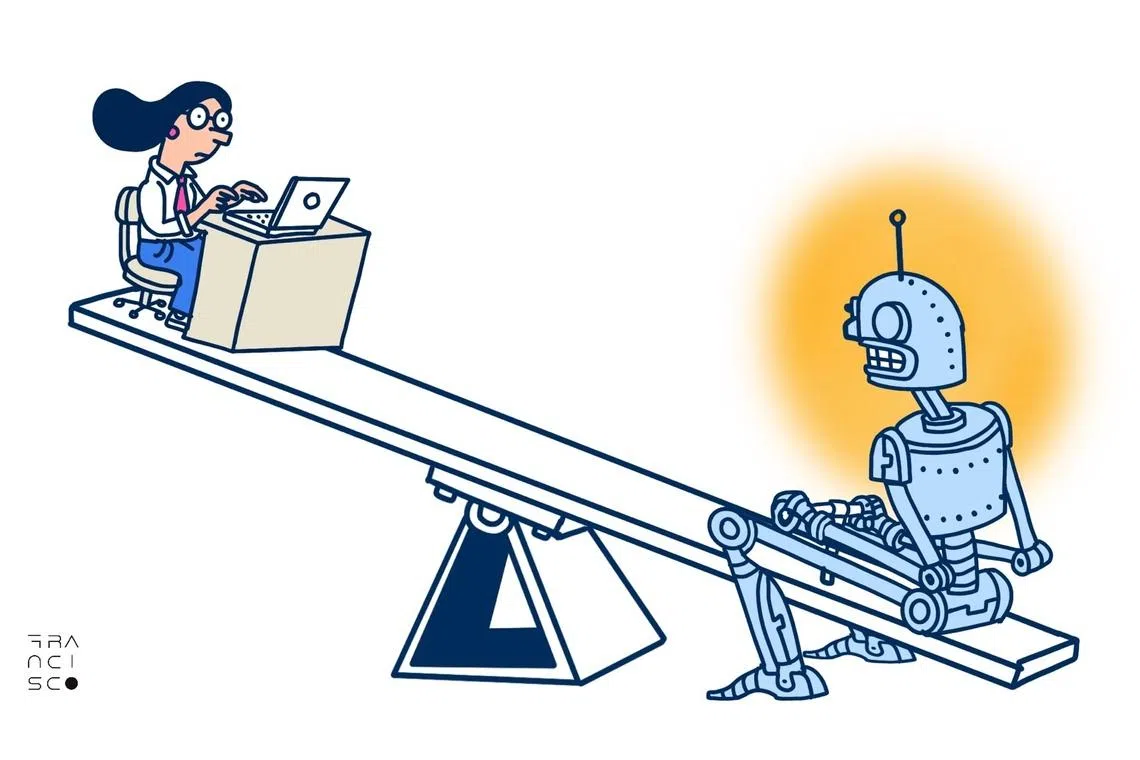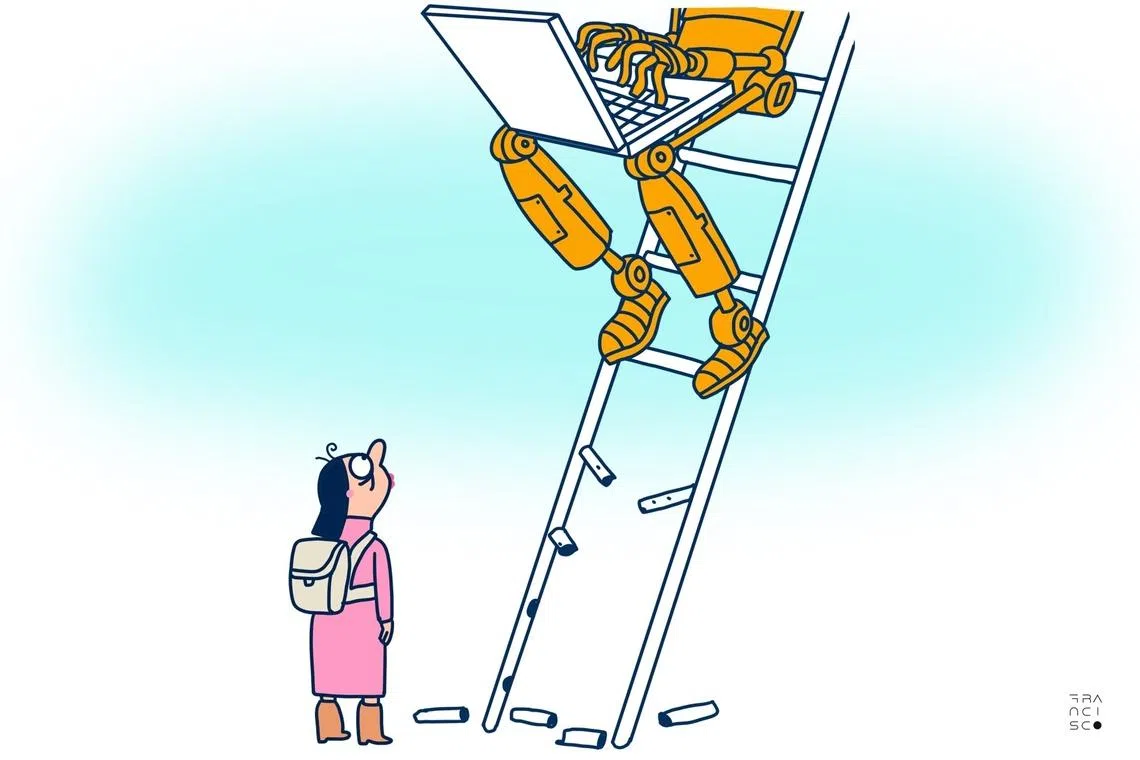
In this series, business journalist Timothy Goh offers practical answers to candid questions on navigating workplace challenges and getting ahead in your career. Get more tips by signing up to The Straits Times’ Headstart newsletter.Artificial intelligence is changing how early-career learning happens as routine tasks that used to serve as a training ground are increasingly automated.Things like research, basic analysis and drafting reports are increasingly handled by AI tools, which reduce the repetitive “practice work” available to junior employees.This can make the traditional learning curve feel steeper because fewer roles are built around gradual skill-building through repetition, said Michelle Koh, managing director at executive search firm The Edge Partnership.“But I am not sure this is entirely bad... Many young professionals I speak to are not keen to handle routine work like data entry or processing dozens of invoices manually, either,” she said.To build expertise, the answer for young workers is not more repetition, but earlier exposure to judgment and decision-making.“I see young professionals building expertise by working on varied problems, understanding trade-offs and making sense of ambiguous information,” said Koh.“AI can support this by handling execution faster, but the human focus must shift towards interpretation, deeper analysis, decision-making and context.”The traditional entry level, where juniors primarily perform structured, low-complexity tasks, is shrinking, she noted. “There are fewer purely ‘training’ roles, and more roles where even junior staff are expected to contribute meaningfully to outcomes, often alongside AI tools.”The new entry-level roles are less about doing the same task perfectly 100 times, and more about learning to evaluate, question and improve what AI produces the first time.“The bottom rung has not disappeared,” Koh said. “It has shifted higher.”Zachary Wang, co-founder of AI start-up Level3AI, said young workers who use AI as a shortcut to avoid learning may find it harder to develop the skills needed for long-term career success.Historically, junior employees build judgment by doing routine work. As AI takes over some of these tasks, the early rungs of the learning ladder can “quietly disappear”.But young workers who use AI without understanding why it produces what it produces are building fluency, not expertise, said Wang.“Fluency means you can operate the tool, while expertise means you can tell when the tool is wrong,” he said.Over time, this can create a gap between appearing knowledgeable and developing genuine expertise – a gap that may become more consequential as a person’s career progresses.Wang said organisations that integrate AI thoughtfully can create new opportunities for learning and development for young workers.“Joining a company that considers how to onboard both employees and AI strategically will create accelerated opportunities for learning.“In organisations that are deliberate about how AI is incorporated into workflows, routine and administrative tasks can be automated, allowing younger workers to spend more time developing higher-value skills,” he added.
askST Jobs: Will AI make it harder for young workers to learn on the job?
AI is changing how young workers learn, shifting the focus from routine tasks to decision-making. Read more at straitstimes.com. Read more at straitstimes.com.
TL;DRAI
AI automation removes entry-level routine tasks (research, analysis, reporting), pushing junior roles toward decision-making earlier. Young workers must build expertise—understanding why AI produces outputs—to avoid fluency-only gaps that compound over career progression.
464 words~2 min read