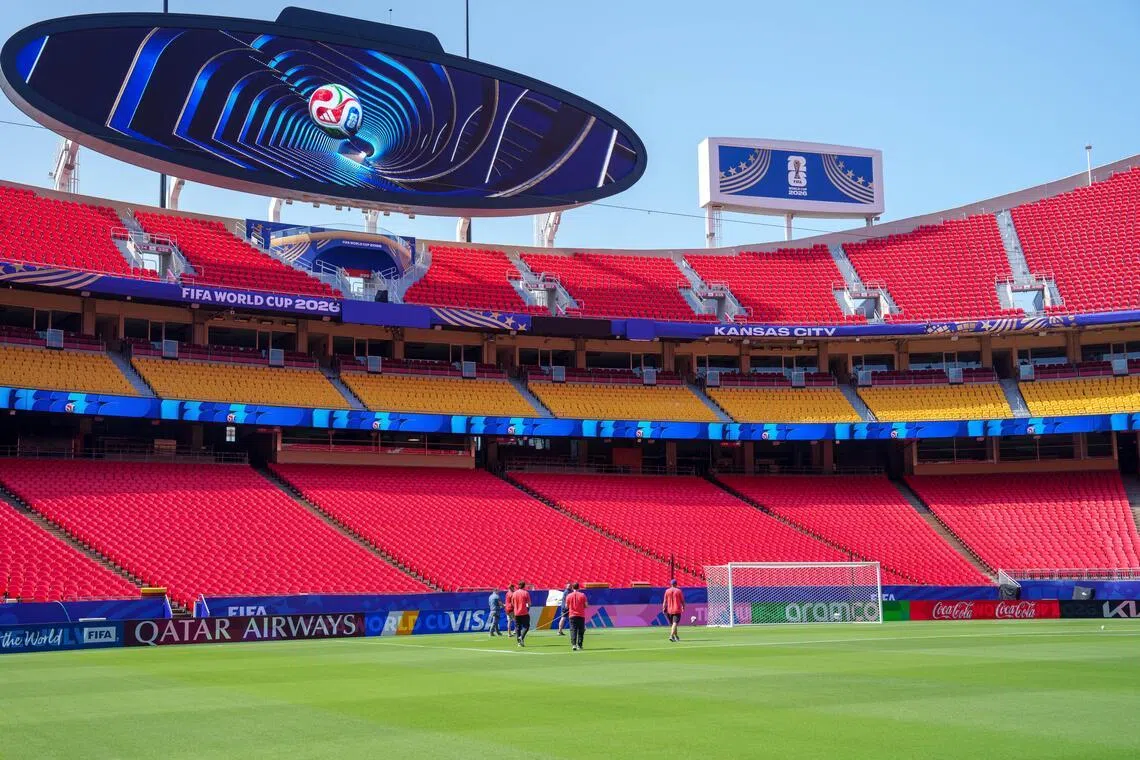
“Success in a fast-moving arena is often about being nimble and disciplined” – so said legendary French footballer Thierry Henry at the UBS Asian Investment Conference, held in Singapore and Hong Kong in May 2026.That exacting discipline Henry singles out is reshaping not only how sports is played, but also how it is valued. What was once viewed as entertainment is increasingly being treated as an investable asset class. Investors are discovering that the forces transforming society – data, technology, media fragmentation and institutional capital – are the same ones reshaping sports itself.Historically run on instinct and tradition, many franchises across football, basketball, cricket and other major sports are now managed like institutional enterprises. Technology and analytics sit at the heart of this transformation, influencing everything from athlete development and game tactics to commercial strategies and fan engagement.The numbers are striking. The World Economic Forum estimates that the US$2.3 trillion (S$3 trillion) global sports economy today could surge to US$8.8 trillion by 2050. Investors following the money are increasingly navigating a sophisticated ecosystem of media rights, sponsorship, consumer spending and private capital.Yet, what sets sports apart is how it remains one of the last few content formats that can reliably command vast captive audiences by offering a uniquely authentic experience – the thrill and unpredictability of a live result.Football proves the point. The FIFA World Cup 2026, taking place across North America from June 11 to July 19, could engage six billion people globally. In a digital age with viewership fragmented across thousands of channels and platforms, few events can still command global attention on that scale.For investors, that coveted scarcity is becoming increasingly valuable. Football’s evolution offers a useful lens through which to understand how sports is maturing from cultural pastime into a professionalised sector with investment appeal.First, technology now underpins nearly every facet of modern football, recasting how teams prepare and perform. In training, data collection and wearables allow clubs to manage player fatigue and optimise recovery. Innovations such as Liverpool FC’s custom player app, which integrates wellness indicators with GPS movement data, have shifted periodic assessments to continuous data-driven management, tailored to each athlete.The modern game is also rewarding repeatability over improvisation. Set pieces, once considered a novelty, have become commonplace. In the English Premier League, non-penalty set-piece goals accounted for roughly 28 per cent of goals last season, versus around 22 per cent a decade ago. Opportunities once left to instinct are now engineered through preparation, repetition and analysis.On match days, video assistant referee (VAR) systems and semi-automated technologies make decision-making more transparent and measurable. These advances influence defensive strategies, set-piece execution and risk management around marginal decisions.The result? A move away from subjective interpretation towards a more formalised approach to the game.Off pitch, technology is transforming fan engagement. Digital platforms now allow clubs to maintain continuous fan relationships through personalised highlights, behind-the-scenes content and targeted commercials. Clubs like reigning Bundesliga champions Bayern Munich are investing in integrated fan databases to deepen loyalty and unlock revenue opportunities. Second, marquee events no longer solely drive sports’ commerciality. Consumption is becoming more fragmented, shaped by time of day, device and platform, and not a single shared viewing moment.London-based market research company GWI notes that 72 per cent of Gen Z fans use social media to follow sports, with many hopping across five or more platforms daily. Economically, this expands the inventory around live events, boosts short-form content value, and gives rights-holders, sponsors and platforms more ways to monetise attention beyond live broadcasts.Women’s sports also illustrate the expanding opportunity set. The 2023 FIFA Women’s World Cup generated nearly US$570 million in revenue, with FIFA targeting US$1 billion by 2027. Importantly, the rise in women’s sports is attracting a younger, more diverse and affluent audience, enticing brands and sponsors.Beyond the attention economy, the tournament buzz also fuels sportswear, wellness, tourism and hospitality spending. Travel booking platform Expedia noted 44 per cent of fans travelled internationally for their most recent sporting event, with this figure rising to 56 per cent for those aged 16 to 34. The economic ripple effects extend well beyond the stadium. As such, sports is increasingly being viewed as infrastructure for the experience economy.Finally, football’s on-pitch shift towards systematic optimisation is mirrored by its off-pitch transformation. Ownership models have evolved from individual wealth to structures shaped by institutional capital, minority stakes and specialised financial arrangements.The rationale is straightforward. Investors appreciate scarce global brands, loyal fan communities and progressively diversified revenue streams spanning media rights, sponsorships, merchandising, hospitality and stadium operations.In turn, the financial growth is evident. The Deloitte Football Money League reported that the world’s top 20 football clubs generated a record €12.4 billion (S$18.5 billion) in the 2024/2025 season, up 11 per cent year on year. New stadium investments, such as English club Tottenham Hotspur’s £1.2 billion (S$2.1 billion) facility, enable clubs to function as year-round operating businesses, not seasonal sporting ventures.Private capital has followed. Seattle-headquartered data provider PitchBook estimated that more than 36 per cent of Europe’s leading clubs were backed by private equity, venture capital or private debt during the 2025/2026 season. Investment structures have diversified beyond outright acquisitions to minority stakes – such as US private equity firm Arctos Partners’ minority stake in current UEFA Champions League winners Paris Saint-Germain (PSG), asset-backed debt financing and revenue-sharing agreements. However, sports investing is not without risks. Revenue outcomes vary by league, geography and business model. The collapse of marketing agency Football Marketing Asia’s US$2.4 billion rights agreement with regional sports governing body Asian Football Confederation, and the recent volatility in French football broadcasting rights highlight why due diligence remains essential.Additionally, ownership motivations are evolving. While some investments remain driven by identity or brand visibility, many are increasingly structured around operational discipline and long-term value creation. This distinction between passion-led and return-oriented ownership is becoming central for institutional capital.Football’s transformation reflects the many sweeping changes redefining modern sports today.While the beautiful game is not a proxy for all sports, its trajectory highlights how the industry is fast becoming a maturing asset class.Every World Cup produces its champions. But long after the trophy is lifted, the evolution of the sport from pastime to platform, and from entertainment to investment may prove to be one of the tournament’s most enduring legacies.The writer is the Asia-Pacific head of UBS Global Wealth Management’s Chief Investment Office.
The business of the beautiful game
Once viewed as entertainment, football is increasingly being treated as an investable asset class. Read more at straitstimes.com. Read more at straitstimes.com.
TL;DRAI
Sports economy scaling to $8.8T by 2050 via analytics, wearables, VAR, and PE/VC capital backing 36% of Europe's elite clubs. Tech signal: data infrastructure and fan analytics shifted from competitive edge to essential operational stack reshaping IT budgets.
1,056 words~5 min read