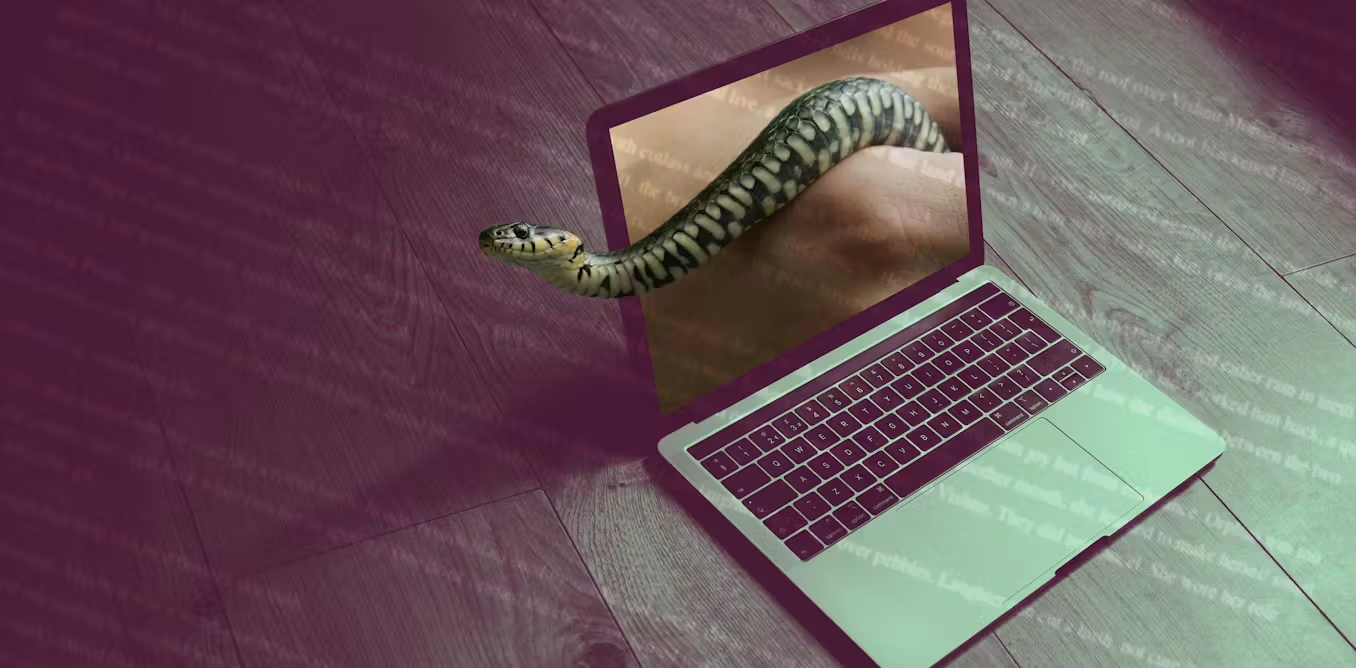
The literary world was rocked last month when it emerged that Granta magazine had published on its website a Commonwealth Prize-winning short story that on closer inspection appeared to be written by Artificial Intelligence (AI). From the time of its inception in 1889, and its resurgence in the 70s as the magazine for “new writing”, Granta has enjoyed the kind of status few magazines that aren’t finance or fashion-related do. To be published in its expensive pages is a dream many writers, old and young alike, harbour. So, the stunned response that greeted this information was only natural.‘The Serpent in the Grove’ by Jamir Nazir, the 61-year-old Trinidadian writer who won a prize for best short story from the Caribbean, was published on the website on May 12. Within days, readers began calling it “AI slop”, pointing out tropes and metaphors AI writing produces, saying the piece was rife with them. Whether or not the story is “good” is as subjective as with any piece of art, but the accusations included someone running the story through Pangram, an AI detection platform, with results showing it was 100% AI generated.Granta responded that they had consequently checked the same on AI chatbot Claude, which said the piece was “almost certainly not produced unaided by a human”. This sounds almost as vague as Granta publisher Sigrid Rausing on the matter: “It may be that the judges have now awarded a prize to an instance of AI plagiarism — we don’t yet know, and perhaps we never will know.” The word “plagiarism” reveals the opinion that this is theft or at the very least regurgitation, as opposed to collaboration or assistance resulting in a new original work. AI language models are trained on datasets made up from the public Internet, yes, but also largely, using books.“But, how couldn’t they tell?” was a question many asked. One argument has been that in this flimsy new world, editors who have eschewed AI may need to engage with it more, simply to be able to spot it. Sayantan Ghosh, Editorial Director at Simon & Schuster India, says the incident has “started a necessary and long overdue conversation”. That said, he adds, “It’s a dangerous path for an editor to walk; looking primarily for signs to check if something is AI generated.” He isn’t worried about AI replacing writers though. “Radio didn’t kill books, television didn’t, broadband Internet didn’t, and AI won’t, but transparency between writers and editors is essential.”Tackling the beastIncreasingly, people claim they’re okay with AI visuals if they’re labelled as such, but with writing, audiences are less accepting. This became abundantly clear when Nobel and Booker-winning Polish author Olga Tokarczuk, in the same week as the Granta controversy, announced on X that she used AI while writing. “Often I just ask the machine, ‘Darling, how could we develop this beautifully?’” More so than Nazir, who was awarded £2,500 as prize money, Tokarczuk’s career has enjoyed many spoils. One can argue that these were for the works of her own mind, not that of a large language model’s.
What Granta’s Commonwealth Prize AI scandal tells us about the future of literary writing
Explore the implications of Granta's AI scandal on authorship and the future of literary writing in today's digital landscape.
1,292 words~6 min read