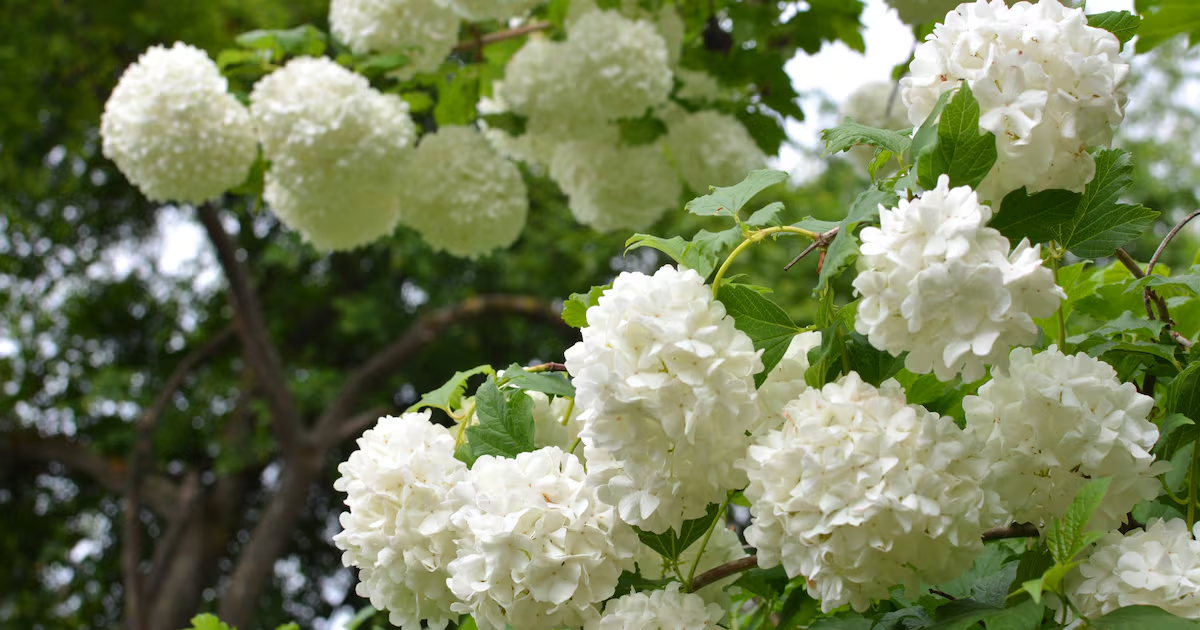
The older I get and the longer I garden, the more I can’t help thinking that so many kinds of flowering shrubs are greatly underappreciated.Have you ever, for example, heard anyone rhapsodise lyrically about the charms of the deciduous shrub known as deutzia? I know I haven’t, yet it’s a charming plant whose arching branches are smothered with generous clusters of pollinator-friendly starry flowers in late spring and summer in various shades of white and pink, depending on the particular variety. Easy to grow, many of the newer kinds make neat, compact, floriferous plants reminiscent of miniature flowering cherry trees and are eminently suitable for smaller gardens, or for growing in a large container. Examples include the white-flowering Deutzia ‘Yuki Snowflake’; pink-and-white flowering Deutzia ‘Yuki Cherry Blossom’; deep-pink-and-white flowering Deutzia ‘Raspberry Sundae’, pale pink flowering Deutzia ‘Mont Rose’; ghostly white Deutzia ‘Nikko’, and Deutzia x lemoinei, a historic variety bred by the famous French nurseryman Victor Lemoine. All are hardy and do best in full sun and a moist but free-draining soil, although they’ll tolerate light shade.Osmanthus x burkwoodii is another example of an excellent flowering shrub that rarely gets a look-in and yet has so much going for it, including evergreen foliage and a generous display of scented white flowers from late spring into early summer. Hardy and happy in most soils so long as they don’t totally dry out, it’s tolerant of coastal exposure and provides a valuable backdrop for other lower-growing plants when used at the back of a border or against a wall, reaching an average height and spread of 3m.Philadelphus is yet another decorative shrubby plant that’s overlooked in too many fashionable “must grow” lists. Tough as old boots despite its refined appearance, in early summer the slender branches of this deciduous flowering shrub are covered in a multitude of intensely perfumed, pollinator-friendly white flowers whose scent is similar to orange blossom, hence its common name of ‘mock orange’.Not only does it make a marvellous, easy-to-grow addition to any garden, mock orange is also exceptionally hardy, very tolerant of pollution, light shade, salty sea breezes and dry soil once established. Recommended varieties include the compact, double-flowering Philadelphus ‘Manteau d’Hermine’, also bred by Lemoine. Another is the taller Philadelphus ‘Belle Etoile’ (height and spread of 1m x 2.5m), a magnificent variety whose deeply scented, large, white, cup-shaped flowers are prettily splotched with purple at the centre. Or for something very different, seek out the compact, pink flowering, award-winning Philadelphus ‘Petite Perfume Pink’, a recent breakthrough in plant breeding produced by the British horticulturist Alan Postill, former chief propagator at the legendary Hillier Nurseries in the UK.Broom (Cytisus) is another late spring/summer-flowering shrubby plant that continues to languish in the horticultural doldrums, despite being very easy to grow, impressively tolerant of a variety of challenging growing conditions including cold and exposed gardens, attractive to pollinators and very ornamental over a long flowering period. For new gardens, it’s also one of those useful, fast-growing plants that will grow well in less-than-perfect soil and quickly gives large-scale impact. Relatively short-lived (an average of five to 10 years), it will then obligingly die off just as growing space gets tighter. Recommended varieties include the scarlet-flowered Cytisus ‘Boskoop Ruby’; the lilac-pink flowering Cytisus ‘Moyclare Pink’; orange-and-yellow Cytisus ‘Lena’; and bright-yellow Cytisus ‘Golden Sunlight’. Or what about the snowball tree, Viburnum opulus ‘Roseum’, a plant greatly admired when seen growing in mature, well-established gardens, yet which we so often inexplicably neglect to plant in our own? Slowly forming a large deciduous shrub, it puts on a reliably magnificent display of its generous clusters of lime-green, pom-pom flowers each year between May and June, while its fading foliage also provides lovely autumnal colour. Again, it’s undemanding and ultra hardy, happily growing in most soils so long as they don’t bake to a dry crust in summer. It’s also magnificent in flower arrangements, the reason why I’ve planted several in my own garden.I grow Coronilla valentina subsp. glauca ‘Citrina’ for the same reason, as well as for the fact that this small evergreen Mediterranean shrub does well in the sun-baked, stony, free-draining soil around the front of our old farmhouse. Its scented, lemon-yellow, pea-like flowers appear in late spring and then intermittently through summer into autumn and may not be to everyone’s taste, but I love its graceful twirling growth habit and glaucous, finely divided foliage.Abelia x grandiflora is yet another neglected shrubby stalwart with much to offer. Evergreen and reliably hardy except in cold or exposed Irish gardens, it flowers from early summer right through into very late autumn with trumpet-shaped, pale pink flowers that are small but intensely scented and produced in profusion on arching branches. Typically forming a large, tall plant, it’s best grown at the back of a large mixed border, ideally against a sunny, sheltered wall. A range of more compact cultivars are also available including Abelia x grandiflora ‘Sherwoodii’ and Abelia x grandiflora ‘Compactum’. Or for the brave at heart, there are also variegated kinds such as Abelia ‘Lucky Lots’ (cream and green foliage with flushes of pink in autumn), and the suitably named Abelia ‘Kaleidoscope’ (bright yellow and green flushing to orange and red). Which is where I personally draw the line. Some unfortunate plants deserve to be forever banished from the garden and the latter, I think, is definitely one of them.This Week in the GardenMake sure to get any remaining young seedlings and transplants in the ground this week before growth levels start to slow and they become stunted and pot-bound. To help them establish, soak their root-balls in a weak solution of liquid seaweed and work some homemade garden compost and a sprinkle of slow-release organic fertiliser into the planting holes.Take the time to knock back young weed growth with an oscillating hoe before it becomes a problem in flower and vegetable beds as well as along pebble paths, while also keeping a beady eye out for any welcome self-seeded plants. The latter can be lifted and transplanted elsewhere or pricked out into pots or trays to grow on until you find a suitable spot.Dates for your Diary: Sunday, June 21st (from 11am), Limerick Milk Market, Limerick City, the seventh annual Limerick Garden Festival takes place with a masterclass by organic grower Jim Cronin and plant sales by many specialist nurseries (see limerickgardenfestival.com); Saturday, June 27th (3pm-5pm), St Patrick’s Primary School, Church Road, Greystones, Co Wicklow, Delgany & District Horticultural Society’s Annual Rose Show takes place, featuring displays of a wide range of plants, vegetables, sweet peas and roses. New members and exhibitors are very welcome. Entries should be submitted in advance by emailing ddhs.showentries@gmail.com
These unsung flowering shrubs will quietly thrive and be magnificent in any garden
These are the low-maintenance, decorative shrubby plants so often overlooked in fashionable ‘must grow’ lists
1,111 words~5 min read