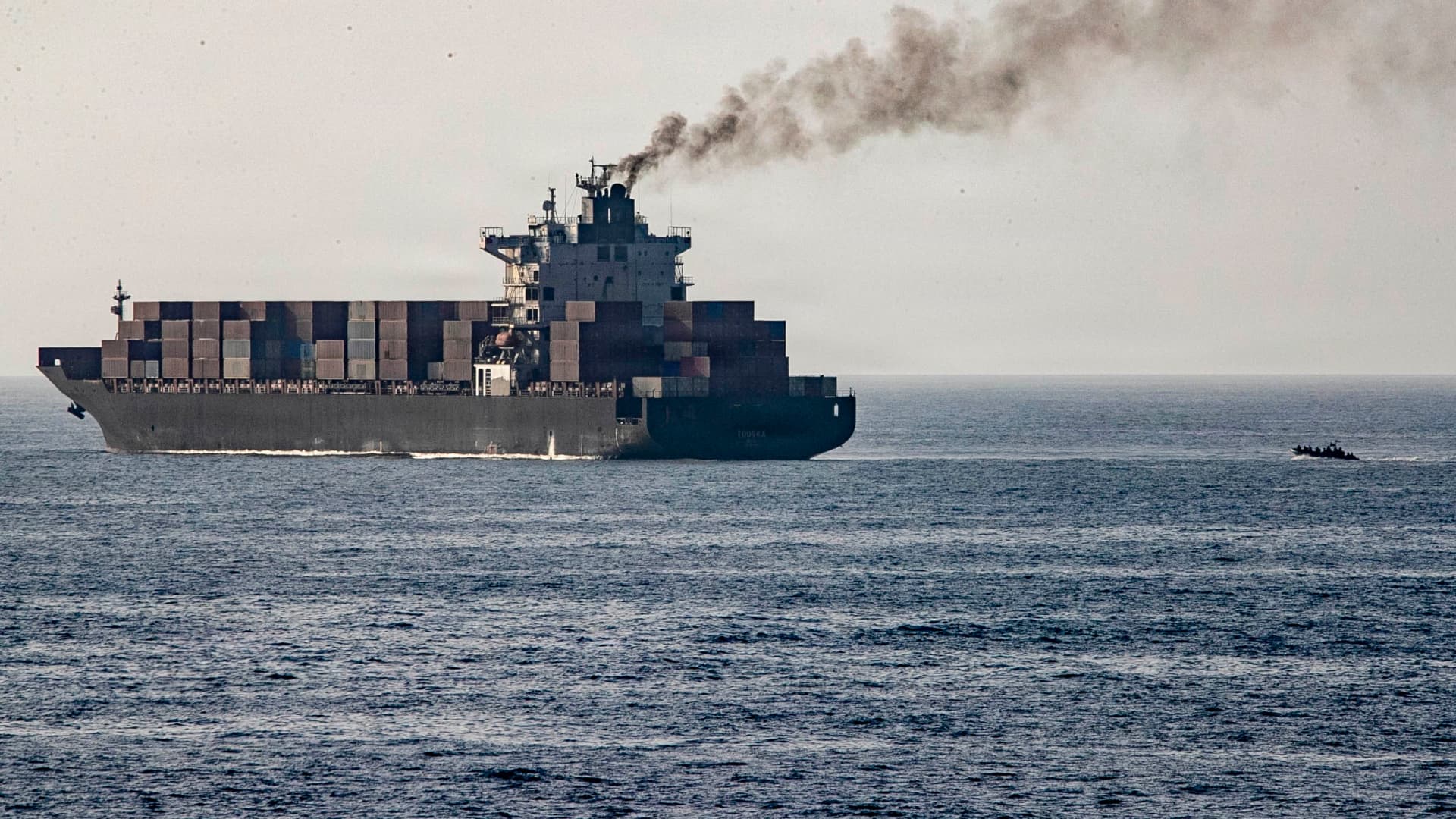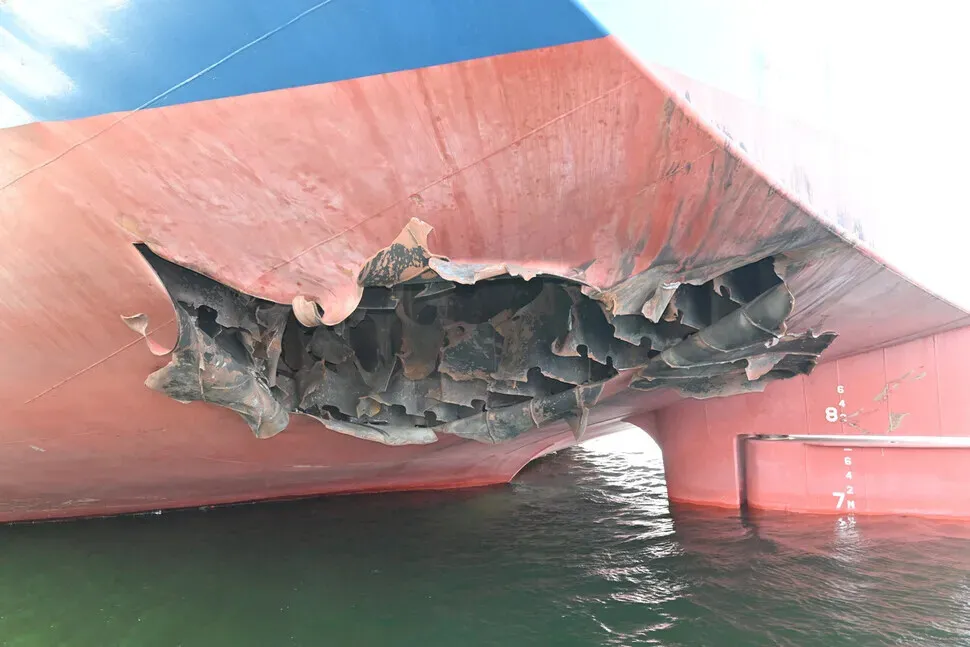
South Korea’s Ministry of Foreign Affairs released this photo on May 10, 2026, of the damage caused by an external strike on the HMM Namu, a Korean-operated ship in the Strait of Hormuz that reported experiencing an explosion and fire on May 4, 2026. (courtesy MOFA)
While the Middle East is often described as a powder keg, few expected it would actually detonate given the extraordinary repercussions for the global economy. But war broke out anyway, making a mockery of all those self-assured predictions.Even after the war began, it was largely assumed that the Strait of Hormuz would remain open. But with their options dwindling, the Iranians played their trump card by shutting down the strategic waterway.As a result, oil prices spiked, which was completely expected since the strait was a conduit for about 20% of the world’s maritime petroleum shipments. The International Energy Agency (IEA) described the strait’s closure as “the largest supply disruption in the history of the global oil market.”That’s no exaggeration. The daily oil supply dropped by around 5 million barrels during the oil shocks of 1973 and 1979, compared to a 10-million-barrel daily reduction due to the Strait of Hormuz’s shutdown.Even when the war winds down, the Gulf states won’t be able to immediately return to peak production. Over 60 oil fields and refineries around the Gulf have been shuttered or destroyed, and it will take longer than many assume to reactivate or rebuild all those sites.Oil prices have a direct impact on inflation. They’re also the key drivers of economic slowdowns and recessions. Oil shocks of the past — in 1973, 1979 and 1990, for example — all led to severe inflation and a financial crash.But this time has been different. Brent crude oil futures spiked to around US$120 but as of May 12 were around US$105.JP Morgan predicted that in a prolonged closure of the strait, oil could rise to US$150 a barrel; Bloomberg Economics predicted a high of US$170.Those predictions ended up being overblown. So far, at least, the economy has shown little movement. Major countries haven’t seen a macroeconomic collapse. Even China, which relies on the Strait of Hormuz for about one-third of its oil imports, is doing fine.Most significantly, the world’s financial markets continue to rise. The closure of the Strait of Hormuz evidently hasn’t had dire consequences (yet) either for financial markets or national economies. But why not? Reports of reduced supply are greatly exaggeratedIt’s true that the Strait of Hormuz’s closure reduced the global supply of petroleum by about 20%. The world’s daily consumption of crude oil is presently around 100 million barrels, which includes a daily average of 20 million-21 million barrels of crude oil and petroleum products exported through the strait by the Middle East’s major oil-producing countries. Since 20% of the total supply of crude oil passes through the strait, the language about a 20% reduction is statistically accurate.However, that frightening phraseology fails to explain why the oil price spike has not materialized. First of all, the Strait of Hormuz is not the only way that Middle East oil producers can export crude oil.Saudi Arabia and the United Arab Emirates maintain pipelines that can circumvent the strait and are using those pipelines to transport 5 million-6 million barrels of crude oil a day to the Red Sea and the Gulf of Oman. That represents 24%-30% of the total crude oil typically exported through the Strait of Hormuz.Until late March, Iran allowed oil tankers operating under the flags of China, India, Iraq and Pakistan to pass through the strait unmolested. So while the oil supply chain has sustained an undeniable shock, there’s a little breathing room.The release of barrels from the US Strategic Petroleum Reserve is also an important factor that has tempered rising oil prices. The IEA decided that it would release 400 million barrels of oil from its emergency reserves, the largest-ever release of its kind. The US is releasing 1.4 million barrels per day. While this does not solve the problem at its core, it allows them to buy time. In the short term, this can mitigate oil price surges and reduce the risk of widespread shutdowns in the oil refining sector. Of course, this strategy has its limits. When we consider the daily shortfall caused by the blockade of the Strait of Hormuz, this volume is only enough to last a little over a month. The fact that China, the world’s biggest consumer of fossil fuels, holds a considerable amount of crude oil reserves is another major factor preventing oil prices from soaring.According to the US Energy Information Administration, China had around 1 billion barrels in commercial inventories, with an average of about 360 million in government-held stockpiles as of February 2026. This is the equivalent of several months’ worth of imports. Since Iran allowed Chinese vessels to pass through the strait until the end of March, we could say that China has established a buffer of sorts against the impact of the oil crisis. Production growth outside the Middle East also helped prevent oil prices from rising. Oil is increasingly produced primarily in the Americas, and organizations project that in 2026, production from non-OPEC countries will rise by 1.3 million-1.6 million barrels per day compared to the previous year. The US, Brazil, Guyana and Argentina are expected to lead this growth. Finally, the most important factor can be found in the change in the US’ standing within the energy market. Since 2019, the US has become a net energy exporter, with crude oil production exceeding 13 million barrels per day. The US EIA reported that the country’s LNG exports averaged 18 billion cubic feet per day in March 2026. Even if a supply shock were to occur, the US is now a potential supplier, not a victim of that shock. Oil prices would have to skyrocket to unprecedented levels for it to really hurt the US.