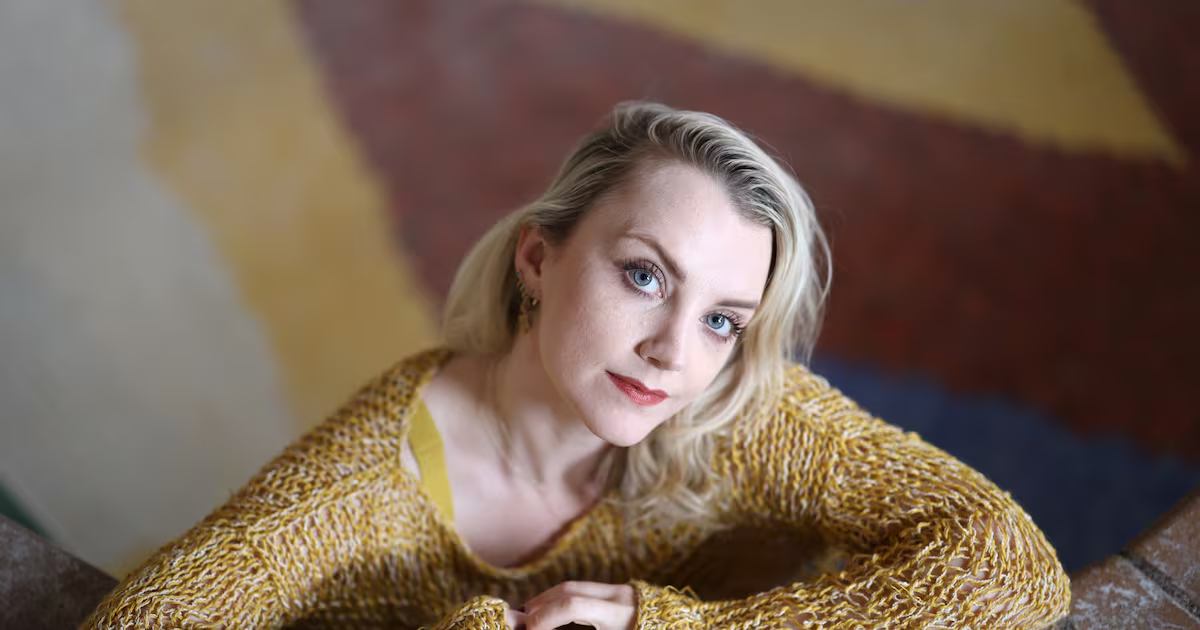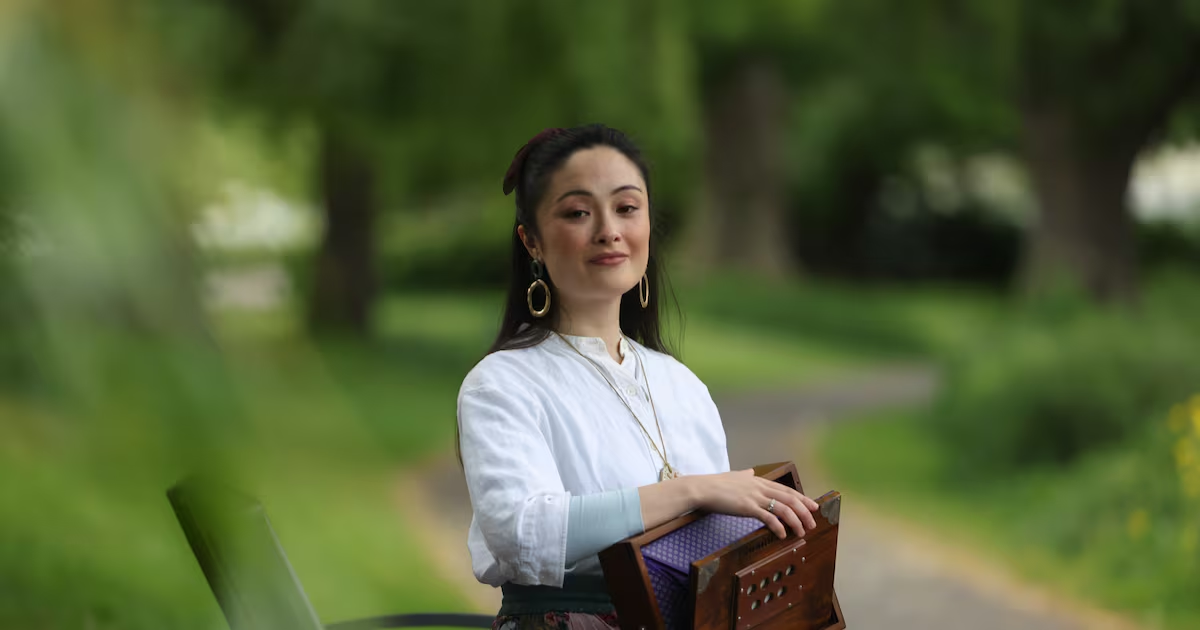
I am a singer, writer and creative facilitator. I grew up in Killarney in Kerry, and I am currently based in Dublin. I am working full-time in the arts. It has taken me about 2½ years to get to this point, so it’s been pretty rapid, actually. About 85 per cent of my work is through the medium of Irish language arts and creativity, which is really a beautiful part of my life. I didn’t grow up in an Irish-speaking household. My grandfather was a native speaker, and I did grow up in the house with him, but we didn’t ever really speak Irish together. As his struggle with memory loss progressed, he did speak a lot of Irish, but more to himself than in conversation. So that was the only living Irish in the house for me growing up. With my mum, I never communicated in Irish, so I got my Irish at school. I was one of that first generation of widespread Gaelscolaíocht. Gaelscoil Faithleann, the new building that’s there now in Killarney, opened in 1999 and I started school in 2000. I was really lucky that my mother made the decision to send me there, even though Irish wasn’t an aspect of her own life. She felt it would connect me to my grandad’s heritage from west Kerry, and she thought it would be an important aspect of choosing to raise her daughter in Ireland rather than in Japan, where my father is from. Like most people growing up in Ireland who don’t come from a Gaeltacht community, the first example of something like sean-nós that I ever heard was Seán Ó Riada’s Ár nAthair being sung in a church, every school mass. Usually a boy would be asked to sing the Ár nAthair, and there was something about it that punched me in the gut. Everything about it just moved me. The love affair was born there. I also had a teacher in primary school, Muinteoir Tomás, who would play a CD by Pádraigín Ní Uallacháin, A Stór Is a Stóirín, at every opportunity, whether it was for our téigh a choladh time or sos lóin time. When he was piecing together songs for a school play, that was what he drew from; which actually probably gave me some problems with my canúint (dialect), because she’s singing in beautiful east Ulster Irish. That early exposure – even though it wasn’t like someone in the room singing these songs to me necessarily, just the records – got under my skin. My baseline of learning songs, first it was Ullacháin, who’s Leitrim/Armagh, and then Lasairfhíona Ní Chonaola, who’s from Inis Oírr. I didn’t start to listen to Munster singers until I was in my early 20s. The Gloaming were releasing albums, and I realised, “Oh, it’s not just that I find sean-nós so difficult, all these people are singing a different canúint.” It is definitely challenging to be a young person, a teenager in their most formative years, and to look around at your community, your family – I didn’t grow up with any of my Asian family in the picture – your friend group, the people who are looked up to in the public arena, politicians, decision makers, people with authority, and never see someone who looks like you, and never see someone who you believe can reflect your experience of life. That is hard, and that is isolating. You tend to look outwards. I looked to the US for role models, where there are lots of mixed Asian people. But contextually they’ve lived a very different life to mine and they are more part of diaspora communities, which is not an experience I can relate to. So, although I tried to mirror and copy some people I identified as role models there, I couldn’t. When I looked to Japan, I also was like, “Okay, sure. I look a little bit like these people, but culturally I don’t have any of the experience of life that they have.” So I can only really be myself.I’m a citizen of Ireland, and so I believe in things like having a responsibility to vote in Ireland, having a responsibility to participate in the public arena, and shape our democracy. I pay tax in Ireland, and so I believe I should have a right to influence how public funding is used. I benefit from being an artist in Ireland, because I can access the Arts Council. So, yes, I’m definitely Irish.[ ‘When I drive off the ferry in Ireland, my heart goes back into its right place’Opens in new window ]That said, I really dislike when people ask me questions like, “Do you feel more Irish or Japanese?”, or when people obsess about which one of your parents is Irish or Japanese. Questions like, “How did they meet?” There can be a fetishisation of mixed cultural origins. I understand that it’s interesting, but if we go far back enough, all of us have some level of mixed cultural or mixed religious or mixed ethnic origins. So perhaps to be Asian Irish or black and Irish today, that’s really, really visible, but Europe has always been a melting pot of linguistic, religious and ethnic heritages. Saying that I’m Japanese-Irish, it’s more a fact than it is an identity. It’s possibly the least interesting thing about me, and I hope it becomes less and less so the older I get. In conversation with Niamh Browne. Amano will perform in the Kevin Barry Recital Room at the NCH as part of the Tradition Now festival on Saturday, September 26th at 6pm. Tickets €10 from nch.ie. For more tour dates see amanoanseo.com.
Amano De Londra Miura: Being Japanese-Irish is possibly the least interesting thing about me
Amano De Londra Miura, who has roots in Kerry and Japan, blends sean-nós with contemporary music and spoken word
947 words~4 min read