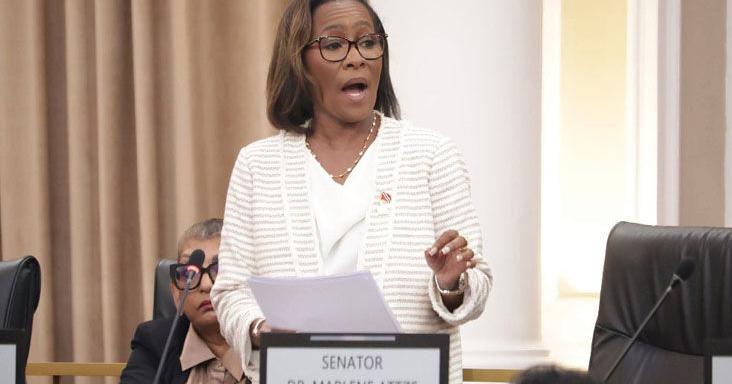
Independent Senator Dr Marlene Attzs has raised concerns that the cumulative impact of increased fines, penalties, fees, and compliance requirements contained in the Finance Bill, 2026 could place additional pressure on already stretched households and businesses.She also questioned whether harsher sanctions alone would lead to greater compliance or simply create punishment.Contributing to the debate on the legislation in the Senate yesterday, Attzs said the combined effect of multiple measures across more than 20 pieces of legislation deserved careful scrutiny, even if many of the individual proposals were justified.“The combined effect of legislative changes can sometimes be greater than the impact of any single measure considered in isolation,” she said.While acknowledging that the measures in the bill served different purposes—including strengthening compliance, enhancing enforcement, broadening the tax base and introducing new reporting requirements—Attzs argued that citizens experienced public policy collectively rather than one measure at a time.“So every new tax, every new surcharge, every new fine, just to keep the language straight, every new filing requirement, every new compliance obligation, every new fee or reporting rule may appear manageable on its own, but when layered one upon the other, they create a cumulative burden that affects the cost of doing business, the cost of housing, and ultimately, the cost of living,” she said.Attzs stressed that her concern was not with any single provision but with the aggregate impact of multiple measures introduced simultaneously.She pointed to Clause 30 of the bill, which increases fees and penalties under the Spirits and Spirit Compounds Act, as an example of how additional compliance costs can ripple through the economy.“Higher compliance costs, increased licencing fees, and more stringent penalties imposed upstream can eventually be reflected in wholesale prices, retail prices, and ultimately, the prices paid by consumers,” she said.‘Tax after tax’According to Attzs, citizens may reasonably question whether the combined impact of the measures amounts to “tax after tax after tax after tax, or penalty after penalty after penalty after penalty.”The Independent senator said policymakers must distinguish between the legal incidence of a tax or fee and its economic incidence.“The legal incidence, the person or entity required by law to pay the tax or the fee or the charge, but the economic incidence might be quite different because the person who ultimately bears the burden may not necessarily be the person intended to pay the tax,” she said.She noted that costs moved through supply chains and markets before often settling on those least able to absorb them.“The challenge for policymakers, therefore, is not simply to assess each measure on its own merits but to consider the aggregate burden created when multiple measures are introduced simultaneously,” she said.Attzs also questioned whether significantly increasing penalties would automatically achieve better compliance.Referring to statements made by Finance Minister Davendranath Tancoo in the House of Representatives, she acknowledged that penalties must be substantial enough to deter unlawful behaviour.“There is merit to that statement. Effective regulation requires credible consequences,” she said.However, she argued that deterrence alone was insufficient and suggested that successful regulatory systems should rest on three pillars—education, facilitation and enforcement.“If the compliance pathways are difficult, Mr President, if information is limited, if regulatory agencies are under-resourced and enforcement remains inconsistent, larger penalties will not necessarily produce better outcomes,” she said.The bill increases penalties across several sectors, including gambling, tobacco, pesticides and forestry.While some increases may be warranted, Attzs warned that they would remain ineffective if agencies lacked the resources to enforce them.“Compliance requires, among other things, inspectors, investigators, prosecutors, and functioning institutions. The fact is, if some of these agencies lack the resources to enforce these penalties, then the increases exist only on paper,” she said.Attzs also addressed Clause 15, which proposes increasing the penalty for manufacturing copra products without the necessary approvals from $4,000 to $8,000.She noted public concern over increased penalties affecting the production of products such as coconut oil and homemade vinegar.While emphasising that the bill does not prohibit the manufacture of these products or impose a new tax on them, she said it substantially increases penalties for those who fail to comply with statutory requirements.“Standards need to be placed. I totally agree with the minister that we need to have standards,” she said.However, she argued that pathways to compliance should be strengthened at the same pace as penalties.Attzs said many small-scale producers were not large corporations with compliance departments or legal advisers but are often cottage industries, rural households, women-led micro-enterprises and people trying to supplement household incomes.She called on the Government to explain what measures would be introduced to help such producers transition into the formal regulatory framework.“If we are increasing penalties, we should also be creating pathways to compliance, particularly for those with limited resources and limited familiarity with the regulatory processes,” she said.“Another question emerges as we contemplate this bill, Mr President. Are we trying to build a culture of compliance or are we trying to impose a culture of punishment?”Culture of complianceAttzs argued that effective legislation requires more than larger fines and harsher sanctions. It also depends on capable institutions, clear regulations, public trust and practical support measures.Among the measures she suggested were phased implementation, public education campaigns, warning notices for first-time offenders, and graduated penalties reflecting the severity of offences.“Such measures would build a culture of compliance,” she said.Attzs warned that costs, penalties and fees ultimately moved through the economy until they reach those least able to afford them.—Anna Ramdass
Attzs: More fees, penalties create a burden for consumers
Independent Senator Dr Marlene Attzs has raised concerns that the cumulative impact of increased fines, penalties, fees, and compliance requirements contained in the Finance Bill, 2026 could place additional pressure
TL;DRAI
Bill 2026 stacks 20+ taxes, penalties and compliance rules cumulatively burdening businesses and households. Penalties without accessible pathways and resourced institutions won't improve compliance; governance needs education and enforcement balance.
899 words~4 min read