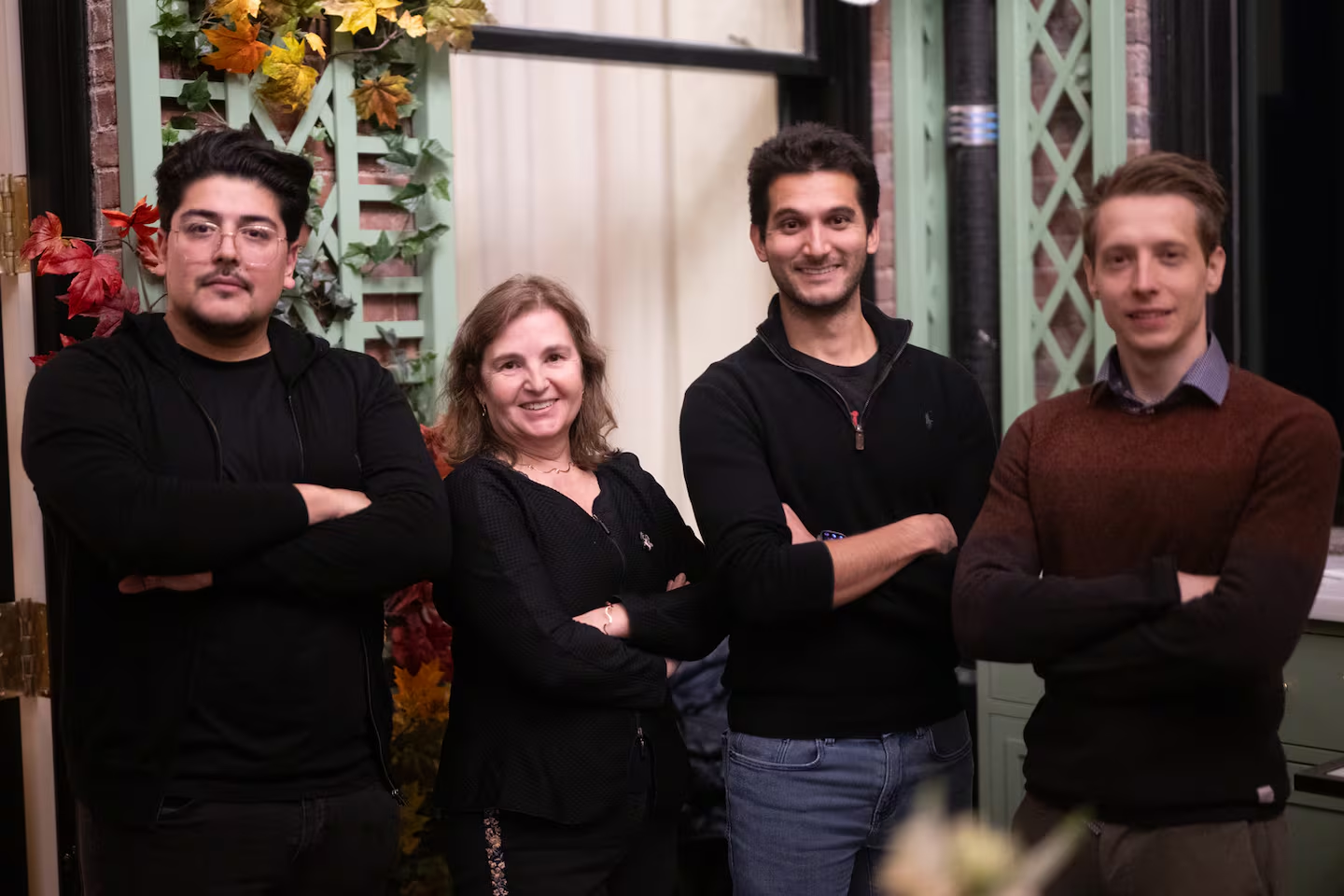
California may have birthed giants such as ChatGPT developer OpenAI and Claude creator Anthropic, but the next round of AI development should play into Massachusetts’ strengths: applying technology to real world problems. Since the days of minicomputers and Lotus Notes, Massachusetts companies have built the tech that helps enterprises run and do better.And with more Americans worrying about the social, economic, and environmental implications of AI, the Massachusetts tech sector is grappling with the ethical concerns that Silicon Valley often ignores. Ultimately, local tech leaders and thinkers say, the challenge is to ensure that people, not only corporations, benefit from the technology. Already, local startups are using AI to improve medical diagnoses, speed scientific discovery, modernize software, and even make music. Others are developing efficient AI models that can be more easily integrated — into computer networks, business operations, and devices of all types (including robots) — than the mega-models built in California. “The real value is going to be not just in that kernel of invention, but getting AI into applications, actually changing real lives and real businesses,” says Andrew Lau, cofounder and chief executive of Boston software firm Jellyfish. “Boston’s in a great position to do that.” The region might have been slow out of the AI gate, but it is gaining momentum. At MIT, for example, President Sally Kornbluth is reinvigorating the school’s support of the local innovation ecosystem, unveiling new online classes dedicated to AI — with free entry-level classes for anyone — and encouraging more entrepreneurship on campus. The Massachusetts AI Hub, a $100 million initiative launched by the Healey administration in 2024, has struck deals to get free access to Google AI training for any state resident and to give 40,000 state workers access to ChatGPT. The Boston fitness-tech company Whoop this year helped organize a coalition of tech and investment firms to attract AI startups to the state while encouraging local entrepreneurs to start tech companies — and keep them — here. Local tech executives from Whoop, Suno, and other local companies gathered to discuss how to stimulate the region's AI economy.Massachusetts AI CoalitionIn just one week in May, the coalition held 17 events, including a summit on integrating AI into medical devices, a hackathon dedicated to creating apps using AI tools (no prior coding knowledge required), and an early-morning networking run along the Charles River. The coalition is also offering a package of benefits for new founders, including six months of free co-working space. “We get back into the AI game by actually building,” says Whoop CEO Will Ahmed, “not just talking.”One builder is Ariel Galipeau, director of AI programs at a startup called Launch by Lunch, which provides consulting and training about AI tools to companies and executives. With no formal background in writing software, Galipeau learned to make apps to help run her company at events sponsored by Women Applying AI and other groups that have sprung up over the past year. One of her apps can draft personalized marketing emails. Another creates invoices.“Those communities provided me both the education and the confidence,” Galipeau says. “Because so much is changing, to be in conversation and learn from others is one of the best ways to keep up-to-date.”The Boston area already boasts stars in applied AI, including Lila Sciences, PathAI, and Generate Biomedicines, which use the technology to advance health care and scientific discovery, and Suno, the Cambridge firm that lets anyone — regardless of musical background — create songs with AI help.These local successes show there’s more to AI than large language models underlying apps such as ChatGPT, says Noubar Afeyan, one of the area’s top startup backers. As the name suggests, large language models are trained on the written word. But Afeyan, CEO of startup factory Flagship Pioneering, says AI models trained on patterns found in the natural world — the shapes of proteins or immune system reactions — could make breakthroughs in medicine, agriculture, and other fields. “The next decades will be all about creating alternative forms of machine intelligence that can allow us to, for the first time, actually understand what’s happening in nature,” says Afeyan. Other kinds of AI models are needed to guide autonomous cars, robots, and weather forecasts. Tutor Intelligence in Watertown is recording 100 humanoid robots performing simple tasks over and over in an effort to create an AI model for automation.Josh Gruenstein, cofounder and CEO of Tutor Intelligence, with an AI-powered robot used for warehouse palletizing.Ken McGagh for The Boston GlobeCambridge startup Liquid AI is developing models inspired by the brain structure of a simple worm. Its models, which can uncover financial fraud and pilot autonomous drones, require far less electricity to operate than large language models, saving energy and water, which is used to cool data centers. Liquid AI is just one example of how Boston is grappling with the broad implications of artificial intelligence. Grass-roots movements are emerging to try to steer AI toward ethical uses that benefit a wider swath of people. Many analysts fear that left unchecked, AI could throw people out of work, funnel most of the benefits to large corporations, further concentrate wealth, and increase income inequality. Local groups such as Women Applying AI, AI-Powered Women, and the Future of Life Institute are working to make sure people understand how AI works and what it can and can’t do. They are encouraging people, particularly women, to get involved in shaping the technology and how it is used. And they are urging voters and political leaders to learn about the promise and perils of AI, and support policies that spread the advantages while protecting from its misuse.“Massachusetts had the first public library, we were first to marriage equality, and the first state to have universal health care,” says Kara Peterson, cofounder and CEO of legal startup Descrybe and an early member of Women Applying AI. “Why shouldn’t we lead in ethical AI?”Aaron Pressman can be reached at aaron.pressman@globe.com. Follow him @ampressman.
How the local tech sector is cleaning up Silicon Valley’s AI problems - The Boston Globe
California may have birthed giants such as ChatGPT developer OpenAI, but the next round of AI development should play to Massachusetts’ strengths.
TL;DRAI
Boston tech pivots to domain-specific AI models—medical diagnosis, robotics—backed by $100M state funding, moving from mega-LLMs toward applied, efficient solutions for real businesses. Enterprise leaders note: AI value shifts from model scale to specialization and governance frameworks. Efficiency and responsibility reshape CTO decisions and stack investments.
994 words~5 min read