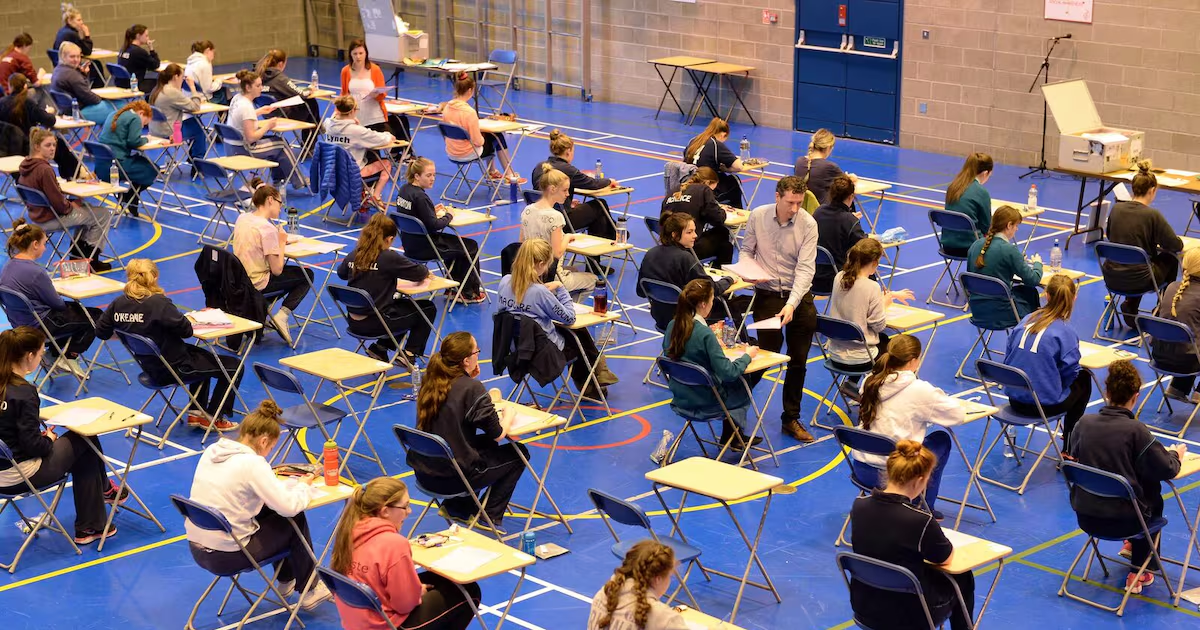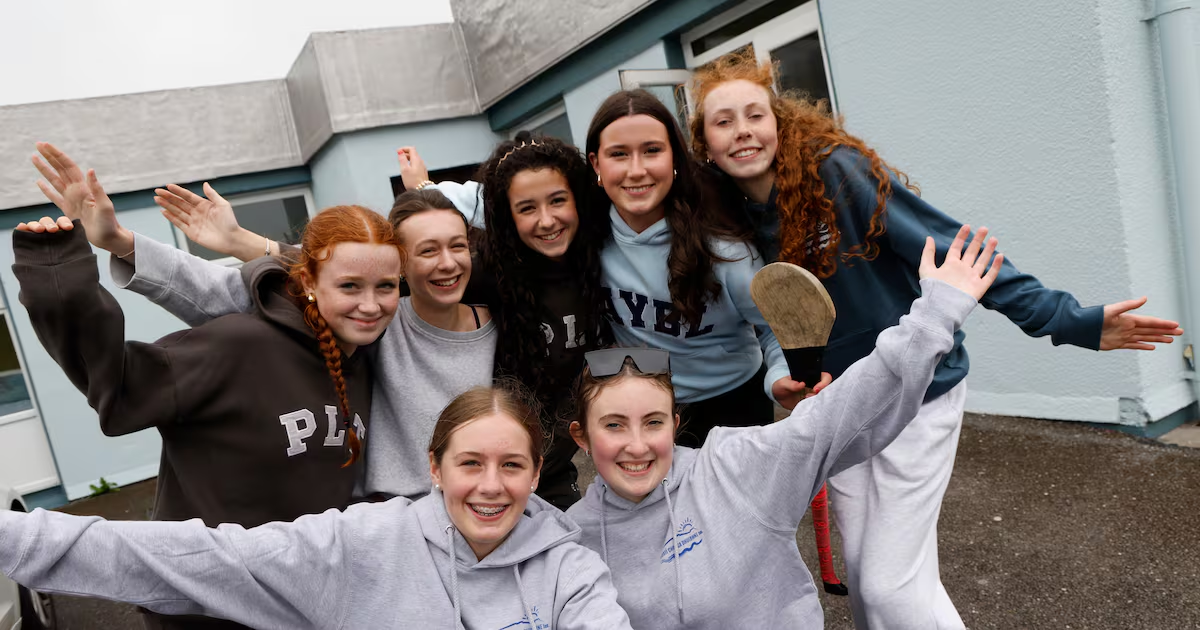
David Hickey (16), from Laois is attending Irish college in Corca Dhuibhne on the Dingle peninsula so he can communicate better with his Kerry grandfather. “I came to Irish college because my grandad loves Irish and is an Irish speaker. He is from here originally. I don’t have a lot of Irish so I am here to improve my Irish,” he says, speaking the language fluently. Of his experience so far, he says “I like it all,” but adds that a particular highlight is “playing sport on the beach”. Hickey is one of the tens of thousands of students who attend Irish college each summer. Students take classes, lodge with local families, and take part in sports and céilís. A two-week course in the Gaeltacht can set a family back some €1,200, with this fee covering meals, housing, lessons and activities. The Irish college system, which is older than the State itself, dates back about 120 years and is increasing in popularity. According to the Department of Education, 18,332 students attended official Irish colleges in the Gaeltacht in 2022, rising to 22,753 students in 2024. The number of daily speakers of Irish may be dwindling with each census, but the demand for these immersive language courses keeps growing. What are students and families hoping to get out of a two-week stay in the Gaeltacht? Improving spoken language skills is at the top of the agenda for many students.Lucy Flynn (17), from Limerick, says she came to Corca Dhuibhne after transition year “because we weren’t speaking a lot of Irish in fourth year”.Students in Irish college in Ballyferriter, Dingle Peninsula: Róisín Ní Raoghaill, Sophie Gallagher, Lisa Holmes, Ciara Looby, David Hickey, Sophie McMahon and Lucy Flynn. Photo: Nick Bradshaw/The Irish Times Another student, Lisa Holmes (17), from Dublin, says that the language immersion is helpful.“I think we’re learning a lot because we are learning Irish in school and then after class we are speaking Irish; either when we do sport or during lunch.” “My bean an tí [the ‘woman of the house’ who hosts students] is really nice and a good cook and we have great chats,” says Róisín Ní Raoghaill (17), from Kildare. There appears to be a consensus among students about the importance of the language. “It’s a really important subject because it’s our native language and it’s important to keep it alive. I think my Irish is improving and it’s so nice to learn new phrases and richer Irish,” says Flynn. Sophie McMahon (15), also from Limerick, adds: “I think Irish is important. I didn’t go to a Gaelscoil primary school but now I am going to a Gaelcholáiste and now I think it’s important to keep it [Irish] alive in Ireland.” Even though every day is the same structure, each day is different— Lucy FlynnAnother appealing aspect of Irish college appears to be the routine it provides. The students we speak to are woken in their shared room, where they sleep in bunk beds, at 8am. Students in Irish college in Mhuiríoch, Dingle Peninsula: Ellie Ní Shé, Rhian Mac Comhaill, Sadie Ní Anragáin and Doireann De Barra, Sadie Ní Anragáin and Photograph: Nick Bradshaw/The Irish Times It is then something of a race as the teenagers shower, eat breakfast and collect their packed lunches before a bus comes to collect them at 9.30am for their classes, which start at 10am and run till 1pm. After the hour for lunch, there’s afternoon sports – usually on the beach, if the weather permits it, but there are contingency plans; Zumba in the sports hall, kayaking in the rain or a trip to the Dingle aquarium. Then it’s back to the house from 5-7pm, where the students squeeze in dinnertime, getting ready for the evening céilís and importantly, a precious hour for phone time during which students can ring their parents and check their social media, before heading off to the sports hall for the dance at 7.30pm until 9.30pm. In spite of the limited phone access, the teenagers seem to overwhelmingly enjoy the routine.Students attending Irish college in Ballyferriter, on the Dingle Peninsula. Photograph: Nick Bradshaw/The Irish Times “I like the structure of each day, but even though every day is the same structure, each day is different,” says Flynn.“There are different themes for the céilís and we learn something different in the classes each day.” “I love the schedule because we are so busy but also it’s fun. It’s good to meet people from other counties too,” adds Holmes.When asked if students miss their parents there is a resounding “no”. “We are too busy,” says Holmes. “Maybe on the first day [we missed them] but there’s just so much going on you don’t have time to miss them,” says Sophie Gallagher (17), from Dublin. But among the younger students, who are in second year of secondary school going into third year in September, there is a bit more hesitancy when asked if they missed their parents. My family told me it was great and really fun— Rhian Mac ComhaillDoireann De Barra (14), from Cork, says: “I talk to my parents every day so I am not missing them an awful lot but it’s nice to hear them every night.”Sadie Ní Anragáin (14), also from Cork, says it’s not so much that they miss home, but perhaps wish that they could bring their parents with them to the Gaeltacht. Ellie Ní Shé (14), from Cork, agrees. “I don’t want to leave the Gaeltacht but I want to see my parents.” Meet the Irish college class of summer 2026: ‘Students don’t really miss the phone’ While some students might miss their families, a lot of them received encouragement to go from them. “My cousins said that Irish college was loads of fun and I wanted to improve my Irish,” says De Barra. “My family told me it was great and really fun,” says Rhian Mac Comhaill. “And I also wanted to make new friends,” he adds.Students gather into groups for team kayaking. Photograph: Nick Bradshaw/The Irish Times For the junior cycle group, the biggest highlight is by far the céilís, with themes such as “black and white” on the first night, “pink” the night before, and this evening’s theme will be “multicoloured”. “There’s the Young Offenders theme and at the end of next week, there will be boys as girls and girls as boys. It’s really nice learning new dances,” says De Barra. Aingeal Pháid Uí Ghrifín is peeling potatoes for dinner this evening. It is one of the many tasks the bean an tí needs to do to make sure her students are fed and looked after. Tonight’s dinner is bangers and mash. “A typical day starts at 6.30am,” she says. “I get up and do my workout in the morning before I call the students. Normally I get them up at 8 o’clock. I get them up for breakfast. They have their showers, packed lunch, I get them ready for school. They normally leave around 9.30am.”Aingeal Pháid Uí Ghrifín: 'The students don’t really miss the phone because they are kept so busy.' Photograph: Nick Bradshaw/The Irish Times The students, who lodge with Uí Ghrifín, could range from 13 years of age to adult trainee teachers. After they head off for their day’s Irish lessons, she does not see them again until dinner time. “The students don’t really miss the phone because they are kept so busy,” she says.“Although I notice the girls tend to miss it a bit more than the boys at first.”After dinner and phone time, the students head straight back to the hall for the evening’s céilí, before coming home for a cup of tea and a biscuit before bed. I love having that kind of activity in the house; coming and going and the bit of noise around the place— Aingeal Phaid Uí Ghrifín“I send them off to bed and normally I would have lights out about 11pm at night. Then I would wait for another hour for them to settle, to make sure that they are asleep, so that I can get a night’s sleep. But you never get a good night’s sleep when they are in the house. It’s like having a newborn baby in the house. You’re always listening out.” She says that being a bean an tí is “basically a 24 hour job”. “You are always worried in case one of them might be sick or one of them might need you throughout the night. And it’s a long old day.” Despite this, she loves the “comhluadar” or the “companionship” of the students in the house. “I love having that kind of activity in the house; coming and going and the bit of noise around the place.”“It is hard work. There’s no job that’s easy about it but it’s a rewarding job. Especially when you get students back after being here a few years and they will come visit and say: ‘Oh my God, I had such a good time when I stayed with you’.” Seán Céitinn says Irish college is 'almost a rite of passage for the kids'. Photograph: Nick Bradshaw/The Irish Times Seán Céitinn teaches in Pobalscoil Chorca Dhuibhne in Dingle as well as at Coláistí Chorca Dhuibhne during the summer months. He is from Cork originally, but speaks Irish with a strong west Kerry cainúint, or dialect. He says that the advantages of sending your child to Irish college are not just academic, but personal. “It’s almost a rite of passage for the kids,” he says. “There’s an emphasis on the language but there’s also an emphasis on personal growth. We have a points system here where we run a competition among students from all the different houses, and the house with the most points gets a party at the end of the college.”However the duaiseanna, or prizes, are not only awarded for speaking Irish, “but also if you’re cleaning up or if you’re nice with a person”. Among the prizes are Ceoltóir an Chúrsa (best musician), Rinceoir an Chúrsa (best dancer) and Scoláire is mó feabhais (most improved student). “We also have an award for the best student of the course, it doesn’t go to the best Gaeilgeoir but the best person. We are very strict on that – if people are rotten to each other there’s a penalty because it’s about personal development as well," says Céitinn.“If you come here, you do a lot of work on yourself. If you come here and do well, it stands to you in the future. It’s a brilliant thing to be able to say you will have memories for life from the fortnight you spent in the Gaeltacht.” Government figures show 22,753 students attended Irish college in 2024. Photograph: Nick Bradshaw/The Irish Times Some Gaeltacht teachers like to put a strong emphasis on studying for state examinations but Céitinn likes to place an emphasis on written and spoken Irish. “It’s also important to see Irish as a language instead of a subject because they are inside in classes doing reading comprehensions, but here it’s used as a language. They see the teachers, the mná tí (women of the houses), people in the shop, people all over speaking and enjoying Irish as a living language. It’s very important to encourage Irish, to advance Irish and to grow Irish.” Nathanna cainte is fearr – Favourite phrases: “I loved the phrase: ‘Bainnean ciall leis.’ It makes sense. It’s really useful in sentences.” – Lisa Holmes (17), Dublin“I like the seanfhocal (proverb) ‘marbh le tae, marbh gan é’ which means dead with tea and dead without tea. My bean an tí says it every night to me.” – Róisín Ní Raoghaill (17), Kildare“‘Sin rud ná feadar’ – I don’t know, that’s very useful for the oral exam and in general conversation.” – Sophie Gallagher (17), Dublin “I learned the phrase ‘Tír gan teanga, tír gan anam’ [a country without a language is a country without a soul]. I like this seanfhocal because I think it will be useful in essays and for the Leaving Cert.” – Ciara Looby (17), Dublin“I like the phrase ‘ag deanamh iarrachta’ – making an effort. I don’t know why. It’s useful.” – David Hickey (16), Laois“I learned a new phrase for football which is ‘caid’. I had never knew that there was another name for Gaelic football.” – Ellie Ní Shé (14), Cork“‘Caid’ was a new one for me as well. In Cork we say ‘peil ghaelach’.” – Rhian Mac Comhaill (14), Cork“I learned the phrase ‘giobal’ which is an old clothes rag that you use for cleaning.” – Doireann De Barra (14), Cork“I am learning the difference between the Irish in Kerry and Cork. Like they say ‘bhíos’ here instead of ‘bhí mé’.”- Sadie Ní Anragáin (14), Cork
Meet the Irish college class of summer 2026: ‘Students don’t really miss the phone’
Students in the Gaeltacht discuss pros and cons of attending Irish college
2,132 words~10 min read