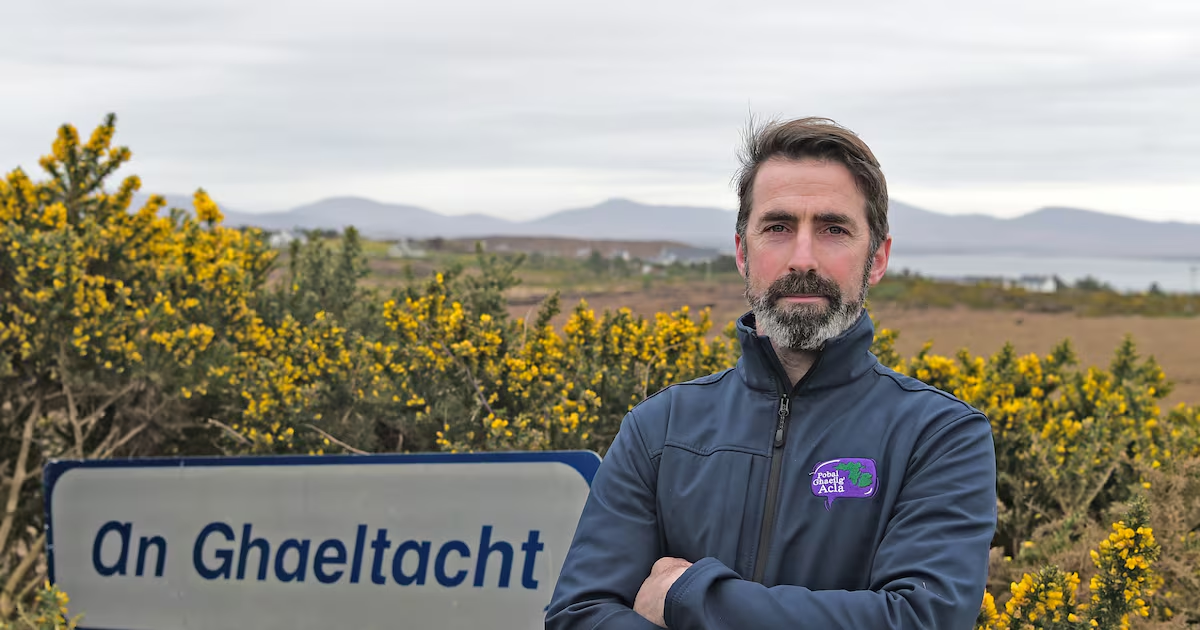
The Gaeltacht is facing not just a housing shortage but a linguistic and existential crisis for a small population who have passed on the Irish language from generation to generation, the chair of an advocacy group has told an Oireachtas Committee.Donncha Ó hÉallaithe, of Connemara-based group Banú, told a meeting of the Oireachtas Committee on Housing that the State’s failure to provide homes for Irish speakers is threatening the future of Irish as a living first language. At a marathon meeting of the committee, Gaeltacht groups, TDs and Senators from all parties argued for a change in policy direction that would ensure that native speakers could afford to acquire homes in their own area. Ó hÉallaithe said the combined pressures of short-term lets, high property prices and restrictive planning rules were making it “increasingly difficult” for young adults to remain in Irish-speaking communities.“The overall effect of this housing crisis is detrimental to the survival of Irish as an everyday community language,” he said.He cited the example of a young Connemara woman who was refused permission to build on family land because she was deemed to have no housing need while living in Galway city – a decision he said failed to take the Irish language into account as a factor.“People who want to move back to an Irish-language community should be supported – instead they are inhibited. That is the mindset,” he said. Ó hÉallaithe also criticised planning structures that did not reflect the reality of Gaeltacht settlement patterns. He noted that a large stretch of south Connemara, with a population of 4,000 and key infrastructure including an airport, a TV station and three industrial estates, did not qualify as a “designated village” for planning purposes. He said landlords had not built the kind of villages in Connemara that were familiar in every other part of the country, and that this unique settlement pattern should be recognised by planners. A perfect solution for such an area would be a ready-to-build scheme where a cluster, or hub, of serviced sites could be developed and sold to individuals to build their own homes. Several speakers agreed there was a need to develop such hubs and clusters in the Gaeltacht areas, many of which did not have villages comparable to other parts of the State. There was much focus on the role of Údarás na Gaeltachta, with arguments that it should play a greater role in housing provision. Tomás Ó Síocháin, chief executive of Údarás na Gaeltachta, said the agency would play a strong supportive role, including encouraging greater use of the vacant homes renewal scheme (there is already a significant uptake in Gaeltacht areas), providing serviced sites from its own land bank, and progressing community housing in existing settlements in Gaeltacht areas as a “novel rural initiative”.He said such developments of five or six houses could “make a huge difference”, in rural areas as they could ensure the survival of schools and communities. Many TDs and Gaeltacht representatives argued that Údarás should take a leading role in delivering housing in Irish-speaking regions.However, Dr Aodhán Mac Cormaic of the Department of the Gaeltacht and Rural Development told the committee that Minister for the Gaeltacht Dara Calleary believed the agency should remain in a supportive role, with primary responsibility resting with the Department of Housing and local authorities.He said the Minister’s view was that the agency should not become directly involved in house building.Social Democrats TD Rory Hearne said there was a housing shortfall of 1,200 homes in the Gaeltacht regions. He was one of several TDs, including Donegal TD Charles Ward, who suggested that modular home factories should be established in the Gaeltacht regions to address housing needs there. Officials from the Department of Housing pointed out that future policy would be informed by two policy papers now being prepared, a national planning statement on rural housing due later this year, and a specific planning statement for the Gaeltacht which is expected in the first half of 2027.
State’s failure to provide homes for Irish speakers ‘threatening future of language’
Young adults cannot remain in Gaeltacht areas because of high prices, holiday homes and planning rules, Oireachtas committee told
665 words~3 min read