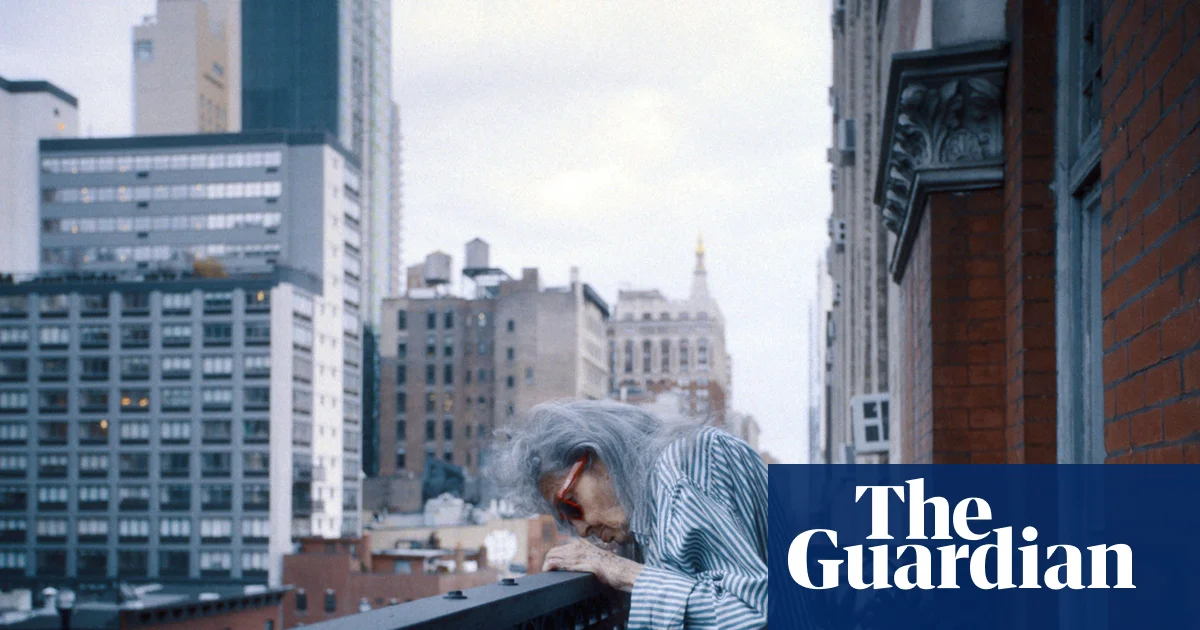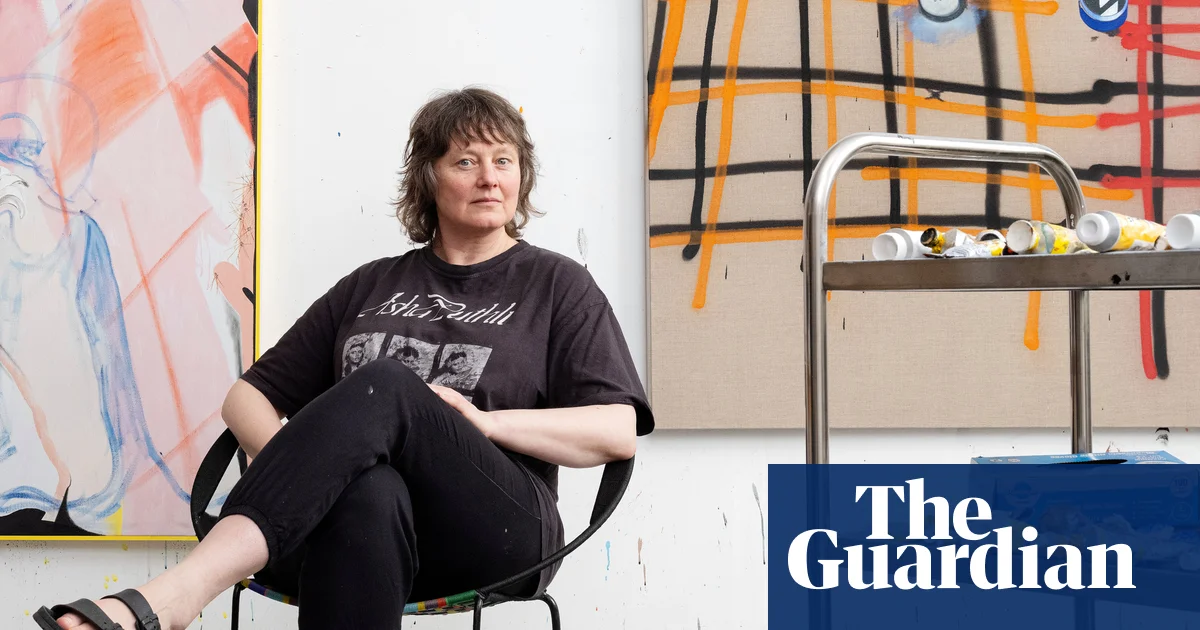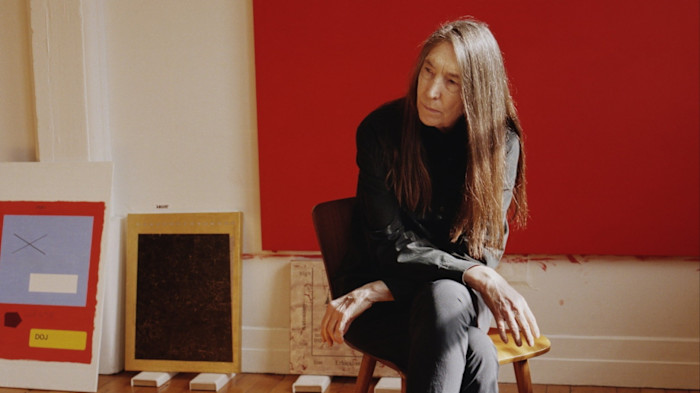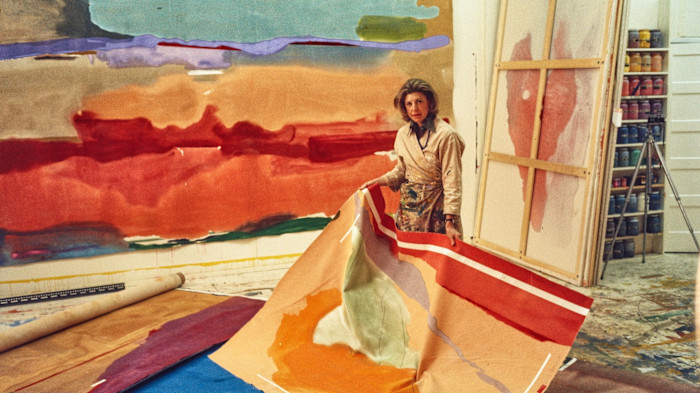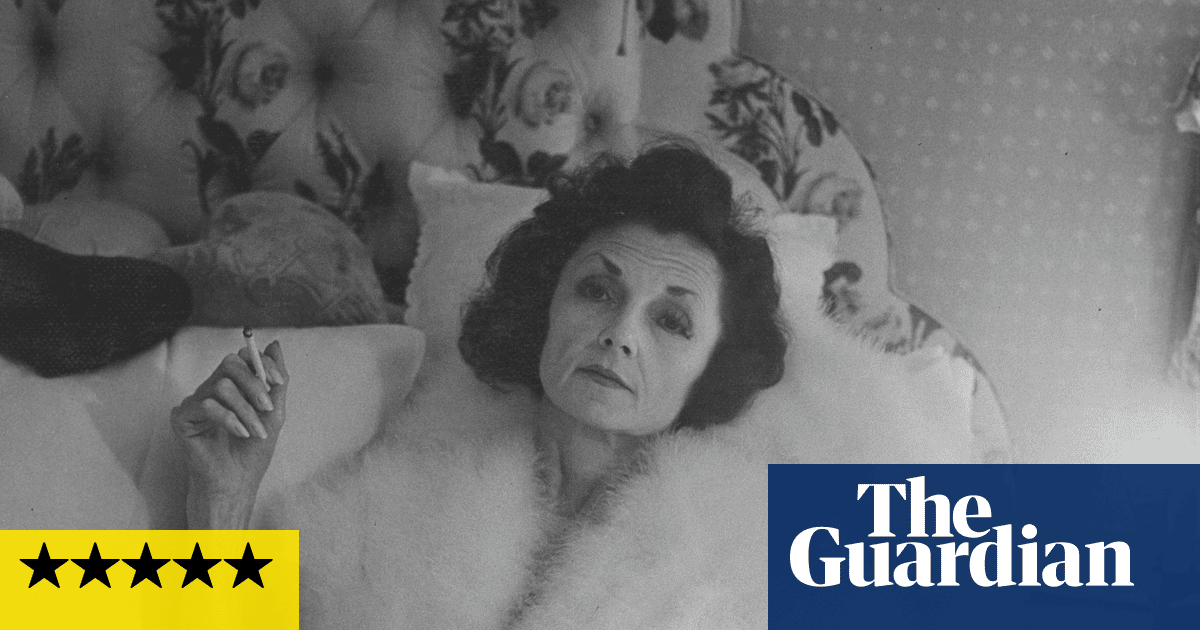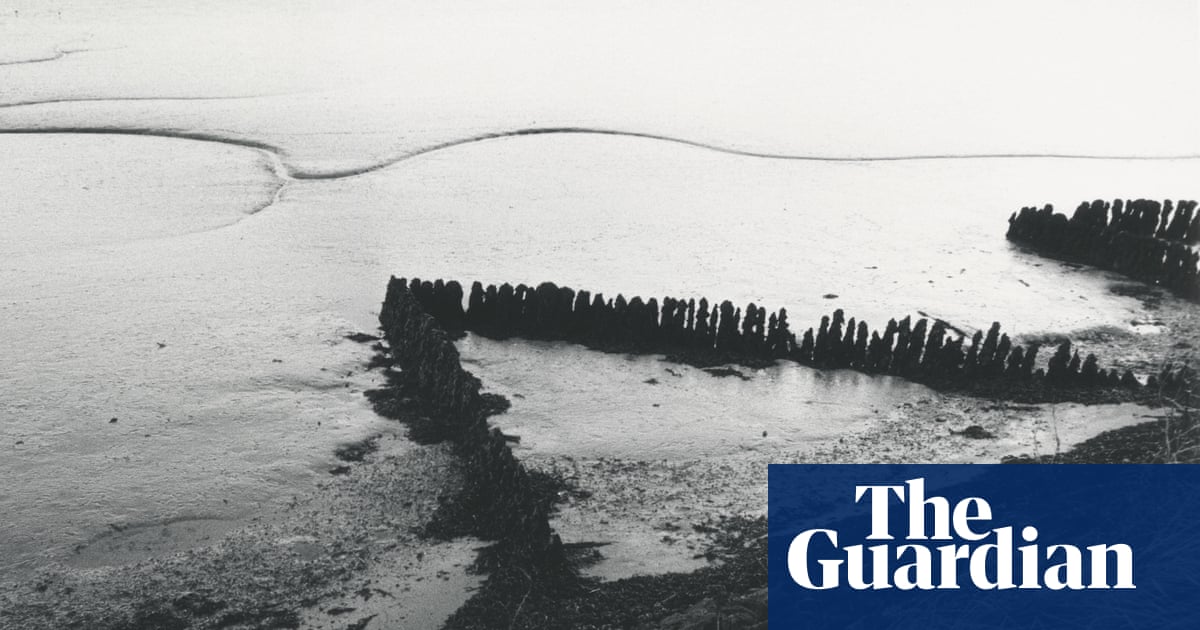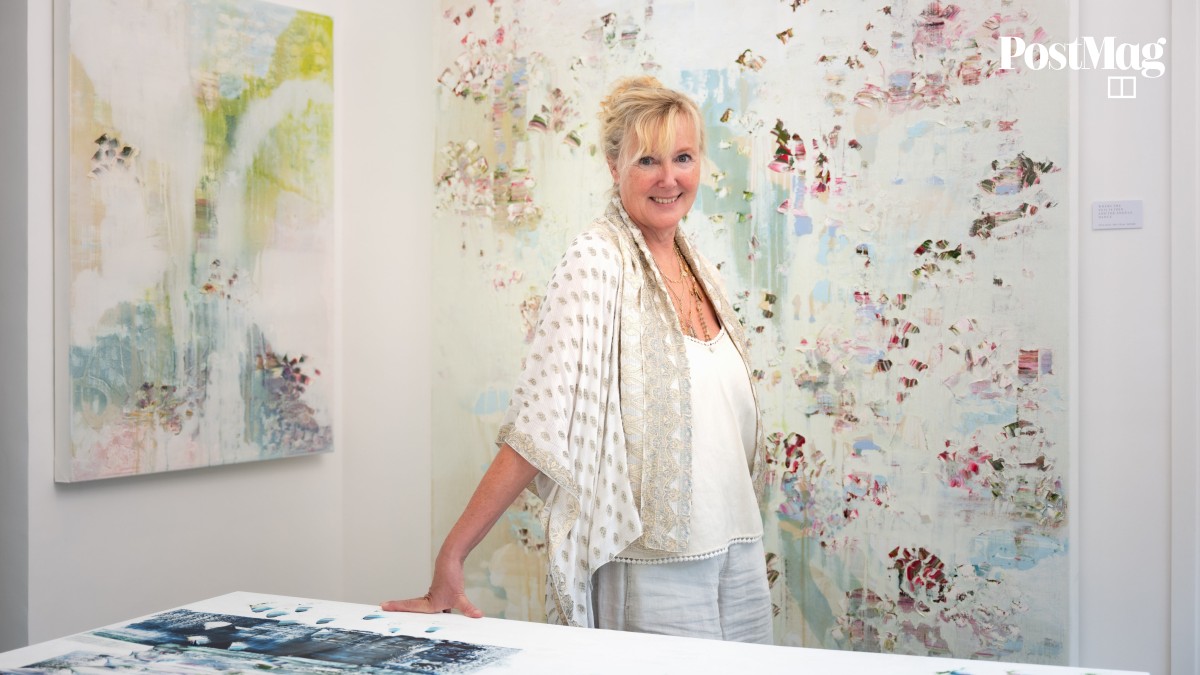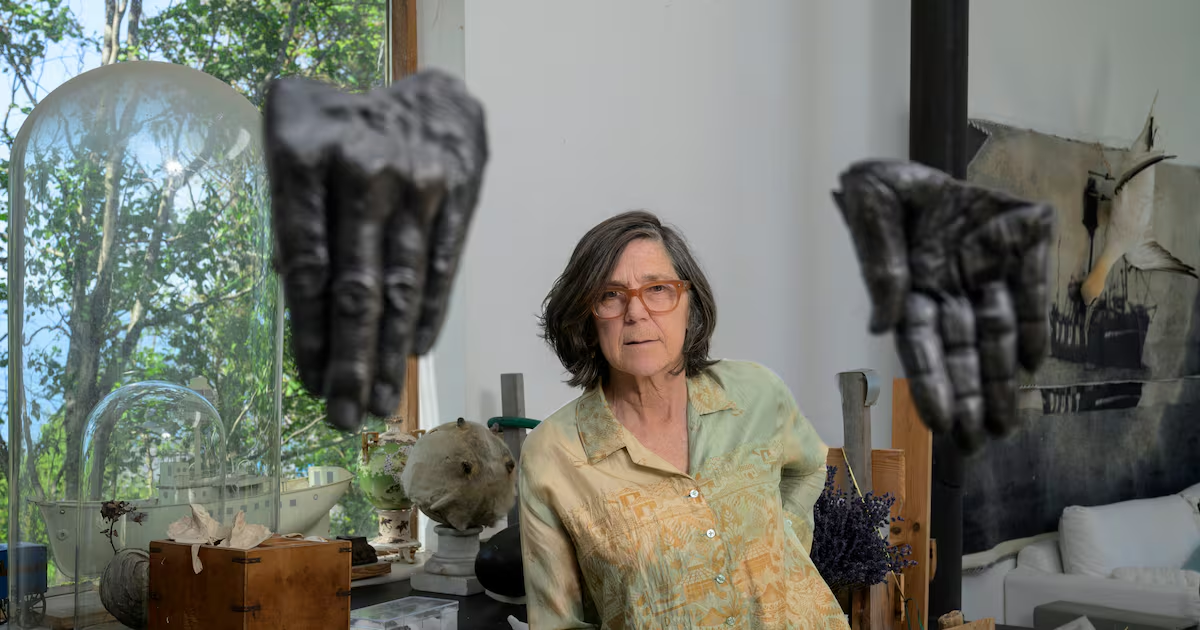
For several years, my fourth-floor desk in the ramshackle former Irish Times building on Fleet Street in Dublin was next to a large pillar. I used it as my gallery, taping to it festival posters, front-page photographs and whatever art was intriguing me. Things came and went, but one piece of paper torn from some magazine or catalogue remained a constant.It showed two black-and-white images of a storm in an elegant teacup. The top one was of a roiling empty sea. The bottom one was of three men on it in a curragh. The stills were from Man of Aran, Robert Flaherty’s ethnofiction film, a manipulated documentary from 1934. The artist who had superimposed the stills on to the vintage teacup was Dorothy Cross.Every time I looked at the ocean in the tiny cup and at the valiant rowers I felt drawn in. No matter how often I looked – and I looked at it daily, for years – it still seemed fresh, and also somehow disturbing, beguiling and menacing.“That teacup is inside in the kitchen,” Cross says now, of the blue-and-white cup with the golden handle and delicate flower trim. We are sitting in her magnificently located studio at her Connemara home, mugs of coffee to hand.Only a wall of glass separates us from the bright green fields and stone walls that run down to the Atlantic. It is a view that is wild and glorious and turbulent: rural Ireland at its storybook, romantic best.“The teacup belonged to my mother. I wanted the perfect teacup, and I wanted it to be quite precious. It was more about an English respectable teacup and this beautiful, perilous little cycle of life on the Aran Islands that would be going round and round inside it.” If you look at Cross’s excellent website you can see the full work, from 1997, from which the two stills were taken. Called simply Teacup, it is a mesmerising three-minute video, played on a loop.“It was the first time a few of us were guinea-pigged to do something on computers in Temple Bar, as I recall,” the artist says.Cross, who was born in Cork, turned 70 on February 5th. Less than a week later she was elected a Saoi of Aosdána, the Government-funded affiliation of creative artists founded in 1981. The title of Saoi – the word means sage, or wise one – is the most prestigious accolade a member of Aosdána can receive. There are currently four Saoithe. Teacup, by Dorothy Cross. Photograph courtesy of the artist President Catherine Connolly at a ceremony to mark the election of visual artist Dorothy Cross as Saoi of Aosdána. Photograph: Enda O'Dowd At the ceremony to honour Cross, President Catherine Connolly said it was to mark “a lifetime of outstanding creative work and the esteem in which she is held by her artistic peers”.Anyone who is made a Saoi receives a twisted torc of gilded silver, cushioned in velvet within a beautiful hand-carved wooden box. Cross shows hers to me. Its previous recipient was the composer Seóirse Bodley. A little plate inside the box bears his name and the dates he was Saoi, from 2008 to 2023, the year of his death.“I thought you’d have it forever, but you don’t,” Cross says twice, regarding her own name in the box, with the date 2026 beside it and a dash for another date that will be engraved at some point in the future. “You have to give it back when you die.”Twice the reporter pedant in me wonders if I should point out that, technically, Cross does have this torc forever, in so far as she retains it for her lifetime. Twice I say nothing. It seems superstitious somehow, or bad manners, or something else, something deeply unsettling, to be talking about a time when one of the two of you in this room will be dead. (When she does die, she tells me, she would love to be buried in her field in front of her home, between her deceased dogs.)Cross’s art has had a powerful and unsettling element throughout the half-century she has been making it. Her work spans sculpture, video, photography and installations, both at specific outdoor locations and within galleries and other spaces. She has long been represented by the Kerlin Gallery in Dublin and the Frith Street Gallery in London.In the 1990s she made a series of pieces using cows’ udders, which attracted widespread attention. There was a croquet installation, with udders as the balls. There were tureens with udders bulging out of them. There was a lifebuoy with an udder at the centre, where a human torso would be if the buoy were in use.The most famous piece in the series was one called Virgin Shroud, a sculpture in the form of a woman covered in cow hide and a cream silk-satin wedding train. The train had been worn by her grandmother on her wedding day. The sculpture’s “head” had four upwards-pointing teats, like the crown of a bridal veil, or the stars that float above the head in traditional images of the Virgin Mary.Virgin Shroud, by Dorothy Cross (1993). Photograph courtesy of the artist and Kerlin Gallery, Dublin Cow's udder bodhrán by Dorothy Cross. Photograph: Michael McLaughlin “I made about 22 pieces with udders and a bodhrán that I have never shown. I was very precise the places where I put the teats. It had significance. It could have become a gimmick if I had put them on everything,” she says.The bodhrán is hanging on one of the studio walls. Cross looks up at it. “The reason I put teats on the bodhrán is that I thought it would make a different sound – and it does – when you hit the teat.”When I arrived I spent time looking around the shelves and walls and surfaces of the studio – the closest most of us ever get to exploring the inside of an artist’s head.There are casts of whale bones, and casts of hands, and objects under vitrines, and model ships, the shell of a huge horseshoe crab, bookshelves, files and cardboard boxes marked with descriptions such as “Dorothy’s Hair 2008, age 52″ and “Lace veil and taxidermied finch” and “Bone buttons”. Something that looks like an innocuous piece of bleached coral turns out to be one of the oddest things I have ever seen.Dorothy Cross pictured with Fergus at her home and studio on the Connemara coast. Photograph: Michael McLaughlin Studio objects, materials and fragments in Dorothy Cross’s studio in Connemara. Photograph: Michael McLaughlin “It’s petrified lightning,” Cross says. She bought the fulgurite, as such clumps of fused sediment are known, along with small pieces of meteorite at geological fairs in the United States. You could spend a week combing through the mixture of work completed, ideas in progress, records of work; a true cabinet of curiosities.“I’m sorry there’s nothing to see,” Cross says, gazing around a studio full of astonishing objects. What she means is that there’s no evidence of work in progress. “I’m not working on anything at the moment.” The piece of public art by Cross that seems to have left the most lasting impact was Ghostship. For three weeks in February 1999 the decommissioned lightship was moored at Scotsman’s Bay in Dún Laoghaire. It was covered in phosphorous paint. Small craft nearby trained lights on it at intervals, and by night it pulsed with an eerie glow in the winter darkness.“It was four years in the planning,” Cross says. “The budget had been €50,000, and it went up to €120,000 because of the cost of the paint.”Ghostship, by Dorothy Cross. Photograph courtesy of the artist What happened to the ship afterwards? “It was sold for scrap for very little money,” Cross says, looking pained. “At the time I had very little money. I wanted to buy it. My idea was to bring it around Ireland and have it really function as a ghost ship. It would have to be tugged. But there was no interest in doing that. “The thing about Ghostship is that it was terribly simple. It was one idea. Every culture knows about a ghost ship. So it could have existed, but nobody wanted to fund it. Imagine it moored out here,” she says, waving a hand in the direction of the Atlantic, and I see the vessel again in my mind’s eye.“Some nights it didn’t work so well as other nights. But it triggered something in the people who saw it. Little kids wrote me letters telling me they had seen the ghost ship. It was terribly popular, which art isn’t normally, and which in the beginning made me uncomfortable, but in the end it didn’t. People still remember it.”Cross, with her fellow artist Willie Doherty, represented Ireland at the Venice Biennale in 1993. Surprisingly, she has not shown her work there in the intervening 33 years. Also there in 1993 was the British artist Damien Hirst, at the start of his staggeringly successful career, and at the time infamous for putting animals in formaldehyde, and sometimes cutting them in half. His piece that year was Mother and Child (Divided), a cow and its calf bisected, and displayed in separate vitrines.Dorothy Cross at her home on the west coast of Ireland. Photograph: Michael McLaughlin “The udder was gone,” Cross says. “I thought it was so wrong that her udder was gone. There was a big party at a palazzo, and we were all drinking champagne, and I went up to him.”Cross challenged Hirst about the cow’s absent udder. “He didn’t know what I was talking about,” she says. “At the time I was so distressed at the lack of an udder. I found it very brutal.”One of the pieces in the studio that Cross draws my attention to is a cast of a kiss, a definition that makes one’s head spin. It’s a delicate, almost weightless object that looks like something you might find washed up on a tropical beach, a skeleton of something strange that lived underwater.“This was the first cast I took of a kiss,” she says. “It’s dental plaster, electroplated with silver, so it is terribly light.”She explains how she made the casts. Irish artist Dorothy Cross works across many mediums. Photograph: Michael McLaughlin “I invited loads of people to dinner and gave them dental floss. Then I gave them a mouthful of dental rubbery stuff that is the kind you use for imprints for false teeth. I would ask them to kiss; they would push their mouths close to each other, and then they had to go sideways, to avoid the nose.“It was very tricky, because it was very fragile. You then had to extricate it from the mouths of people who were usually roaring laughing, then prop it up with cotton wool and let it dry. Then it would go into rubber, and you’d inject wax into it. And then you do the casting.”Out of about 40 such kisses, Cross got three she was able to use. “It’s very simple. It’s an idea. It’s the sculpture of a kiss. It’s about persistence. You get the final result through a lot of failure. Which wouldn’t be the way I would usually work necessarily, but in that case it was.”She has never been squeamish about the artefacts she uses in her work, be they whaleskin or skulls or human organs. She also has an eye for the random contents of a skip.“I once found a skull in Herbert Park in a marble box that someone had thrown away. It was an anatomical educational tool. My aunt, who was a pathologist, she had bones in her house, leftover bones. “In the old days, before they started making plastic bones, they used human bones. I had some bones from her. I recognised the box when I saw it. I knew it was a skull box, and I climbed into the skip and took it out.”Dorothy Cross on her land by the sea, close to her studio in Connemara. Photograph: Michael McLaughlin Being the artist she is, of course, Cross used the found skull. “I gilded the inside of it. The only way to work with it was to be respectful. Then I placed a meteorite in it, so you have this transition through death, this meteorite that existed in outer space coming to meet the remains of the human life. I made a sculpture of that, which was of a telescope looking down into the skull and the meteorite.”Cross’s “simple” ideas are often big ideas, some of which take years to achieve. Persistence is watermarked into her work. One such simple idea that took four years to make happen was her 2019 project Heartship. A Naval Service vessel sailed into Cork City with a human heart on board while the singer Lisa Hannigan performed alone on deck. “It was such a simple idea. That’s where I get frustrated. It is so simple: borrow a battleship that had been in the Mediterranean and saved many migrants from drowning. It had spent three years in the Med. Put a human heart on it, and have Lisa Hannigan singing songs about the heart.”The practical difficulty wasn’t, as one might think, persuading the Naval Service to participate in an art project. “The navy were fabulous. We didn’t cost them any money, because they were coming up the river anyway in their ship.”The part that took four years was the sourcing of a human heart. “That nearly drove me crazy.”Everest Shark at Dorothy Cross’s studio. Photograph: Michael McLaughlin Cross eventually sourced one from the Pitt Rivers Museum, in Oxford. It had been acquired by the ethnologist and archaeologist Augustus Pitt Rivers in the 1860s. “We paid quite a lot of money to rent that heart, and we only had it for a day.”The heart was on board the naval vessel but out of sight the entire time. “Nobody saw it when it was on the ship. The curators carried it on in a little box, and they sat down below with it. But it was present, and it was terribly important it was present. And because we only got the green light two days before the thing happened, people didn’t know it was happening.”About 700 people gathered on the dock to watch the ship come into Cork Harbour, with Hannigan singing. Cross was also aboard. And then it was over. Four years of work was over in hours.“Recently I was doing a talk where somebody was saying that so few people see this work and you spend your whole life doing it, and it is true in a way. But then something like Ghostship lasts in memory. It’s not about an object surviving forever,” she says.One object that will endure is Virgin Shroud, which Tate Modern bought in 1993, the year Cross represented Ireland in Venice. She has consistently mentioned in interviews that her mother was still alive when this happened, and that the acquisition helped her mother understand the significance of her work.She says this to me, too, adding that the “endorsement” of the acquisition “also helped people’s faith in the work”.Has the Tate acquired anything since Virgin Shroud?“Not since, no.”I ask if that upsets her. In a morning of constant, confident conversation, there is a markedly long pause before she replies.“No,” she says, sounding uncharacteristically uncertain. “It’d be nice if they did. But it doesn’t really upset me, no. I don’t get upset by those things, really. It’s a waste of energy.”Dorothy Cross with the bones of a pilot whale. Photograph: Michael McLaughlin Is there anywhere she would particularly like to do another big site-specific piece?There is. On the English Channel, between England and France. On a submarine. It would be the third in an ambitious trilogy, after Ghostship and Heartship.“I have been looking for a submarine for years, and I can’t get one. We’d borrow a submarine. They do exist; you can get them. We tried the British navy. They said no. Then we looked at trying to buy one, because they do have decommissioned submarines, but there wasn’t the budget.”Cross wanted to have the borrowed submarine surface in the English Channel and for Hannigan to come out of its fin, or tower. Hannigan would sing from there, and a human heart would again be concealed within the vessel.“This would be closer to the drownings, because of the people who drowned between France and England, and the abomination of that,” Cross says. “It would magnify that whole desperation of drowning.”All forms of art invite responses from those who experience them. What impact or effect does Cross hope to have on the people who see her work?“I hope there would be some response,” she says. “It’s not about words; it’s about an excitement. It can be about a disturbance. In the early days it probably was about disturbance. And I’m always saying, as Baudelaire did, that the beautiful is always bizarre. But then it makes you see in a new way. It is never about trying to shock. It’s about trying to recalibrate one’s self.”
Dorothy Cross: ‘The beautiful is always bizarre ... It is never about trying to shock’
The artist’s best-known work had a lasting impact. The cabinet of curiosities that is her studio offers an insight into the master behind it
TL;DRAI
Questo articolo non è rilevante per Warptech Tech News. È un'intervista culturale all'artista irlandese Dorothy Cross (arte contemporanea, scultura, video, installazioni) — nulla di tech, AI, startup o enterprise. C'è stato probabilmente un errore nel copia-incolla. Hai un articolo tech che vuoi riassumere? Se sì, passami il titolo e il corpo, e farò il riassunto seguendo le regole: 2 frasi, max 260 caratteri, focalizzate sull'implicazione per manager tech.
2,849 words~13 min read