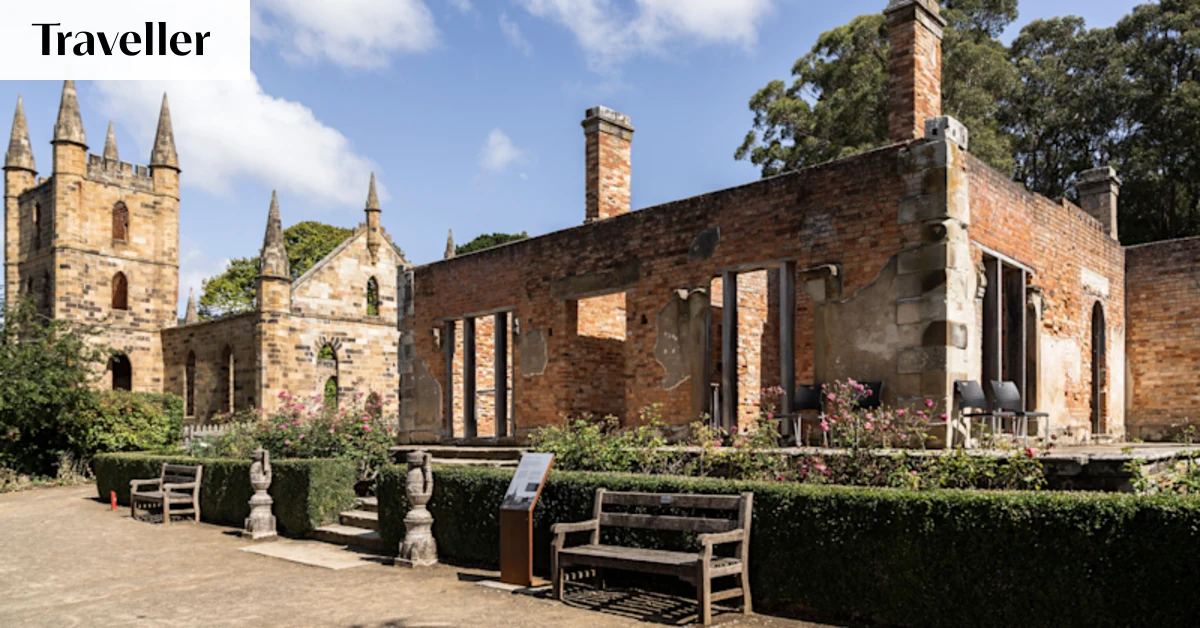
June 13, 2026 — 5:00amSeven wonders of Port Arthur, TasmaniaThis notorious World Heritage convict prison site is a testament to ingenuity and hopeless cruelty in equal measure.Mind the poochA statue marks the dog line at Eaglehawk Neck.Tourism TasmaniaBefore you venture down the narrow isthmus that leads into the 40-hectare Port Arthur Historic Site, you must pass the Dog Line at Eaglehawk Neck. Designed to alert the guards if prisoners were trying to pull a quick one, this over-30-metre stretch was guarded by canines (between nine and 18, who slept in barrels lit by oil lamp) kept on chains, trained to bark at the slightest movement or noise. Reports of their effectiveness are mixed. Now, the only pup is bronze, located a short walk from the all-timber 1832-era Officers Quarters, which is considered one of the country’s oldest military buildings.Send a messageSign up for the Traveller Deals newsletterGet exclusive travel deals delivered straight to your inbox. Sign up now.The Signaller’s House at Hobart’s Princes Park provided communication with Port Arthur.
AlamyIn the 1800s, near-instant communication was revolutionary. At the Port Arthur Semaphore Station, set up in the early years of the penal colony by Commandant Charles O’Hara Booth, a message could be relayed to Hobart (the Signaller’s House in Hobart is pictured) in less than 15 minutes using a complex 3000-code system. It was operated by well-behaved prisoners who lived in a hut at the mast’s base. The main semaphore was fashioned onto a tree trunk, reaching more than 20 metres high. In the museum, there’s a blackwood model of a semaphore probably made by a prisoner, which was believed to have been used to learn the codes.Check out the bricks (and other remnants of industry)Convicts made the bricks to make their own prison. Many felons were skilled tradespeople whose knowledge was integral to Port Arthur’s development and success. The prison officials used these incarcerated shipwrights, bakers, stonemasons, coopers and tailors – alongside free “overseers” – to train fellow inmates, with hard work deemed a method of reform. The settlement began as a timber-getting station, mill and saw yard; the penitentiary was a flour mill before it became cells; and by the 1850s, copious workshops hummed with the volume of industry. The dockyard produced more than 150 vessels, including oared whaling boats, during its operation. In one year, more than 5000 pairs of shoes were exported from Port Arthur, and during one month in 1841, 160,700 bricks were made.Experience the isolationThe cruel prison within the prison. The eerie, unsettling panopticon part of the prison (where a hidden guard in a central observation tower is seemingly always on watch) positioned isolation and silence as a severe punishment for re-offending prisoners. Inmates’ identities were erased when they donned compulsory masks to hide their appearance, from thereon referred to as a number. They were allowed one hour of exercise in the high-walled yard each day, and they’d be banished to soundless, lightless “dumb cells” for up to 30 days if they acted up. Two are left and one is accessible; shut yourself in to see how long you can cope.Journey to the island of deathThe Isle of the Dead. Your entry to Port Arthur includes a 20-minute harbour cruise past the Isle of the Dead (and towards Point Puer Boys’ Prison), but if you want to explore the final resting place of more than 1000 convicts, free officers, their wives and children on foot, tack on the 40-minute tour ($30 for adults). Convicts ended up in unmarked graves at the end closer to the water, while the free and military members ended up marked with headstones higher on the island.Explore the evolutionThe Commandant’s House, now the museum and study centre at Port Arthur.Tourism TasmaniaAfter the prison shut in 1877, tourists flocked to the area; the site was known as Carnarvon from around 1880. Land was privately purchased and a small community established, but fires in 1895 and 1897 destroyed many original timber-shingled buildings. When For the Term of His Natural Life premiered in 1927, morbidity tourism amped up again, so three hotels and two museums catered to the demand. Find the remnants of this at the Commandant’s House, which was once the Carnarvon Hotel and then a boarding house.Sweeten the dealHeading back towards Eaglehawk Neck, leave a good taste in your mouth with truffles and treats at Tasmanian Chocolate Foundry. Timber tables are stacked with giftable (or quaffable) bon bons, blocks and horse-shaped snacks, as well as chocolate soap and a front-row view of the onsite chocolate-making operations. See tasmanianchocolatefoundry.com.auMoreparks.tas.gov.auThe writer visited Port Arthur Historic Site with Outback Spirit as part of its Tasmanian Wilderness Explorer tour. See outbackspirittours.com.au Riley Wilson is a freelance journalist and editor specialising in travel, food, architecture and agriculture. She is a former desk editor at The Sydney Morning Herald and The Age, and the creator of the Greater Good newsletter.Connect via email.From our partners