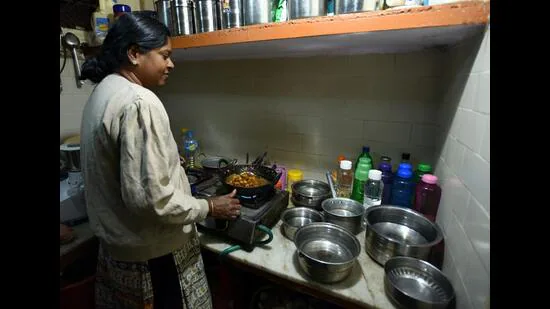
What is the value of a dead “homemaker”? On Thursday, a Supreme Court bench put it at ₹30,000 per month while adjudicating a case on calculation of compensation in a road accident case. The top court’s judgment might be the first institutional acknowledgement of the value of unpaid and unrecognised labour that “homemakers”—overwhelmingly women in India—perform.To begin with, the problem must be acknowledged as two-fold. The first is the socio-cultural baggage of burdening women with “homemaking” duties, a hangover from India’s pre-capitalist past. (HT Archive)The numbers that should disabuse us of undermining the importance of such work have been around for a long time. According to the 2019 and 2024 Time Use Survey (TUS) data collected by the National Statistics Office (NSO), women spent close to eight times the time spent by men performing household and care work. This affects their ability to do paid work. The latest Periodic Labour Force Survey (PLFS) data show that only 30.7% of women were working or looking for a job compared to 59.1% of men. This entrenched headwind against women’s economic activities also affects India’s overall fortunes. The latest World Bank data show that India’s per capita GDP deficit with China is 59%, while its per worker deficit is only 47%. China is not immune to its patriarchal voices, but it performs better on women’s participation in the workforce. A recent study by Azim Premji University economists found that women dropping out of the workforce strongly correlates with their getting married, perhaps due to their obligations to perform unpaid household work.What can India do to correct the gender imbalance between whose work is valued and whose isn’t, which impacts who gets to do more economically rewarding work? It has been a struggle to merely get the problem recognised; solving it will be even more challenging.To begin with, the problem must be acknowledged as two-fold. The first is the socio-cultural baggage of burdening women with “homemaking” duties, a hangover from India’s pre-capitalist past. Even though material realities have changed, the mental framework persists, resulting in a gross gender asymmetry in the distribution of household care work. Social, political, and institutional nudges are the only way around this. To be sure, nudges alone will not suffice. Employers, both government and private, must also be asked to make it easier for women to balance work and household responsibilities such as child-care.It is also important to accept that the problem is not purely a manifestation of a pre-capitalist patriarchal mindset confining women to the kitchen. Capitalism’s evolution has blurred conventional ideas around work and made it more difficult for women to seek work — (family) life balance. This is not just hearsay. The 2023 Nobel Prize awarded to economist Claudia Goldin, who has advanced the idea of “greedy jobs”— such as investment bankers and lawyers that pay well but require much higher working hours — was an important institutional ratification of this idea. As capitalism evolves further, greedy jobs might not be limited to the economy’s crème de la crème anymore. Think of a woman working on a gig-work platformthat pays more for longer hours worked or ability to be available when others are not.National fortunes can’t be advanced when half of the population faces discrimination anchored in tradition as well as markets. The Supreme Court’s judgment against discounting the value of unpaid household work is a good occasion to amplify this message. Our politicians, some of whom are going around announcing paltry monetary incentives for women to have more children, would do well to pay attention.
Why women’s household work deserves economic recognition
It has been a struggle to merely get the problem recognised; solving it will be an even bigger struggle
TL;DRAI
Supreme Court valued unpaid household work at ₹30K/month—women perform 8x more domestic labor than men, capping female workforce participation at 30.7% vs 59.1% male. Gender-driven labor imbalance correlates with India's 59% GDP-per-capita deficit vs China; requires employer flexibility and dismantling "greedy jobs" culture penalizing non-24/7 workers.
590 words~3 min read