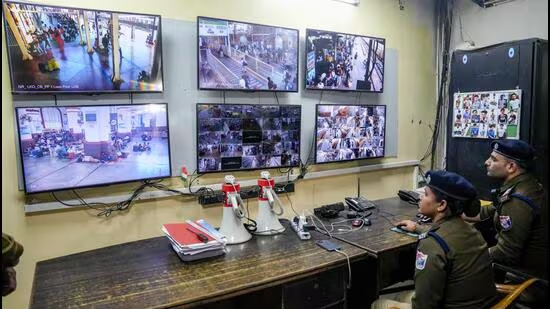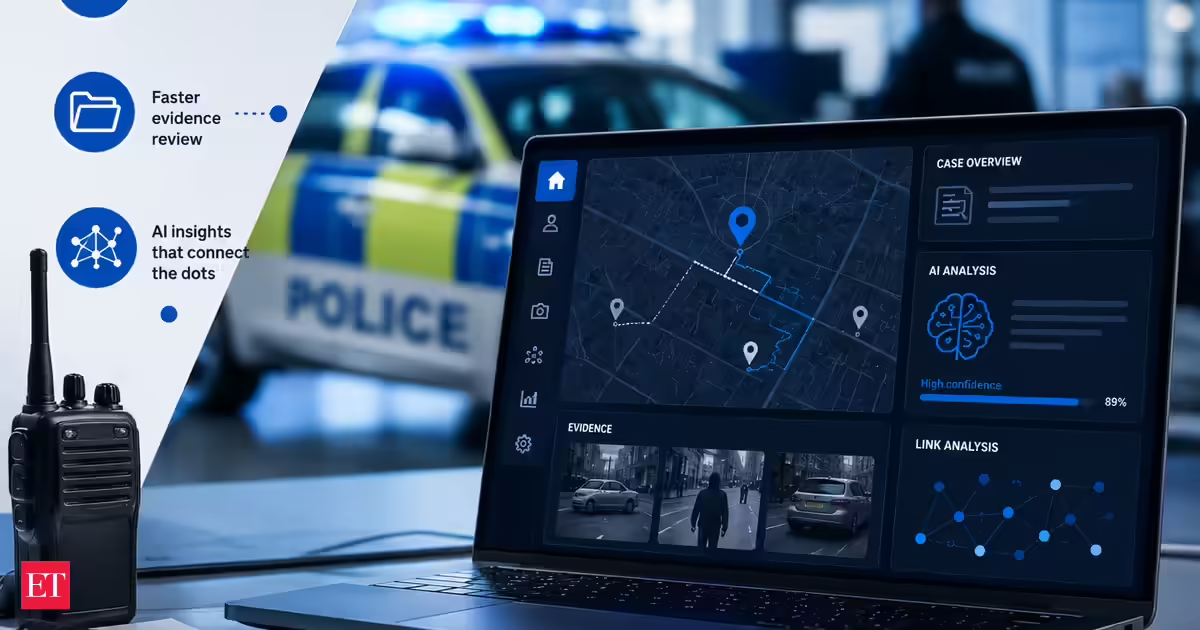
A police investigation today does not always begin with a chase. More often, it starts with hours of going through digital clutter. CCTV clips, phone records, messages and reports. Enough information to fill days of viewing before a case even begins to move. Now, artificial intelligence is quietly stepping in to clear that clutter, so officers can prioritize actual investigation over sorting data. In the United Kingdom, a national system called PoliceAI is being developed to bring AI tools into policing in a more organized manner. Rather than each police department trying different tools on their own, this system brings everything under a singular umbrella. The aim remains straight-forward: make investigations faster, smoother and more consistent across all regions. Early estimates suggest that this system could save up to 6 million working hours every year. To put that in simple terms, that is millions of hours that officers currently spend on office work, which could have been used for field investigations and public safety work. The centre, backed by a record £75 million over 3 years, will work across all forces to identify, test and scale AI tools that deliver practical results. It will act as a co-ordination point where different AI applications are evaluated and then introduced into policing workflows based on performance and suitability. PoliceAI is built around a set of operational use-cases that target the most time-consuming parts of policing work. One of the primary areas is digital evidence processing. This includes large volumes of CCTV footage, body-worn camera recordings, phone data and digital records that are usually reviewed manually during investigations. AI systems in these workflows are designed to scan long video files, detect moments of interest and flag sections that require human review. Instead of watching full recordings line by line, officers are directed to specific time-stamped segments that are more likely to be relevant to a case. Another core function is transcription and document conversion. PoliceAI will support systems that will convert the spoken audio which was recorded and collected, into written text. This includes emergency calls such as 999 and non-emergency 101 calls. These tools would reduce the need for manual note-taking and help standardize case documentation across forces.Alongside transcription, the system also includes summarization tools for case files and reports. This helps officers quickly understand case histories without reading full length reports repeatedly. PoliceAI also includes data linking functions across different systems. Police work often involves fragmented data spread across multiple sources such as call logs, crime reports, digital evidence systems and intelligence databases. The AI systems being introduced are designed to identify overlaps between these datasets.Early trials referenced by the government show the scale of processing improvement possible. In one case, around 800 hours of CCTV footage in a kidnapping investigation was reviewed in approximately 3 hours using AI-supported workflows, contributing to an early guilty plea. In another instance, large-scale digital datasets equivalent to half a million e-books were translated instantly, helping investigators process multilingual evidence in a serious organised crime case.The pilots for PoliceAI are scheduled to run through 2026 and 2027 before wider rollout across all 43 police forces. One of the key focus areas during this phase is audio and video redaction, wherein the AI will remove sensitive or private information from recordings before they are shared externally. If implemented across all forces, this capability alone is expected to save up 1 million working hours annually.PoliceAI will also support policing responses to AI-enabled crime. This includes deepfake content. A dedicated policing AI threat hub will be introduced to support detection and response capabilities in this area. The system will provide tools and training for officers to identify and manipulate digital content and handle emerging forms of AI-driven crime. Aside from investigative workflows, the systems will also support practical polishing areas such as retail crime and tool theft. AI tools will help trace ownership of recovered items, enabling stolen goods to be returned to victims more quickly. PoliceAI is also expected to become part of the UK's planned National Policing Service framework. As part of this, a public registry of AI tools policing will be published in partnership with CENTRIC (Centre of Excellence in Terrorism, Resilience, Intelligence and Organised Crime Research) at Sheffield Hallam University, offering visibility into how AI is being deployed across forces. The first version of this registry is expected by autumn. All AI systems under PoliceAI will undergo independent testing for accuracy and bias before deployment, ensuring reliability in sensitive use cases like evidence handling and translation while also checking fairness across different groups. These safeguards define the system’s final guardrail, keeping AI tightly monitored in use and firmly anchored to human accountability as it moves deeper into policing.Nominate now for ET Most Innovative AI Awards 2026Disclaimer Statement: This content is authored by a 3rd party. The views expressed here are that of the respective authors/ entities and do not represent the views of Economic Times (ET). ET does not guarantee, vouch for or endorse any of its contents nor is responsible for them in any manner whatsoever. Please take all steps necessary to ascertain that any information and content provided is correct, updated, and verified. ET hereby disclaims any and all warranties, express or implied, relating to the report and any content therein.
PoliceAI UK: How AI in Policing Could Save 6 Million Hours
PoliceAI UK is bringing AI into policing to analyse digital evidence, speed up investigations, detect deepfakes, and save up to 6 million work hours annually
879 words~4 min read