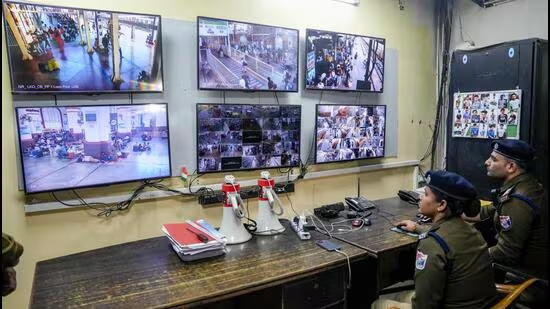
In a scene straight out of the Hollywood movie Minority Report, in April, UK’s Metropolitan police launched investigations into hundreds of police officers thanks to an AI tool. This tool, called Nectar and built by Palantir, US’s spy-tech company, is aimed to root out rogue policemen by sifting through internal police force data.RPF personnel monitor CCTV feeds at a control room in Lucknow. (PTI File)The AI software runs algorithms on existing internal data to spot patterns, anomalies and red flags. It looks for what doesn’t fit and it’s pretty good at it.Within a week of being deployed, the tool flagged hundreds of UK officers for violations -- from work-from-home abuse and misconduct to serious ones such as corruption and even rape. The AI tool highlighted officers who abused roster shifts for personal or financial gain, or those accused of misconduct in public office. Three officers have so far already been arrested while 98 officers are being assessed.The software deployment is part of UK police’s AI centre announced earlier this year. With a budget of £115 million (around ₹1480 crore), the AI Centre wants to adopt AI across 43 forces in England and Wales for fighting crime, centralising innovation, and robust testing. “Policing faces growing demand, complex digital crime, and sustained financial pressure,” said Alex Murray, the National Crime Agency Director, UK, in a press release talking about the software.The UK is not alone in implementing AI to fight crime. As Murray said, policing is increasingly complex. Digital and financial crimes are abusing porous borders and getting sophisticated with AI, while forces are facing budget pressures. Policing systems across the world from India, US to South America are trying out different ways that AI can help them become more efficient and root out more crime.Getting super-powered eyes The first phase of AI adoption by police in the West and in India was through Facial Recognition Technologies (FRT). These technologies which can run on top of CCTV feeds recognise faces and objects in a crowd. A policeman can ask AI to locate a man in an orange kurta, or a blue car in weeks of CCTV footage, reducing days of human intervention.The aim of FRT, which is still being implemented and getting better thanks to AI advances, is to react faster in an evolving situation or during crowd management. For Maha Kumbh 2025, Uttar Pradesh police used AI analytical software by Gurgaon-based startup Staqu Technologies Pvt Ltd to run video analysis on top of existing CCTVs to look for live incidents – overcrowded sections, fire, altercation – so they could react rapidly. Nashik, which is hosting Simhastha Kumbh Mela in 2027, held an AI strategy workshop with MIT and companies such as Meta, Google, Microsoft, and Indian startups to create a Kumbh AI stack that could process live feeds from 5000+ CCTV cameras, IOT sensors, surveillance drones and mobile networks simultaneously, to keep a track on the 12 crore people it’s expecting in its city.Solves the problem of plentyThis rapid, even forced adoption of AI, does feel a little like competition or FOMO, but it’s an essential need for policing in modern life. Thanks to a proliferation of recording devices in public spaces such as CCTVs, drones, bodycam, footage, forensic logs and digital proof like social media, the problem for the police is not a lack of evidence. It’s too much of it.It is not humanely possible to sift through the 5000+ CCTV cameras that Nashik will have during its Kumbh. AI, however, excels at wading through mountains of data.Increasingly, police departments are handing out all aspects of forensics analysis to AI, to build patterns, a method called predictive policing which identifies promising targets, crime hotspots for police intervention, even solves older crime.India’s fractured, state-specific policing systems are a challenge to this one big database of big data, which is why the Union home ministry is introducing an integrated Crime and Criminal Tracking Network & Systems (CCTNS 2.0). CCTNS 2.0, which is already being implemented, connects 17,000 police stations across India on a centralised online platform and is part of a larger initiative called Inter-operable Criminal Justice System (ICJS) which links police, courts, prisons and forensics in one data pool.Run AI tools on this massive data, and the home ministry hopes for more efficiency in predictive policing – find crime hotspots or high-risk individuals or manage live emergencies.Can AI be a good detective? Countries that have implemented predictive policing are already seeing surprising results in AI finding new leads and suspects in unsolved cases. In Anchorage, in Alaska, US, the police system adopted technology from Closure, a startup that searches large datasets for evidence and solves old cases. Its AI agent ran through the police’s jail calls, interviews, social media, photos and old case files to flag new moments, crucial messages, even in different languages.“There’s some cases where you have detectives listening to over 1,000 hours of jail call data to try to find a word, a phrase, a name, a threat, things like that,” said Police Chief Sean Case at the local Assembly in Anchorage Police Department, earlier this month. “When we tested the software, one of the things that we primarily used it for was throwing in jail call data.”In the last few years, there’s been a proliferation of AI startups who want to automate the labour-intensive tasks of real-time surveillance and analyzing massive police datasets. Closure is one, Longeye is another which offers something similar to Seattle’s police department. AI is the new detective that police forces have at their disposal – but only if you have a massive dataset on your citizens.Powering up niche departmentsA few months ago, Kerala Police’s Counter Child Sexual Exploitation (CCSE) team found a forum by the name of ‘Cheese Pizza’ on the dark web, linked to child sexual abuse material. They saw multiple photos of one child, who they suspected was from Kerala. Using an AI tool, Katalyst, developed by a New Zealand-based nonprofit Kindred Tech, they waded through volumes of photos and data points scattered across platforms, social media like Facebook, Telegram and Instagram, to narrow down a potential perpetrator. Within a few weeks, they arrested a woman in Thiruvananthapuram who was posting photos of her niece. “This problem was amplified by technology. We must use technology to fight back,” Ankit Asokan, SP Cyber Crime, Kerala Police, said during a press interaction, adding that a small team like theirs won’t be able to review or go through all this data manually.Tackling financial fraud Another place where AI is proving very useful is financial crime. INTERPOL launched Operation Shadow Storm in March which uses AI-driven data analytics to track money trails of global “scam centres.” In seconds after a transaction, AI case predicts where stolen funds will flow next and freezes these accounts across borders.India’s home ministry is working with IIT Bombay and RBI to use AI to identify suspect mule accounts – to counter financial fraud. The ministry wants to develop a model that runs real-time on financial transactions so banks can flag and stop potential fraudulent transactions. The tools it has developed identify suspected mobile connections through pattern recognition, real-time tracking of cybercriminals, identifies mule accounts and also monitors dark web and social media.The bad, awkward and ugly While AI can help streamline processes, even fish out tiny details in a stack of data, using it in policing can also lead to serious repercussions on civil liberty and rights – if badly done. Along with IIT Bombay, the Maharashtra government is currently building a ₹3 crore AI tool that will help law-enforcement agencies identify suspected illegal Bangladeshi nationals in the state analysing their speech patterns, tone and linguistic usage. Will this tool, created in Mumbai be able to differentiate between West Bengal dialects and pronunciation of those of Bangladesh? Or will this become another case of a badly implemented software, like in Minority Report?In Australia, police used CCTVs to auto detect if a person’s wearing a seatbelt or using their phone while driving. Based on it, the police issued 300 fines per day. Sixty percent of these AI-detected fines were overturned – especially phone usage as AI flagged wallets, glass cases or battery packs as phones.Potential misdirection because of the technology’s limitation is one thing, the other is surveillance and prejudice against citizens. In Minority Report, the protagonist has happily been using a predictive policing method called Pre-Crime (that uses mutants to see crime before they happen), to arrest citizens who might do a crime. He sees how wrong it is when the predictive policing pulls up his name.AI’s great, when used well, but badly created AI agents, based on faulty datasets, automation bias or even human prejudices, can lead to false positives and abuse .The author tracks the evolving relationship between science, technology and modern society. She also works as a philanthropy researcher and advisor.
Good bot, bad bot: What happens when cops get AI
Analysing massive data, predictive policing is rooting out corrupt officers, tackling child abuse and flagging financial fraud to help police departments worldwide fast track criminal cases. | India News
1,475 words~7 min read