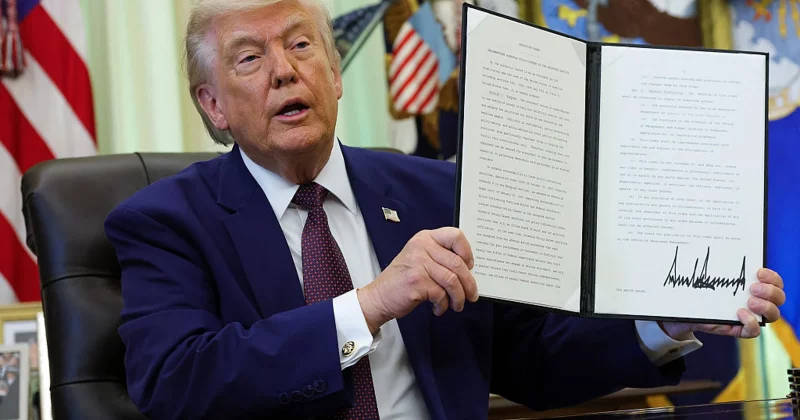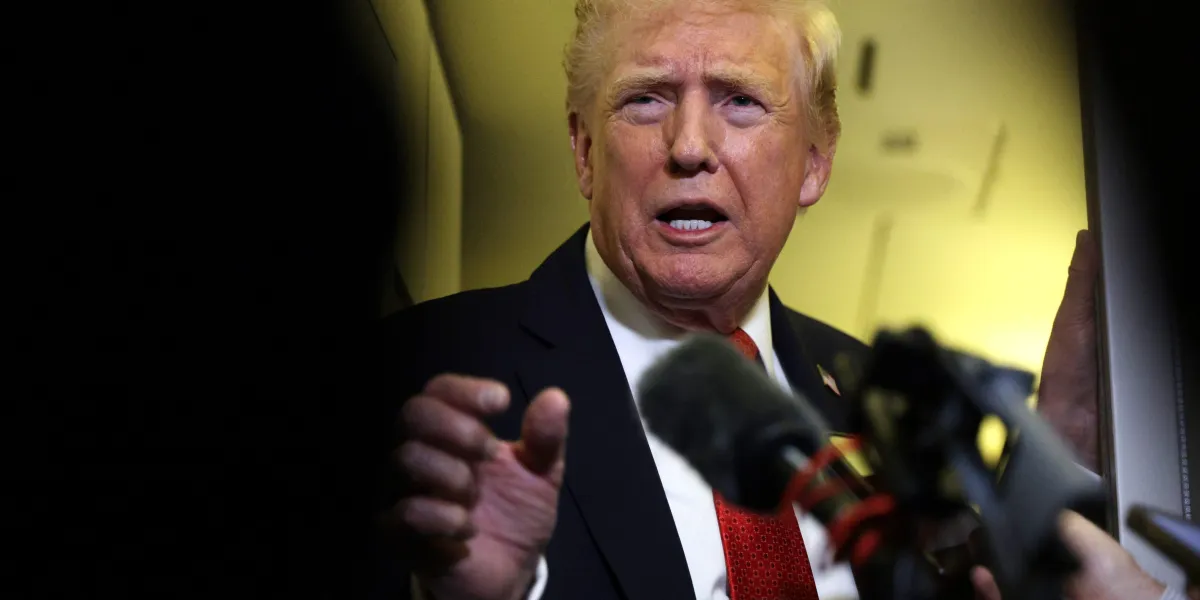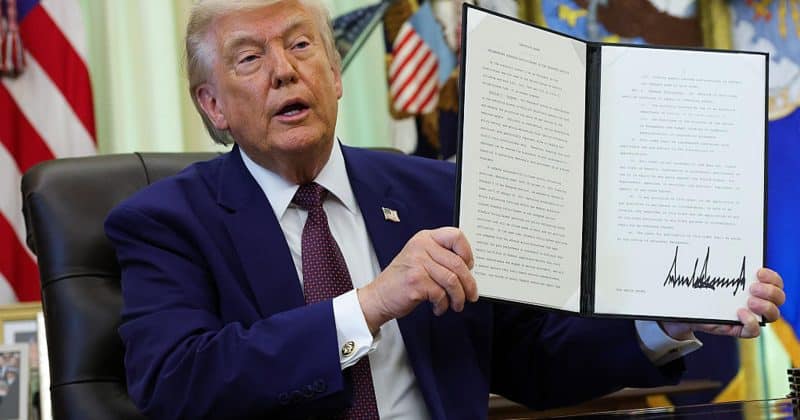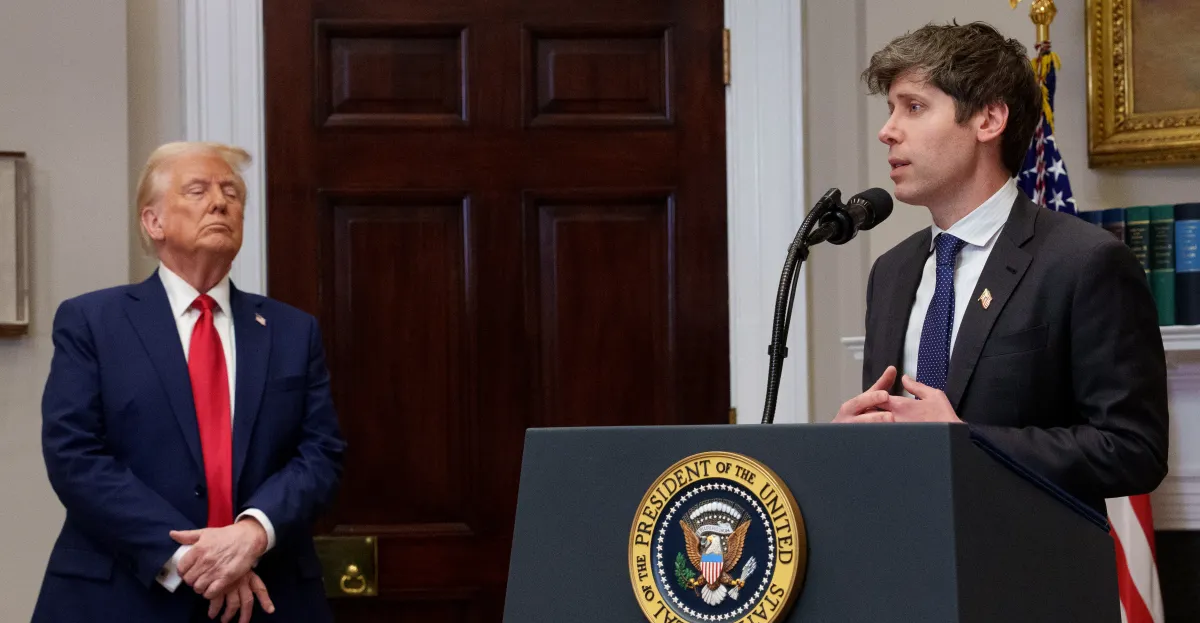
A new, bipartisan idea is taking Washington by storm: collective ownership of the means of production.Sort of, anyway.Last Friday, President Donald Trump announced that he would soon be meeting with the executives of top AI companies to discuss a financial “partnership.”“There are concepts where pieces [of these companies] could be given to the American public, where the American public essentially becomes a partner with the companies,” Trump said. “And by doing that, they’re going to like it better.”Key takeawaysPresident Donald Trump says the government may take ownership stakes in major AI companies and share the returns with the public — an idea pitched to him by OpenAI’s Sam Altman.Critics suspect OpenAI’s real aim is to insulate itself from regulation and competition by aligning its profits with the government’s interests.A broad, well-governed public wealth fund could genuinely help counter AI-driven inequality.But an informal deal between the White House and a few favored firms is more likely to breed cronyism than spread wealth.By this, the president (seemingly) meant that the US government may take an ownership stake in major AI companies and then distribute the fruits of its investments to the general public, perhaps through universal dividend payments.This proposal did not come to Trump via some undercover, socialist operative embedded deep within the White House — but rather, from the CEO of OpenAI.As NOTUS reported last week, Altman first pitched Trump on the concept in early 2025 and discussions between the administration and OpenAI have heated up more recently. No deal has been finalized. But talks have centered on an arrangement in which top AI labs voluntarily donate shares to the government — an approach that might enable Uncle Sam to partially nationalize the AI industry without Congress passing any law.Officially, OpenAI’s interest in effectively transferring wealth from its shareholders to Uncle Sam is public-spirited. The company maintains that advances in AI are likely to generate massive profits for top labs, while sowing wrenching disruptions through labor markets. Thus, to ensure that ordinary people “share in the upside” of AI-fueled economic growth, the company has called for the creation of a “Public Wealth Fund,” which would invest in “both AI companies and the broader set of firms adopting and deploying AI,” and then send a portion of the returns to every American. In other words, it would pay out a universal basic income (another popular idea in Silicon Valley).Yet many suspect OpenAI’s motives are more self-interested: By giving the US government a direct stake in its success, the company may be trying to insulate itself from stringent regulation or open competition. Moreover, whatever Altman’s intentions, skeptics argue that the government getting into cahoots with individual AI companies is a recipe for cronyism and conflicts of interest. (Disclosure: Vox Media is one of several publishers that have signed partnership agreements with OpenAI. Our reporting remains editorially independent.)These concerns seem well-founded. A narrow partnership between the federal government and select AI companies would plausibly do more to generate corruption than redistribute income.Yet there is a real risk that artificial intelligence will shift massive amounts of income away from workers and towards capital. And a highly diversified, scrupulously managed public wealth fund could help mitigate that hazard. Unfortunately, the Trump administration has evinced little interest in that approach to social ownership (or in scruples more broadly).Why is OpenAI trying to get itself nationalized?Companies don’t typically cook up schemes for reducing the value of their own shares. And yet, on its face, OpenAI’s reported proposal amounts to precisely that: If the company donates equity to the government, it will dilute the value of all its existing stock.This invites the question: What’s in it for them?There are multiple plausible answers. OpenAI may be trying to limit its exposure to regulation. In opinion polls, a supermajority of Americans express concern for where AI is taking their society — and support for more heavily regulating the industry.Turning every American into an OpenAI shareholder could theoretically reduce the company’s susceptibility to onerous new rules in a couple of different ways. First, doing so may simply soften the AI industry’s image and buy it some goodwill from the American electorate (Trump seemed to reference this when saying that his arrangement would make Americans like AI better).Second, such an arrangement would more closely align the public’s interests with those of OpenAI. After all, regulations that reduce the firm’s profitability would now also cut government revenue and/or, Americans’ dividend payments (such payouts might be small at first, but could become substantial over time, particularly if the government cuts deals with other major AI labs). Voters might be less inclined to protest a noisy data center if they think they’re directly profiting from it.Similarly, accepting partial nationalization could boost OpenAI’s odds of securing a federal bailout if its revenues do not grow fast enough to cover its debts (a scenario that some analysts consider quite likely). There is a long history of governments shielding state-owned enterprises from market discipline. Thus, the progressive economist Dean Baker fears that an AI wealth fund would “end up being a mechanism to shovel yet more money” at billionaires aligned with the administration.It is also possible that, by donating shares to the government, individual AI firms might buy themselves an advantage over their competitors. For its part, the Trump administration has displayed no shyness about rewarding businesses that curry its favor, and retaliating against those who do not.Indeed, the White House has already tried to sabotage OpenAI’s chief rival. In February, Anthropic refused to sign a contract that would have authorized the Pentagon to use its AI for mass surveillance and fully autonomous weapons systems. The Defense Department responded by declaring Anthropic a “supply chain risk” — a designation that would restrict the capacity of government contractors to do business with the AI company. If a federal judge had not blocked that move, it could have done serious damage to Anthropic’s business — while benefiting both OpenAI and xAI, which is owned by Trump megadonor Elon Musk.If the government took a stake in OpenAI but not Anthropic — or in all the major AI labs but not in more recent startups — the Trump administration might have further incentive to intervene on behalf of its favored firms.Separately, the White House could use a public wealth fund to unduly influence AI labs’ decision-making. The government’s shares could give it the power to vote on companies’ internal policies — or else, seek to deter certain decisions with threats of selling off the firm’s stock.These risks are amplified by the reportedly informal and ad-hoc nature of the public wealth fund being contemplated. Without congressionally authorized rules governing the fund’s management and investment decisions, the administration could have wide latitude to use its newfound financial power in self-interested ways.“It would be good for OpenAI to have every American underwriting them,” Samuel Hammond, Director of Artificial Intelligence Policy at the Foundation for American Innovation, told me. “But in America’s political context, we’re likely to get a corrupted version of a state enterprise that is used for personal enrichment and the partisan motives of whoever’s in charge.”The case for having a little communism, as a treatAlthough Trump’s (reported) version of a public wealth fund seems to invite more risks than benefits, this would not necessarily be true of all such funds.As a general concept, combating AI-induced inequality by increasing public ownership of corporations has much to recommend it.Artificial intelligence could greatly increase investors’ share of national income at workers’ expense: If companies replace much of their high-skill workforce with AI, their shareholders could reap the benefits, even as white-collar laborers lose their jobs and bargaining power.And if the technology truly takes off, generating an explosively productive economy run by software and robots instead of people, the AI giants could end up harvesting profits of mind-bending scale.At the very least, this is what a lot of investors are seemingly betting on. Despite myriad economic headwinds, stock prices are hovering near record highs, due largely to the sky-high valuations of AI stocks. Meanwhile, Anthropic and OpenAI’s impending initial public offerings are expected to be among the biggest in history, and Musk could soon become a trillionaire.The government could seek to share this wealth through traditional tax and transfer policies: If investors and tech firms are raking in cash, Congress can raise rates on capital gains, inheritances, and corporate income, then use the proceeds to fund more generous social programs or cash benefits for ordinary Americans.Conventional taxes are surely part of the solution. As an approach to redistributing business income, however, a public (or “social”) wealth fund has some advantages over corporate taxes.The corporate income tax applies only to the profits a company reports, which firms have considerable latitude and incentive to minimize. Large enterprises spend vast sums of money each year on finding innovative ways to defer or relocate their profits, so as to reduce their liabilities. The government then must dedicate its own resources to auditing these practices. This system not only enables corporations to weasel out of their obligations but also generates tremendous waste: All the skilled labor and entrepreneurial energy currently devoted to tax avoidance could otherwise be deployed towards creating actual value for consumers.A public wealth fund circumvents these problems. Suppose that, instead of taxing corporate profits at 25 percent, the government required each firm to hand over newly issued shares equal to 25 percent of its total stock. From then on, whenever the company paid a dividend or bought back shares, the government would automatically collect a quarter of the payout. With this approach, a business’s profits have nowhere to hide: A company can shift its earnings to a subsidiary in Dublin or a mailbox in Singapore. Regardless, if that corporation wants to reward its shareholders, Uncle Sam will get his cut. And even if the company hoards its cash, when its operations get more profitable, its stock will rise — and the government’s portfolio will gain value.Separately, a public wealth fund could have political advantages over traditional tax-and-transfer programs. Once voters get accustomed to the idea that they collectively own a share of their society’s financial wealth, dividends paid out of those assets may be seen more as an entitlement than a handout.The Alaska Permanent Fund is a case in point. In the 1970s, Alaska used royalties on its oil resources to seed a financial fund owned by all its residents in common. This year, it will pay out $1,200 to each Alaskan. Critically, despite Alaska’s conservative bent — and Americans’ general skepticism toward unconditional cash welfare — the permanent fund is overwhelmingly popular among Alaskans, and no serious effort has been made to restrict eligibility for dividends.“There’s this notion that we all own this,” Matt Bruenig, founder of the People’s Policy Project and a leading advocate for social wealth funds, said. “So, there’s this attitude of: Maybe I disapprove of you or speculate that you’re going to blow your dividend on a snow machine or whatever. But it’s not my business. It’s your money.”It’s possible that this consensus reflects the particular origins of Alaska’s fund: The idea that everyone has some entitlement to their state’s oil reserves — which no human being brought into existence — may be more intuitive than the notion that we all deserve a share of corporate profits writ large.Yet American companies’ value derives in large part from inherited technologies, knowledge, and institutions that no living person created — as well as public goods that all US workers and taxpayers help to sustain.And artificial intelligence may make the social origins of private profits more readily apparent: As Bernie Sanders recently noted, when AI generates useful code, images, or writing, it does so by synthesizing vast corpuses of data that humanity collectively produced.Granted, America would probably screw this upTo be sure, a broad social wealth fund would present some of the same risks as the rumored Trump-Altman proposal.Although a fund that invested in all corporations would be less likely to fuel government favoritism towards select firms or industries, such a policy would still align the government’s interests with those of corporate shareholders: Any new regulation that reduced the corporate sector’s profitability — whether by increasing its labor costs, environmental responsibilities, or some other mechanism — would simultaneously reduce the government’s revenue and potentially, voters’ dividend payments. Some on the left oppose social wealth funds on these grounds.And yet, the government already has a stake in corporate profitability: When firms earn less profit, they pay less in taxes. A public wealth fund might make this reality more apparent. But the alignment of interest between the state and corporate shareholders is inherent in capitalism. And democratic governments have nonetheless constrained businesses’ profits in myriad ways, for better and worse.This said, a public wealth fund would undoubtedly risk centralizing economic power and thus, abetting corruption: The government could theoretically leverage its status as a mega-shareholder to micro-manage the internal operations of private businesses. A world in which the Trump administration and its allies exercised influence over every corporate news outlet — rather than just some — would be less than favorable for democratic freedom.This threat is also manageable in principle. One approach would be to simply have the public wealth fund hold exclusively nonvoting shares, which would limit the government’s role in corporate decisionmaking. Another would be to establish transparent, technocratic, and bipartisan rules for how the public wealth fund will exercise its voice in corporate affairs, as Norway has already done for its own fund.Of course, many things are possible in principle but not in today’s United States. A rule-bound, universal social wealth fund might help ordinary Americans share in the fruits of AI-fueled economic growth. A voluntary partnership between the Trump administration and select AI firms, by contrast, seems more likely to help the president’s favorite companies limit their investors’ downside risks.If so, Trump’s wealth fund would be less of a bold reform for unprecedented times than a new spin on an age-old tradition: Socialism for the rich, capitalism for the poor.
Trump’s strange flirtation with AI socialism, explained
Uncle Sam and OpenAI may go into business together.
2,334 words~11 min read