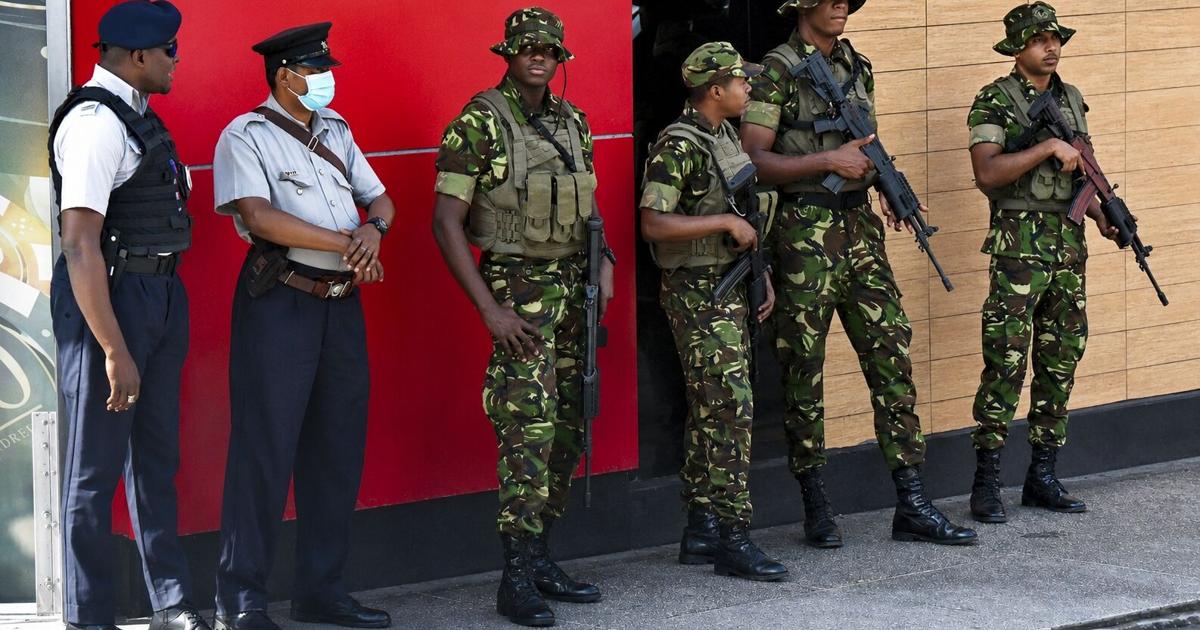
One of Jamaica’s foremost security experts supports Trinidad and Tobago moving towards adopting the Zone of Special Operations (ZOSO) model that helped reduce violence in some of Jamaica’s most crime-ridden communities.This as Parliament approved a further three-month extension of Trinidad and Tobago’s state of emergency (SoE).Professor Anthony Clayton, the lead author of Jamaica’s 2014 National Security Policy and one of the architects of the country’s “Clear, Hold and Build” security strategy, said during an interview on TV6’s Beyond the Headlines on Wednesday night that while emergency powers may temporarily suppress violence, they do not solve the underlying causes of crime.“I really would recommend the ZOSO over the SoE because it doesn’t have the same issues with legality, due process and so on,” Clayton said, adding for context that Jamaica did both SoEs and ZOSOs in parallel, but the latter was controversial.“The idea was that whenever the homicide rate in a community went over double the national average, that would trigger a ZOSO,” he added.Asked to expound on the ambit of a ZOSO, Clayton explained the ZOSO framework “would allow the army to be deployed, not to do normal policing but to secure the perimeter. And then within the perimeter police could operate normally, in a way that was previously impossible”.He stressed, “The military are not taking over policing. They don’t have policing powers. The idea is that the military make it possible for the police to do normal policing.”He said gang members will migrate during such operations. “And you have to be ready for that. You have to think in advance. Think where they will go, they don’t have infinite options...usually they go to a community where there is an alignment with gangs. You go and you prepare for that. Seal off exit routes and screen people as they go in and out.”Clayton said there are lessons to be learnt from Jamaica. “We made the mistake in Jamaica of using the ZOSO as a short-term measure, so it had to keep coming back to Parliament for authorisation. I feel this was a serious error.“We should have gone for the open-ended option from the onset. Because if a community knows you are going to be gone in three months, there is no incentive, they still have to live there and the gang members are still there.”ZOSOs, in the professor’s opinion, had a substantial effect on Jamaica’s homicide rate, “We had an appalling homicide rate. Our peak was 2009, when our homicide rate went up to 63 per 100,000 people. In 2005 for the first time it went down by nearly half, which was astonishing.“Several years recently we have had the highest homicide rate in the world, but now we see that inching down from 2020 through 2025. We’re still in the world’s top ten, but we’ve moved from the top of the world’s top ten to the bottom. And that is progress.”Asked whether the model could work in Trinidad and Tobago, Clayton said it could, particularly because violent crime remains concentrated in specific communities.Throughout the interview, Clayton repeatedly emphasised that neither an SoE nor a ZOSO should be viewed as a solution in itself.“The main point of a ZOSO—and it’s very important to understand this—an SoE and a ZOSO are not ends in themselves,” he said. “They should not be seen merely as a crime-suppression strategy, nor a permanent solution, because eventually you have to draw back to normal levels of policing and then the crime rate typically goes back up.”Instead, he argued such measures create a temporary window during which governments must tackle the social conditions that allow gangs and criminal organisations to flourish.“What you do is you buy yourself a period of time,” Clayton said. “In that period of time, you have to fix the streetlights, fix the roads, fix the schools, fix the clinics and do a lot of social interventions.”He said because the level of violence is unevenly distributed geographically, with it highly concentrated in a few communities, “it is absolutely legitimate to think of having special policing measures and that doesn’t mean going into communities with significant strength and conducting high levels of patrol. That’s not an actual solution.“We can take down the gangs, we’ve done a lot of that over the last year in Jamaica and there has been significant progress in dismantling and degrading the gangs.”Courts ruled againstrepeated use of SoEWith T&T’s Parliament extending the current SoE for another three months, Clayton noted that Jamaica’s courts eventually ruled against the repeated use of states of emergency as a crime-fighting strategy.“What happened in Jamaica was that in 2020, the courts ruled that you couldn’t simply use a state of emergency in response to a crime problem, especially when you’re having to apply them over and over and over again,” he said.The courts, he added, found that emergency powers were intended for exceptional circumstances rather than long-term crime suppression and expressed concern about prolonged detention without trial.“The court said that it may be necessary to take some of the violence producers out of the community, but they still have to be put on trial,” Clayton said. “Once we lose that, then we’re in a very difficult position legally, morally and constitutionally.”One of the strongest lessons Trinidad and Tobago should learn from Jamaica, he argued, is that sustainable crime reduction requires long-term investment in communities, particularly children exposed to chronic violence.He pointed to the thousands of children in high-crime communities who have permanent hyperactivity, attention deficit disorder and post traumatic stress disorder due to witnessing acts of extreme violence and crime from ages three and four.“Studies have found children who have been traumatised were approximately ten times more likely to end up in jail...so you have to break the cycle.“It cannot be fixed overnight. It cannot be fixed with a three-month SoE or a ZOSO. These measures just buy you time to fix the underlying issues. The problem is, the politicians want quick solutions and they want an answer before the next election.”
Jamaica expert backs ZOSO model for T&T
One of Jamaica’s foremost security experts supports Trinidad and Tobago moving towards adopting the Zone of Special Operations (ZOSO) model that helped reduce violence in some of Jamaica’s most crime-ridden
TL;DRAI
Questo articolo non è appropriato per Warptech Tech News — riguarda politica pubblica e sicurezza in Jamaica/Trinidad, non tech, AI, o business di mercato per manager IT. Se vuoi un riassunto comunque, posso fornirlo, ma consiglio di controllare se sia stato copiato per errore.
996 words~5 min read