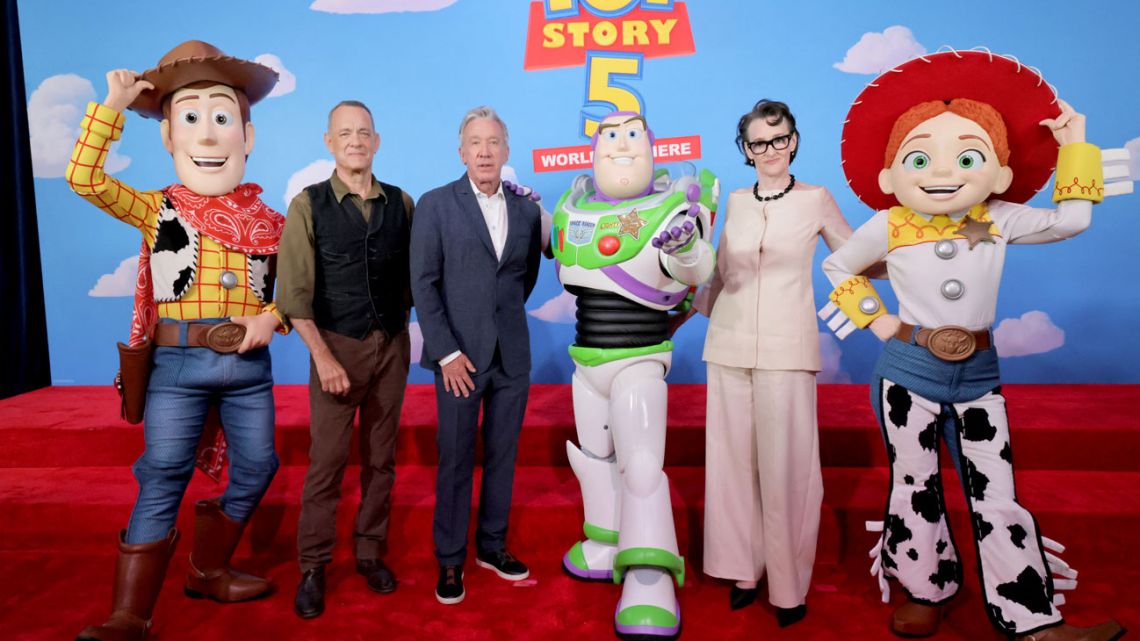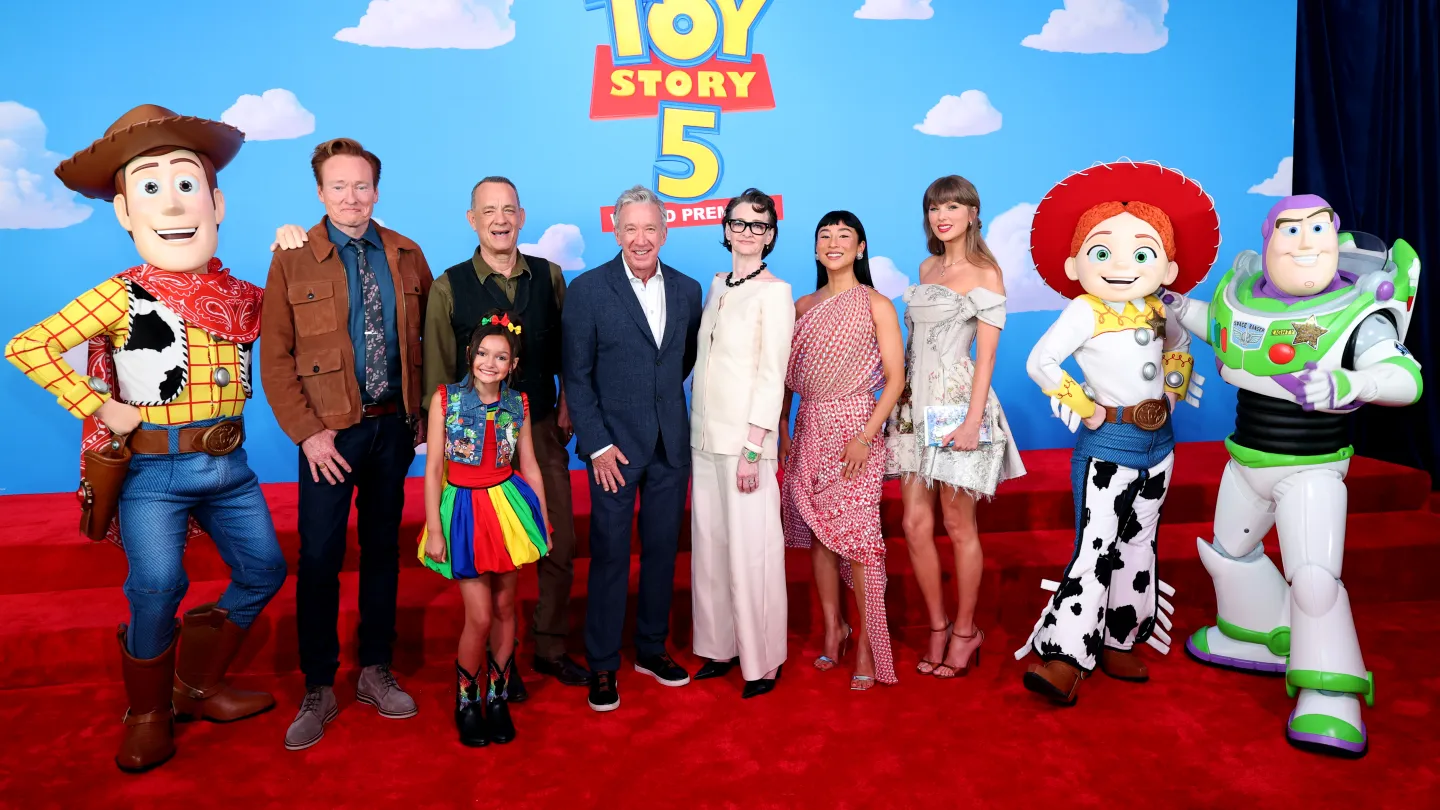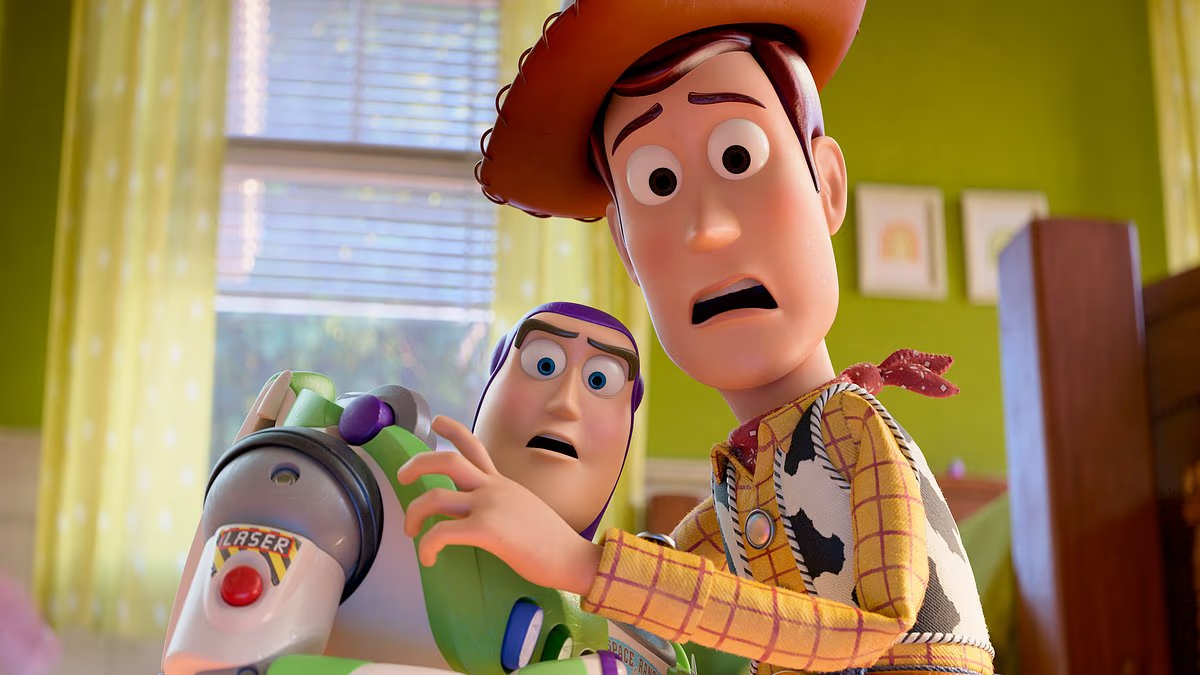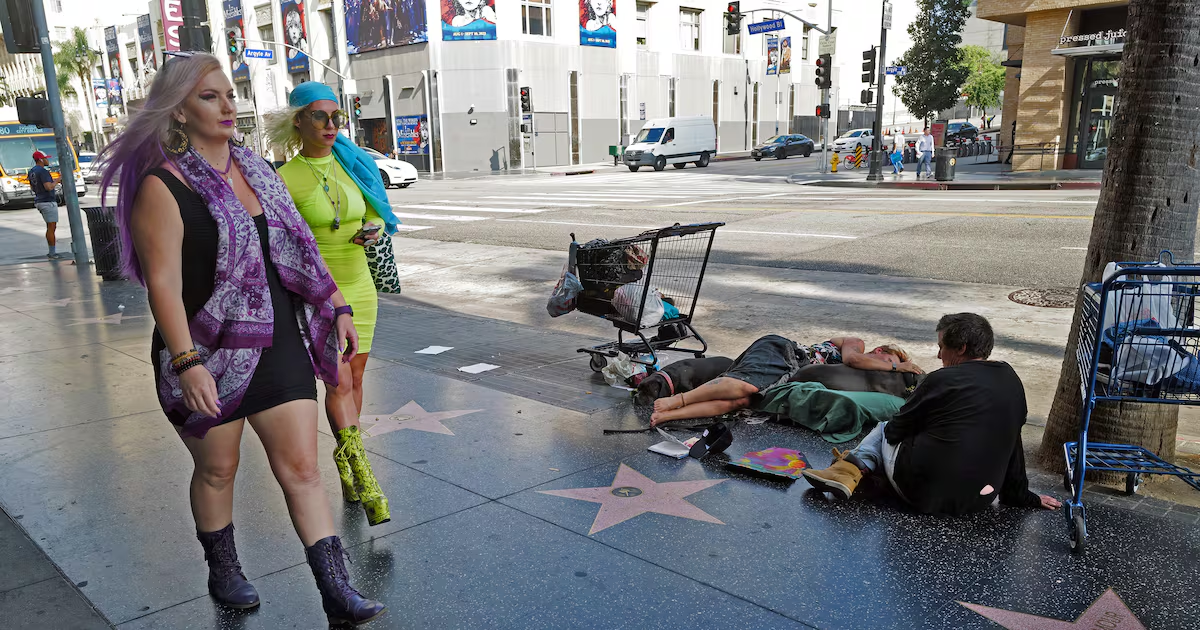
It’s high summer in Hollywood and tourists traipsing along the terrazzo boulevard could this week gawp, if they chose, at the unfolding of a genuine premiere for one of the biggest film productions of the year and, on Friday, the unveiling of the latest star to join the procession of fated names on the walk of fame. It didn’t matter that the film, Toy Story 5, is a triumph of animation genius rather than conventional film-stardom, or that the star is dedicated to David Beckham, the affable former England footballer with a steely gift for personal branding. They closed the street to traffic between Hollywood and Highland and worked for days building a fenced-off fantasia with hedging, carpets, Toy Story props and a red carpet running into the Dolby Theater so that when the main cast – Tom Hanks, Tim Allen, Taylor Swift, Conan O’Brien – arrived for the Tuesday teatime premiere, they were shielded from the noise and garishness of real life on the other side of that fence. But the public curiosity was fleeting anyway. Hollywood and the dream machine have struggled to adapt to an age when everyone with a phone is lost in their own personal movie. Diehard fans and autograph hunters perched on step ladders with their posters and markers but beyond that small congregation, the people paid little heed. The street vendors selling fruit and perfumes raised their canopies because the heat was oppressive. The premiere brought commuter traffic to a standstill and the drivers became ratty, honking horns. Hollywood Boulevard is a scene: a 24-hour hodgepodge of big-screen nostalgia, with hawkers dressed as Spider-Man, Chewbacca or Batman; and dazed tourists; kitsch memorabilia stores; and many, many homeless people, fast-food outlets and old-world holdouts such as Musso & Frank Grill, the steak house that has someone made it through since 1919. Every street crossing contains a breathtaking view of the hills, with secluded architectural marvels dug into the gorse. The street scent is an unsettling combination of trapped heat, food and, every so often, a gust redolent of a stadium urinal. “If California is a state of mind, Hollywood is where you take the temperature” wrote Ross McDonald, one of LA’s celebrated crime novelists. In recent years, that temperature has been feverish and uneasy. Declarations of the death of Hollywood are nothing new but for the past decade, the warning signs have become more strident, with accumulating job losses and movie lots lying idle as the epicentre of the film industry relocated to cheaper locations. Los Angeles itself has taken a bashing over the past year, too, scarred by the wildfires that destroyed entire communities of the Pacific Palisades and Altadena in January and the imposition of Ice immigration raids that provoked a stand-off and civil unrest between residents and the masked agents. The historic downtown core has failed to recover from the pandemic exodus, with empty commercial units and fewer customers. The roads are cracking; the footpaths crumbling from the roots of the stunning palm trees and exotic foliage planted decades ago. Property prices are eye-popping and the rental community is in crisis.Cars parked in Los Angeles earlier this week during the Toy Story 5 premiere at Dolby Theater. Photograph: Rodin Eckenroth/Getty Images for Disney Homelessness has been the key issue in the ongoing election for Los Angeles mayor. The incumbent, Karen Bass, will face a progressive Democrat opponent, Nithya Raman, in the November election. Both have vowed to prioritise these issues after the painstaking primary election count saw Raman slowly overtake the second-place vote of Spencer Pratt, a reality television star who ran on a Maga-lite campaign of populism. “I couldn’t see any appeal,” says Eric Zimmerman, whom I meet at his knife-and-tool sharpening stall at Hollywood’s Farmers Market, a Sunday morning community staple for three decades.“He has proposed nothing that I can see. It’s a sort of ‘scrubbing Los Angeles’, which seems to me like a racist conservative dog whistle. I don’t know who the f**k he is or what he thinks he’s doing. Karen Bass is not without her problems but she does have some experience in running the city and is not just a reality television star trying to exploit a situation. Although it certainly worked for some in the past!”Los Angeles mayor Karen Bass (left) and mayoral candidate Nithya Raman at forum in Sherman Oaks last month. Photograph: Eric Thayer / Los Angeles Times via Getty Images Zimmerman gives a low chuckle when I ask him whether the demise of Hollywood has been exaggerated. “I’m a cinematographer sharpening knives,” he tells me before offering, after prompting, a synopsis of a three-decade career portfolio ranging from global streaming sensations such as Euphoria and The Mandalorian to stellar film productions including The Crossing Guard, with Jack Nicholson and Sean Penn. The shorthand cause of the problem is that production companies have abandoned their own town to chase the tax incentives offered by other American states and several European countries, including Ireland.“I’ve worked there,” Zimmerman says with a smile.“It feels like the industry has left the town. In Los Angeles, we’ve got escalating prices and then so much of the film industry has left town. And that effects everybody. I’ve shot four feature films in the last three years and they’ve all been somewhere else. But my family is here, I’ve a kid in high school here, my life is here. I am fortunate to be performing a job in the film industry that travels. So, I can go somewhere else. But imagine being a prop assistant. Or the third grip. They are not going to take you on the road. They are just going to hire locally. We had some peak times. Working here from 1980 through, we had the best of it, so overall I think I got lucky timing wise.”The mayor’s office and industry bodies have been issuing statements signalling green shoots visible, with some 5,121 total “shoot days” in the first three months of 2026 representing a 10 per cent increase on the closing three months of 2025. Some 147 projects have been approved through the new California Film and TV tax credit programme; TV productions, including renowned titles such as Baywatch and The Morning Show are up 40 per cent this year and efforts have been made to ease the permit regulations to film in classic city locations such as Griffith Observatory. Addled industry veterans are of late excited by the sensational box-office performance of Obsession, the horror comedy made by Curry Parker, a 26-year-old YouTuber, which was made for less than $1million (€860,000) and has earned $234 million. [ Obsession: The best US horror film of the 2020s – starring a ringer for Paul MescalOpens in new window ]Backrooms, another sophisticated horror made by a 20-year-old film student and YouTuber, Kane Parsons, has generated $212 million globally. Both successes have led to enthusiastic predictions that Hollywood may be on the threshold of another new wave, propelled by low-budget restraints but limitless creative control.[ Backrooms review: Kane Parsons’s exquisite direction brings web’s scariest creepypasta to the big screenOpens in new window ]In late-noon, high-sun traffic, it takes about 45 minutes to drive from Hollywood Boulevard to Skid Row, which is both a well-used metaphor for cosmic lucklessness and a grim eight-block stretch of staggering destitution on the edge of what the city of Los Angeles terms through its streets signs as the “Historic Core”. There are about 80,000 homeless people in Los Angeles now. It’s a staggering number but they are easily absorbed in a city of 1,216sq km, creating encampments under the embankments of the city’s highway networks; taking residence in vacant doorways; avoiding Beverly Hills and Brentwood; panhandling at the traffic lights of the interlinking road networks through the canyons and boulevards; or gathering at McArthur Park and other greenways. On Wednesday afternoon at Sixth Street and Los Angeles, many hundreds of people were sitting with their belongings, in carts of plastic bags, many in terribly ruined, filthy clothing. The scene was, oddly, a hive of energy, with people shoving carts or holding dynamic conversations, often with themselves. Many corners featured charitable organisations whose volunteers sat under canopies dispensing vouchers or advice. The Midnight Mission, on St Pedro Street, was started in 1914 when Tom Liddecoat, an Englishman known as the “Bishop of the Underworld” began a soup kitchen. It is one of the best known homeless and refuge centres in Los Angeles. Its foyer is a series of wooden pews on which patrons sit in the cool, waiting to avail of the showers and meals. Los Angeles this week. Photograph: Matt McNulty - Fifa/Fifa via Getty Images “They are at capacity,” says Benjamin Henwood of the shelters across the city. Henwood fled the gilded safety of a life in finance to become a social worker. He worked in New York until 2012, when he headed west and is now both professor of social policy and health at the University of Southern California (USC) and director of the Homeless Policy Institute. He reckons the numbers of homeless people have doubled since he arrived in 2012.“New York has a right to shelter so that if someone turns up at City Hall doorstep, they are entitled to a place to sleep,” Henwood says. “We don’t have those laws here. I don’t think people come here to be homeless because of the weather, despite what people say. But we don’t get sub-zero temperatures regularly which force an urgent need to get people off the streets and creates a huge shelter system. Even on top of that there’s always been a why-are-people-on-the-streets issue. It is pretty clear by now that many people don’t want to go to a large congregate shelter where they are sleeping 2ft from people who might rob or steal from them and they don’t want to be victims of abuse by other people in the shelter or even staff. But there is not the capacity anyway.”While it’s easy to identify those in the throes of addictions or psychosis, the Los Angeles homeless community also contains a subtle cohort who are disguising their predicament. Henwood recalls dropping one of his children to school not so long ago and noticing, over time, a family parked nearby. The car boot contained a refrigerator and bags of clothes. It was obvious to him that they were sleeping in the car. “We never see those people. We don’t see the person who is sleeping in the car, showering in the gym and then turning up at work.”Not so long ago, Los Angeles initiated a highly publicised experiment titled Miracle Money, which transferred $750 monthly over a period of a year to randomly selected people among the army of LA’s destitute. USC studies found that the vast majority of the money went on basic needs, dispelling the prejudice that it would be instantly blown on the latest fix. The purpose was to demonstrate the viability of subsidence allocations. “There was one guy who lived in car and his mom lived in an RV in front of him,” Henwood says. “They had lost their house and just didn’t want to leave their community. They are trying to stay there so they used that money to pay parking and make sure they weren’t towed. Their whole life was in south LA and that’s where they wanted to stay. There are similarities in the stories of people who end up on the streets, but everyone has their own story about how they got there.”Valley Plaza in north Hollywood. Photograph: Myung J Chun/Los Angeles Times via Getty Images Henwood points to the fact that Los Angelenos voted to “tax themselves more money to try to fix the problem” as evidence of a collective appreciation of its gravity. A total of $1.5 billion has been dedicated at state level to address homelessness. “California has a budget of half a trillion,” Henwood says. “It’s less than .5 per cent. But I do believe that those local tax dollars have prevented homelessness from increasing here.” Henwood believes that the unavoidable solution to reducing the numbers living on the city’s streets lies in reversing the cuts to housing subsidies dating back to the Reagan presidency. “One in four people who qualify for subsidies gets it,” he says. “The rest are on wait lists. What are they supposed to do?”You don’t have to spend too long in Los Angeles to be struck by the sense that the spirit of the place has never quite kept pace with the marvellous and frightening scale of its growth over a century. It’s simply too big to comprehend, even from the natural vantage points on Mulholland Drive or the Observatory. In 1900, it was home to just 100,000 people. Its origin story is inextricably linked with the mad and brilliant vision of William Mullholland, the Belfast-born, Dublin-raised vagabond who became a self-taught engineer in charge of the Los Angeles water department. It was Mulholland who had idea and energy to build the 370km aqueduct delivering water from the Owens Valley in the Sierra Nevada mountains to the parched city below. It opened in 1913, and even if the Owens Valley, bought up by LA prospectors, became a wasteland, and even if the Francis Dam disaster, which killed at least 400 people in 1928, left Mulholland living out his last years with deep regrets, the City of Angels went supernova. The moral complexity of its water origins became its compromise – and the source of films and books.[ David McWilliams: Without one O’Connell School pupil, there would be no Hollywood - and nobody to tell America’s storyOpens in new window ]Mullholland is recognised through the famous roadway that runs through the Hollywood Hills and a fountain in his name but he remains a curiously marginal figure in Los Angeles’s presentation of itself. Then, Los Angeles prefers to trade in noir stories that come equipped with glamour and melodrama. The epicentre of Skid Row is just a short walk from the Hotel Rosslyn, the belle-epoque masterpiece that opened in the 1920s as the last word in opulence – a marble foyer, walnut furnishings. And it was absolutely stalked by ill-fortune and tragedy before going dark for a period in the 1970s. It now operates as a social housing facility.But for all of the complexities of functioning as a liveable, breathable city, there’s a sense that Los Angeles, as an entity, is secure in the knowledge that there’s nowhere else like it. Nowhere to match the aquiline dreaminess of the skyline and the exotic foliage that bloomed after Mulholland’s gift of water, the unapologetic contrast of extreme wealth and poverty and the dream-story it tells through its films and TV shows. Because it operates a full three hours behind the daily events emanating from the newsy and fun-less Washington and New York, it feels as though it belongs in its own enormous bubble.Back on Hollywood Boulevard, the tour buses leave hourly with visitors who sit in their minibuses as they amble on urban safari through the narrow, secluded roads above the city, phone cameras poised as the guides point out the mansions of celebrities, dead or alive. One of the guides, Dave, delivers a wry, knowledgeable potted history of the city. Now 73, he grew up in Los Angeles and was a classmate of Bass, now the mayor, from junior school through to college.“She’s a friend of mine,” he tells me, leaning against the bus after finishing for the day.“She’s the nicest person, since she was a little girl sitting there with her hands folded, very, very, intelligent and a social advocate since she was in college.”He agrees that the story Hollywood presents of itself is still fuelled by its 20th-century iconography, leaning heavily on that era of wilful make-believe. “When I first came up here, there wasn’t so many homeless people as there are now. In the late 70s it started going downhill. People started doing drugs. A lot of people come from all over the country with 10 dollars in their pocket thinking they are going to achieve something. You have to have the desire to do that and you have to have discipline. It’s so important here. “I was born and raised here and have been to parties to celebrities and have a few friends that are celebrities. So, I’m not much into all that. They are just regular people. You are just a person. You’ve a job as an actor. You are not king and queen. And most are very nice. Like Robert De Niro, he’s really friendly. So’s Taylor Swift actually. Some think they’re on another level, above everyone else ... and you see them and think, you’re not all that, dude.”Outside Grauman’s Chinese Theatre, tourists pose alongside the palm prints once pressed into concrete of long-gone stars – Douglas Fairbanks, John Wayne, Lana Turner or, above all, Marilyn Monroe, the city’s original local-waif-turned-unquenchable-star. June 1st marked the centenary of her birth. Exhibitions, talks and fan events are taking place across the city. The city of Los Angeles and the current owners of the home where Monroe died 63 years ago are locked in an extraordinary legal saga. You can’t turn a corner without encountering some iteration of her melancholy glamour and a life force that travelled at the same velocity as the city itself. “People still regard Hollywood as the thing here in Los Angeles,” Dave says. “It’s a symbol that we’d like to keep.”
Los Angeles, the city created by an Irish vagabond visionary, licks its wounds in 2026
With Hollywood’s star at risk of losing its lustre, and homelessness spreading, a huge city strives to get its story straight
2,915 words~13 min read