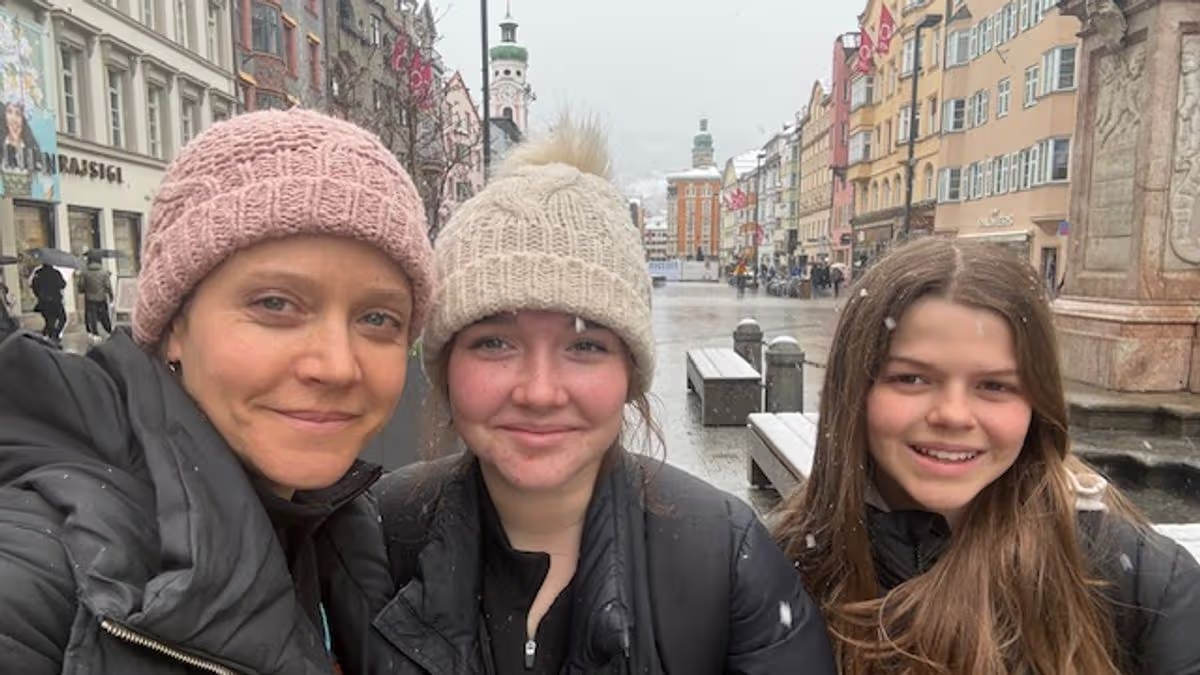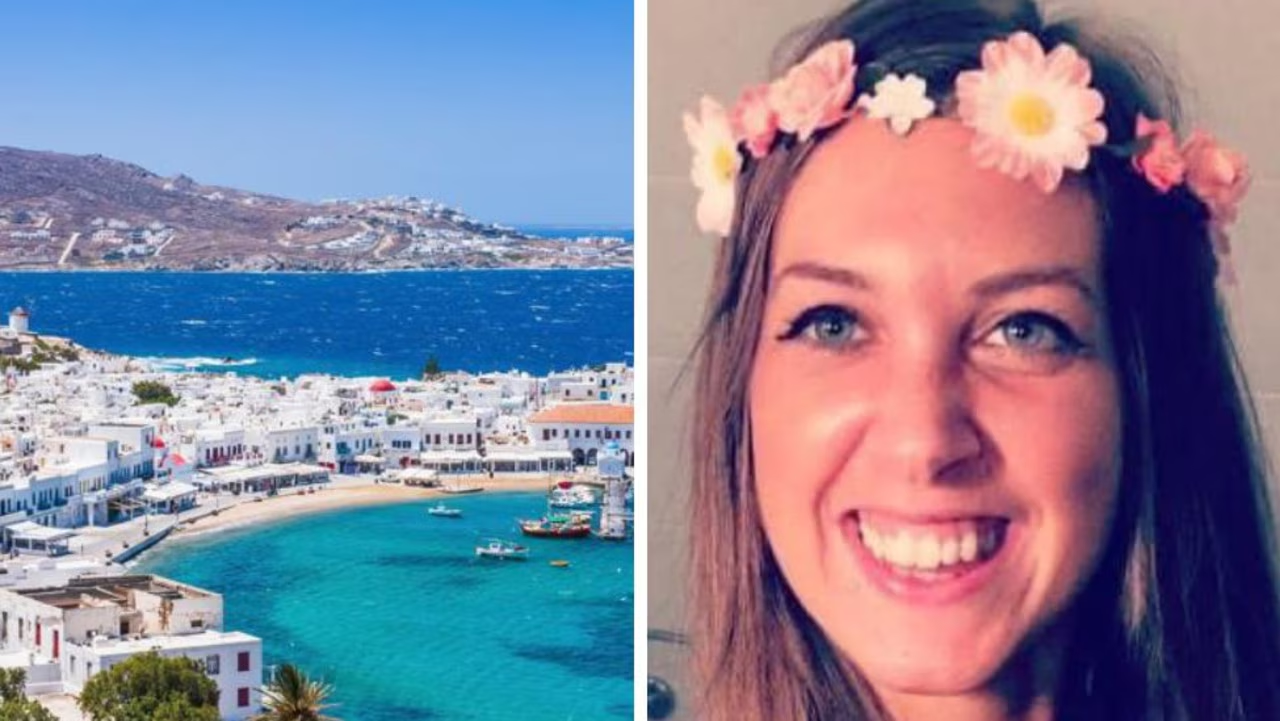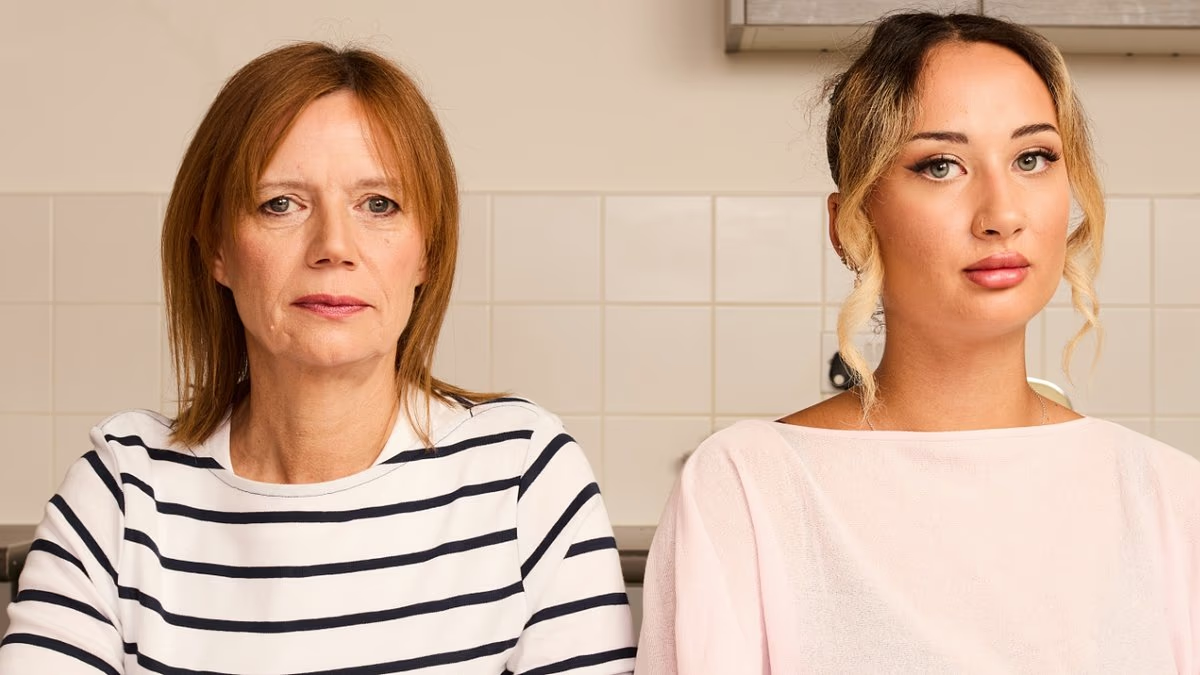
One morning in June 2022, Helen Pimm reached for her phone and opened the family tracking app Life360 to check on her daughter.Anna-Lena, 18, was in Crete celebrating the end of her A-Levels with three girlfriends from her Cambridge sixth form college. This was her first holiday without a parent so Helen was understandably anxious – and Anna-Lena had been happy to share her location details with her mum.‘I really wanted this to be a good experience for her,’ says Helen, now 55, an early years teacher. ‘Anna-Lena had worked so hard. I’d done my bit, helping with the flashcards.’ (Indeed, though they didn’t know it then, Anna-Lena had aced her exams with two As and a B.)‘I was worried too, of course – I’m a mother!’ says Helen, who also has a son two years older than Anna-Lena.‘I’m not a helicopter parent but I did have the family tracking app and I’m always hyper aware of what’s going on in their lives.’To her alarm that morning, the app showed that her daughter was in a Greek hospital.‘I immediately rang her,’ says Helen, ‘but she lied, and told me that her friend had tonsillitis. She said they’d probably have to stay out there a bit longer.’It was a short conversation – and to this day Anna-Lena has no memory of it. In truth, she was alone, in hospital, in deep shock after being brutally raped by two strangers on a deserted beach. It was everything a mother fears for her daughter, and more. Helen says she is 'not a helicopter parent' but does 'have the family tracking app' and is 'always hyper aware of what’s going on in their lives' Anna-Lena and her mother celebrating after the rapists were finally sentenced following a difficult legal ordealIn the years ahead, their fight for justice in another country, in another language and entirely different legal system, would involve three return trips to Crete and two emotional, exhausting, tear-filled court cases.It has also cost them every spare penny they had – Helen is still paying off the debt. Only now, with Anna-Lena’s attackers serving maximum 20-year sentences, can they start to put it behind them, and think about moving forward.Speaking exclusively to the Daily Mail, their story is a stark warning for the thousands of families whose 18-year-olds have finished their A-Levels and are now heading off on holiday with friends for the first time.‘The first two days had been fun,’ Anna-Lena tells me. ‘We’d met lovely people, gone to the beach, the pool, the bars – just standard holiday things.’In the early hours of their final night, Anna-Lena and three others had gone down to the empty beach, where Anna-Lena became briefly separated from them.She had returned to the deckchairs where she’d left her belongings when someone shoved her hard from behind. She laughed – thinking it was one of her group – and ran further down the beach. She was shoved hard twice more.‘I finally turned round and realised it was two people I’d never seen before,’ says Anna Lena. ‘My heart just sank to the floor and I knew in that instant I needed to escape.’These two men, both in their 20s, had been by the deckchairs the whole time – one of them was paid by the hotel to look after them. They’d been sitting in the darkness quietly watching the group.‘They’d been waiting for the split second I was by myself,’ says Anna-Lena. Now, with no one else in sight, she struggled to escape.‘They pulled my legs from underneath me, pushed my head in the sand. At one point, they tried to lock me in a changing cupboard.’ Finally, she stopped fighting. ‘I realised it was two men against me, I wasn’t going to be able to fight them off,’ she says. ‘I thought I was going to die in that moment. I told them: “Do whatever you want as long as I can leave alive”.’The men took it in turns to rape her. Anna-Lena has no idea how long the ordeal lasted. Finally, they walked her back up the beach. With blood and bruises all over her body, her face swollen and covered in sand, she ran into the road, screaming and crying.The street was deserted except for a young woman in the distance on an electric scooter who came to help. That woman turned up at all subsequent court cases as a witness. The police were able to identify the two men and arrest them within hours, then Anna-Lena was taken to the hospital. ‘I was in a state of shock and in so much pain,’ she says. ‘I was given IV drips and injections and no one was telling me what any of it was for. I was told to get naked and lie down while they took pictures of me – there were about six people in the room, all men.‘The DNA swabs were taken by a man, in a room full of people. I just felt so vulnerable.’Though Anna-Lena can’t remember speaking to her mum on the phone, she knows why she didn’t tell her what happened.‘I knew she’d fly out to Greece, just to be here for a day, and there was nothing she’d be able to do to help,’ says Anna-Lena. ‘Realistically, all I needed was to get this over with and leave.’ Three days later, flying home with her friends, Anna-Lena remembers crying on the plane.‘My whole life had changed,’ she says. ‘I was almost scared to go home. I felt that from then onwards, all people would see when they looked at me was “the girl who got raped”.’W hen she got home, she told her mum the barest outline. ‘Telling mum was the hardest thing because I knew it was going to cause her so much pain. She screamed, she was wailing.’Helen can’t recall that reaction at all. ‘I only remember that I just couldn’t absorb it, I couldn’t take it in,’ she says. ‘Anna-Lena only told me that she was raped – I didn’t want to pressure her for details. We didn’t know the full story until the court case.’‘As soon as mum knew, she dealt with everything to do with the case,’ says Anna-Lena. ‘I didn’t do anything. I couldn’t. I was so disconnected from it. I didn’t want to speak about it. I was scared that what happened had been so bad, if I actually let it infiltrate my brain, there’d be no coming back from it. My coping mechanism was to pretend I was completely normal, the same as my friends.’She stayed busy, went out a lot and started her Art Foundation course in Cambridge as planned.Preparing for the court case Helen learned that Anna-Lena had to be represented by a Greek lawyer and that it would happen in Crete. While legal aid was freely available to the rapists – who had top lawyers – it would be extremely difficult for Anna-Lena, a British tourist, to access.‘We needed to raise £8,000 for legal fees,’ says Helen, ‘and I just kept trying to find ways to find money.’ Although she had a full-time job running a nursery, she also raised the money by working out of hours as a massage therapist, and also rented out the bedrooms used by Anna-Lena and her brother. (They stayed with their dad, who lived close by.) She borrowed the rest from a cousin.One year later, in July 2023, Anna-Lena, both her parents and two family friends flew back to Crete for the trial.Although the men had confessed to the rapes when they were arrested, they had now changed their pleas to not guilty. They claimed that everything that had taken place on the beach had been consensual.Anna-Lena had just one 30-minute meeting with her Greek lawyer before the case. It was all they could afford. He gave Anna-Lena her initial statement and asked her to read it out loud, warning that she couldn’t leave anything out. It had to be as detailed and graphic as possible. So there, in his office, in front of her parents, she read her account.‘It was the first time I’d heard exactly what happened,’ says Helen. ‘I was crying my eyes out.’The trial was an ordeal. Anna-Lena was forced by the defence to give her gruelling account twice because they claimed there had been translation problems. Her attackers were half a metre away from her – there were no screens to protect the victim, no possibility of giving ‘video evidence’.The defence’s cross-examination was worse than anything she’d imagined. ‘The lawyer was shouting in my face in Greek, as if I’d done something wrong,’ says Anna-Lena. ‘He said I was a prostitute. He asked if I was wearing knickers, if I was wearing a bra.’(At times, the interpreter was so angered by these questions, she refused to translate them.) The defence claimed that this was a ‘rape insurance scam’.The family learned that it is widely believed that female tourists take out ‘rape insurance’ before travelling to Greece, and ‘cry rape’ on the final day of the holiday in order to claim for it. Helen arranged for the British Embassy to provide a statement to confirm there was no such thing. Helen tears up now, remembering what it was like to watch her daughter on the stand. ‘She was absolutely brilliant,’ says Helen. ‘Our generation would curl up in shame. Everything they said to her was enough to make you collapse – but Anna-Lena knew she’d done nothing wrong. She didn’t need to feel ashamed. I was proud because that’s how it should be.’Both men were found guilty and given life sentences of 20 years. But this wasn’t the end. The defence team appealed immediately and under Greek law, appeals do not require new evidence to proceed.It’s an automatic right, a common tactic to wear down victims and witnesses as it means an entirely new trial. If Anna-Lena didn’t attend the next trial, the men would be freed and she could be arrested for contempt of court if she returned to Greece. Helen and Anna-Lena had an expert legal team, pictured, and the defence quickly crumbled in the final court case, changing their plea to guilty‘We were still hugely in debt from the first trial, and now we’d have to do it all again,’ says Helen.But this time the British charity Centre for Women’s Justice stepped in to help. It assigned Chloe Hingley to the case, a lawyer who specialises in complex cases and took on theirs for free.‘Just talking about this makes me cry again, because from that point on, we weren’t alone anymore,’ says Helen. ‘Everything became so much easier.’They still needed to pay for legal representation in Greece, and with Hingley’s help, organised a crowdfunder which raised £6,500. ‘All these wonderful British people gave us money which was enough for a top-whack lawyer,’ says Helen.They went back twice for the retrial. The first time, in March 2025, the case was postponed. Finally, last September, it went ahead. By then, Anna-Lena’s life had changed beyond recognition. She was about to start her second year of study at the London College of Fashion – and she had a son, Luca.Anna-Lena had been 25 weeks pregnant when she realised and is raising Luca as a single mother. She became pregnant a year after returning from Greece and says: ‘Mum thinks it’s because of the trauma, I was not looking after myself, I was disconnected from my body.’She accepts there might be truth in that. ‘But he was also sent into my life to help me heal because if I didn’t have him, I don’t know where I’d be.‘Instead of constantly focusing on myself, of needing to work on my mental health, he gives me purpose. Just being a mum makes me a better person.’Helen agrees that Luca has been a gift. ‘It doesn’t matter how or why it happened,’ she says. ‘He’s a joy and a blessing.’In the final court case, they had an expert legal team, and the defence quickly crumbled, changing their plea to guilty.T he focus of the appeal shifted to the length of the sentence and Anna-Lena was asked to give a statement about the impact of the rape on her life. By then, Luca was 16 months old.‘I said that I was so blessed that Luca was a boy because having a girl would have broken me,’ says Anna-Lena. ‘I couldn’t have brought a young, innocent version of me into the world when I didn’t feel safe myself.‘I felt that I could raise a boy to treat women with respect – but, for now, this has made me not want to have a daughter.’It’s something Helen will never forget. ‘It was a breathtaking statement,’ she says.‘The whole court was silent. The translator was crying. The witnesses were crying. We were all crying.’ The men’s 20-year sentences were upheld.Anna-Lena is just finishing her second year at college – she juggles her course around Luca. This summer, she is starting intensive therapy too.‘Before the cases were all over, I couldn’t see an end to it,’ she says. ‘What was the point in trying to process this in a healthy way when I’d be retraumatised in court?’But she knows she needs help now. ‘It has changed how I see the world,’ she says and blinks back tears. Anna-Lena rarely allows herself to cry. She’s worried there would be no coming back.One thing that haunts her is a case she saw play out in court before hers, while she was waiting for her own trial to start. Two men stood accused of raping a Finnish tourist – they’d filmed it and there was video evidence.‘She didn’t come to the trial so they were freed,’ says Anna-Lena. ‘I saw them walk out of court, in their shorts and T-shirts, with their mums. I couldn’t stop thinking about that poor girl.‘Maybe she hadn’t told anyone around her, or didn’t have someone to advocate for her.‘I was totally traumatised. If I didn’t have my mum, I wouldn’t have been able to do any of this. I want to tell women that if you can find a way to get justice – it’s worth it.’
Teenager's Greek holiday that became every woman's worst nightmare
'I really wanted this to be a good experience for her,' says Helen, now 55, an early years teacher. 'Anna-Lena had worked so hard. I'd done my bit, helping with the flashcards.'
2,366 words~11 min read