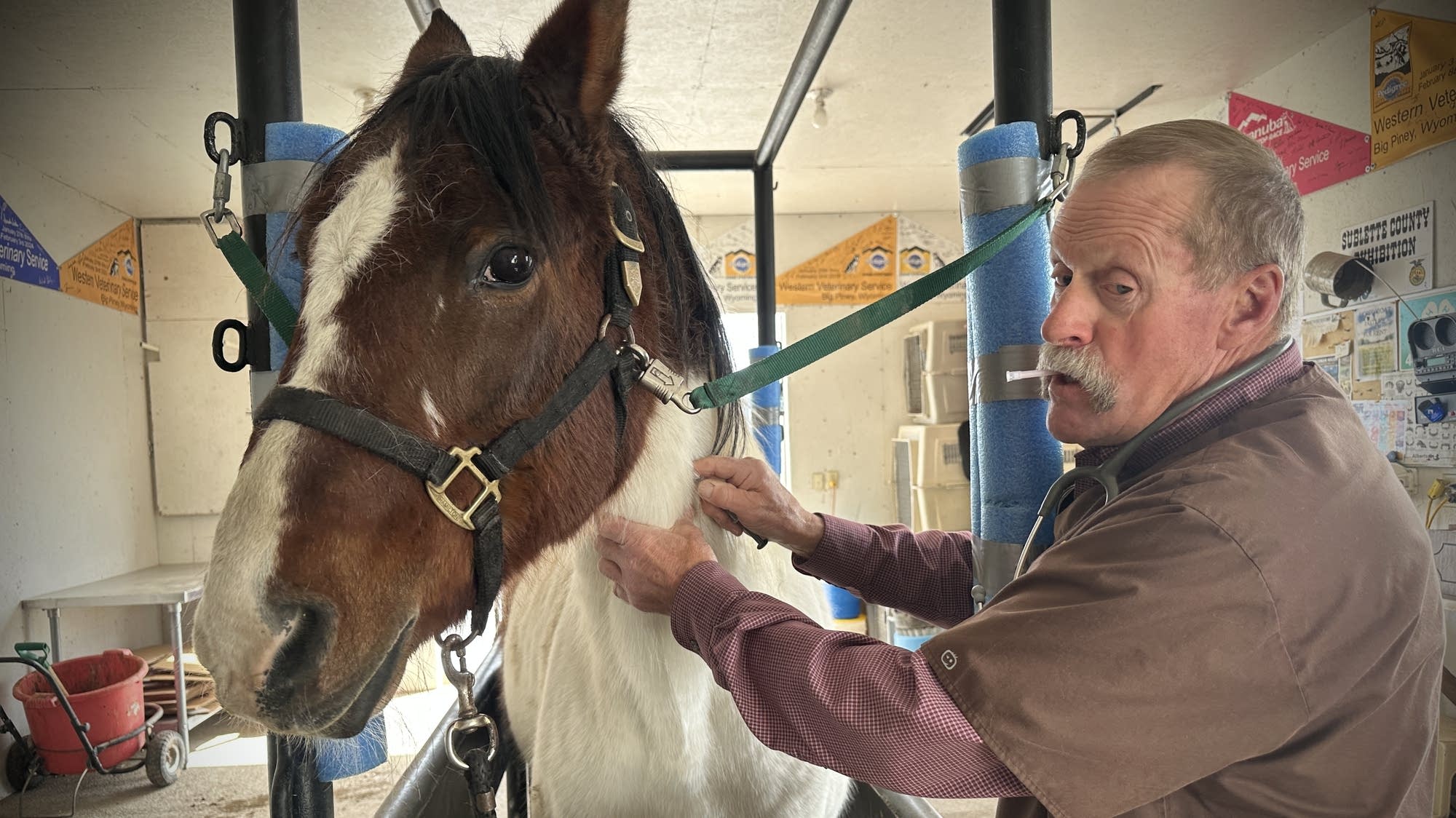
A version of this story originally appeared on Wyoming Public Radio.Rural America has a problem: not enough veterinarians. The root of the issue is that the cost of becoming a veterinarian is high, and higher salaries to pay that debt off are hard to come by in the countryside. In fact, the veterinarian shortage shows up in rural areas of almost every state. A quick glance at federal data show southern Indiana “urgently” needs livestock and poultry vets. A big worry there is bird flu spilling over into dairy cattle. Over in West Virginia, the entire state is in need. Other communities, some in Wyoming, are hanging on with one veterinarian doing a little bit of everything. “A zoo”Beiermann's business sign off the main road in Big Piney, Wyoming. Caitlin Tan/MarketplaceOff main street in Big Piney, Wyoming, Dr. Bob Beiermann’s vet clinic sits next to a hay field.Inside, Patsy Cline played on an old, dusty radio, cats meowed and a lady held an old chihuahua. A horse trailer pulled up outside. “You didn't know Big Piney had a zoo,” Beiermann chuckled. “This is it.” He broke from the interview to advise the owner of Tip, a chunky cat.“So, yeah,” he sighed. “I don't want to see her any heavier.” Beiermann is tall with a thick mustache. He runs the only brick and mortar clinic in the area, so people drive two hours to see him. Sometimes, he drives to them. Especially during spring calving season. “I got 2 C-sections under my belt so far this year,” he said. “One was in the middle of the night.” He will vaccinate those baby cows later on and screen them for disease — a critical step for meat that gets eaten down the line.For-sale signs This is all a lot of work. Beiermann is 71, and he is trying his best to retire. “The practice is listed,” he said. “So, had a couple nibbles, but it's gotta be the right person who wants to come to this.” This being the middle of nowhere. Big Piney is in the western part of the state and is 100 miles from a Walmart. And restaurants? Forget about it. “Well, we only have one, no, we have two sit down restaurants now,” he said.Perhaps one can get past that, but then there is the money factor. A vet in Wyoming makes on average $70,000 less per year than one in California. Plus, Beiermann’s wife, Janet, said a rural vet rarely gets a break. “Yeah, always Christmas, almost every single holiday, we end up taking some calls,” she said.Beiermann preps a needle to sedate a horse. A barn cat keeps him company. Caitlin Tan/MarketplaceThey started the business in 1990, and Janet taught herself how to keep the books. “We couldn't find a place, and so we had the vet clinic in the basement of our teeny, tiny house,” she said.All while raising two kids. “I'd be like, trying to make a birthday cake, and there'd be somebody standing there with their dog to be seen,” she laughed. They lived paycheck to paycheck for a long time. But things eventually got easier as they built up a loyal ranching clientele. “A lot of people say, ‘How do you make a living in a town of 1,000 people?’ Well, that's because we have several thousand cows here too,” Janet said. The next generationIt is a lifestyle. Beiermann is trying to pique young people’s interest through internships. Annika St. George was lured away from Seattle for the opportunity. “I was in the big city, and it was just so overwhelming. And I realized that I wanted to be in a rural area, working with animals,” St. George said.She plans to go to vet school. But it’s expensive. The average student debt is $200,000. Annika St. George (left) reviews the schedule with Janet Beiermann. St. George is interning before starting vet school.Caitlin Tan/Marketplace“If I work in these rural areas, where will I be able to pay out the debt that I'm going to have to incur from school?,” she said. St. George is betting on help. The federal government recently increased how much it’ll pay off on student loans in trade for rural vet work. Wyoming just approved something similar. For Beiermann, help cannot come soon enough. “It’s four years of vet school, so it takes a while before those kids are out in the workforce,” he said. So in the meantime, Beiermann will keep vaccinating, calving, medicating and stitching up animals.“We got an appointment in here right now,” he said, opening the clinic door. Beiermann leaned behind an American paint horse named Scarlett, injecting a numbing formula into her rear leg. “That should be pretty numbed up,” he said. “These kind of horses get cancerous tumors. So, now we're just gonna put a couple of stitches in there.”All stitched up, the horse walked out.“There we go sis’,” Beiermann said, gently nudging her out the door. With another animal taken care of, Beiermann dashed off to the next critter.
Rural veterinarian shortage is felt at small town Wyoming clinic
Veterinarians in the countryside are aging out. Replacing them is tricky, as it is a remote, around-the-clock lifestyle, often with lower pay than vet jobs in the city.
TL;DRAI
Questo articolo non è pertinente al profilo editoriale di Warptech Tech News. Non rientra in nessuna delle categorie gestite (AI, Tech, Startup, Business, Crypto, Geopolitics, Science, Health, ecc.) e non ha una connessione tech/business/AI rilevante per manager IT e CTO italiani. Se intendevi inviare un articolo tech, puoi incollare il testo corretto. Altrimenti, se è un test, fammi sapere.
837 words~4 min read