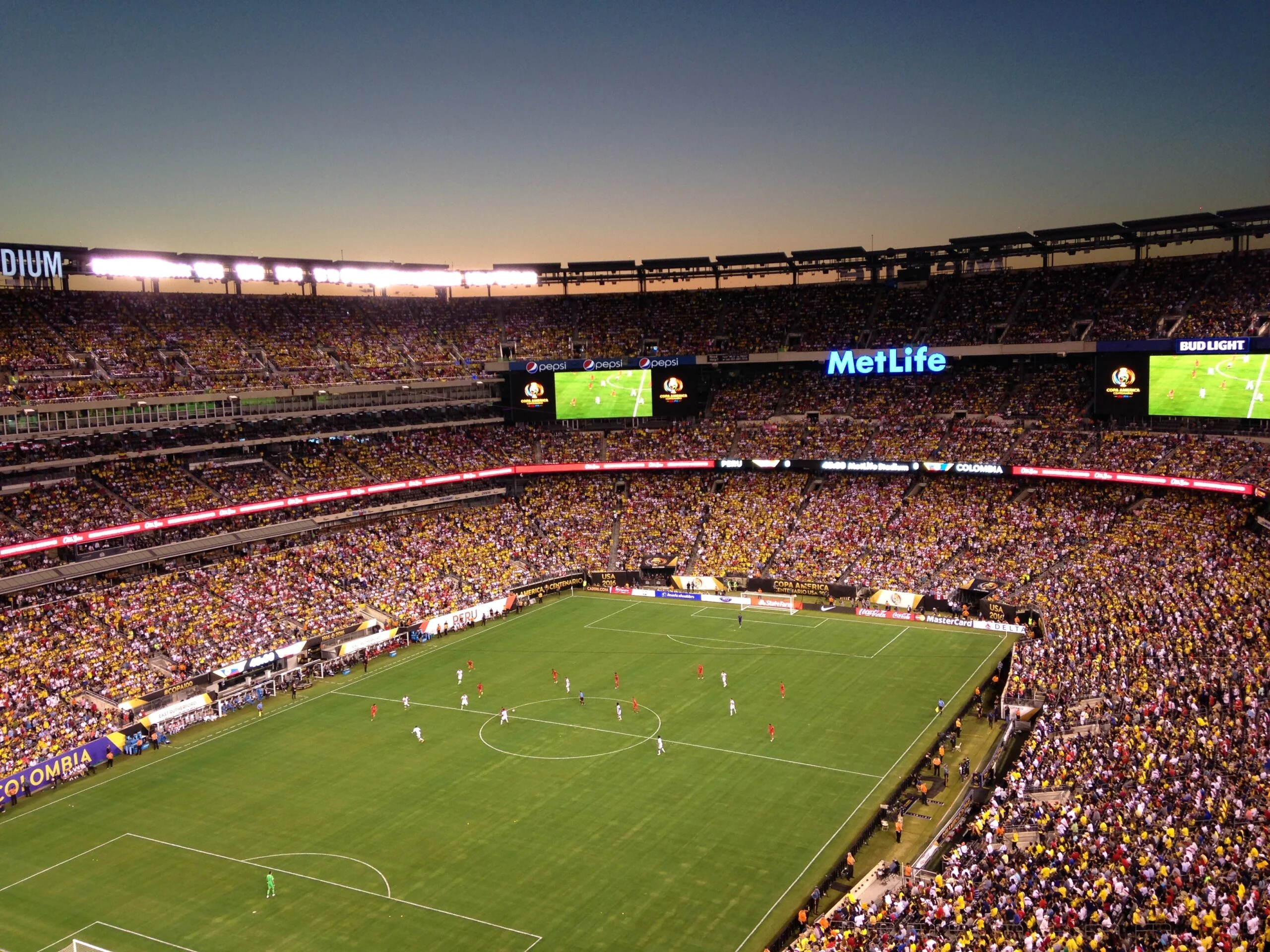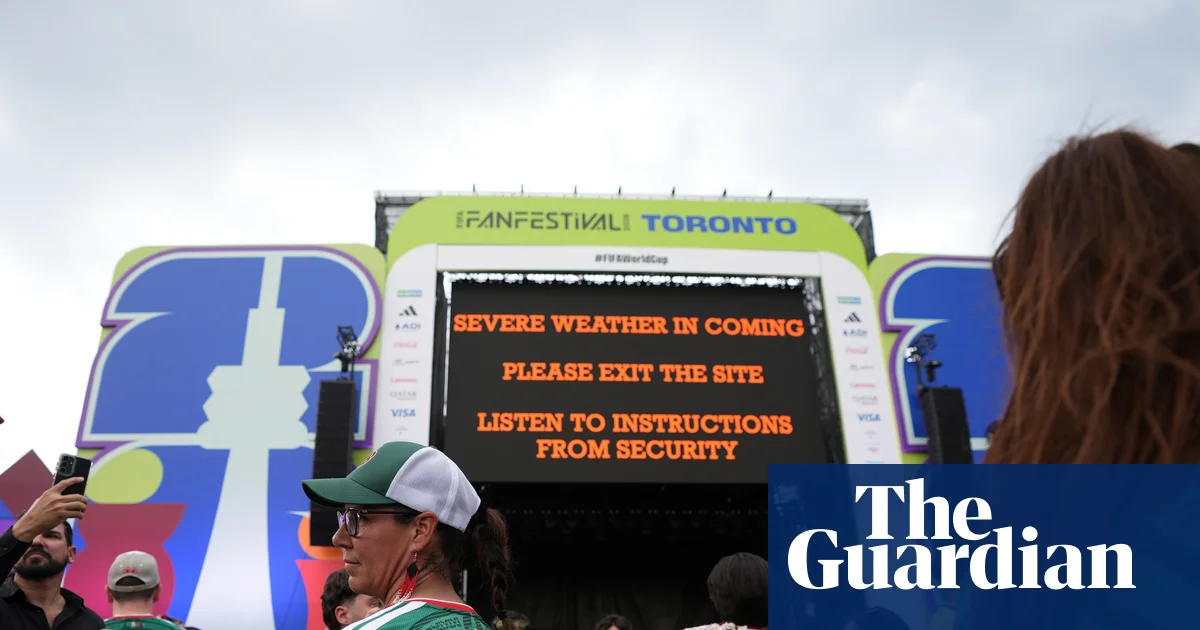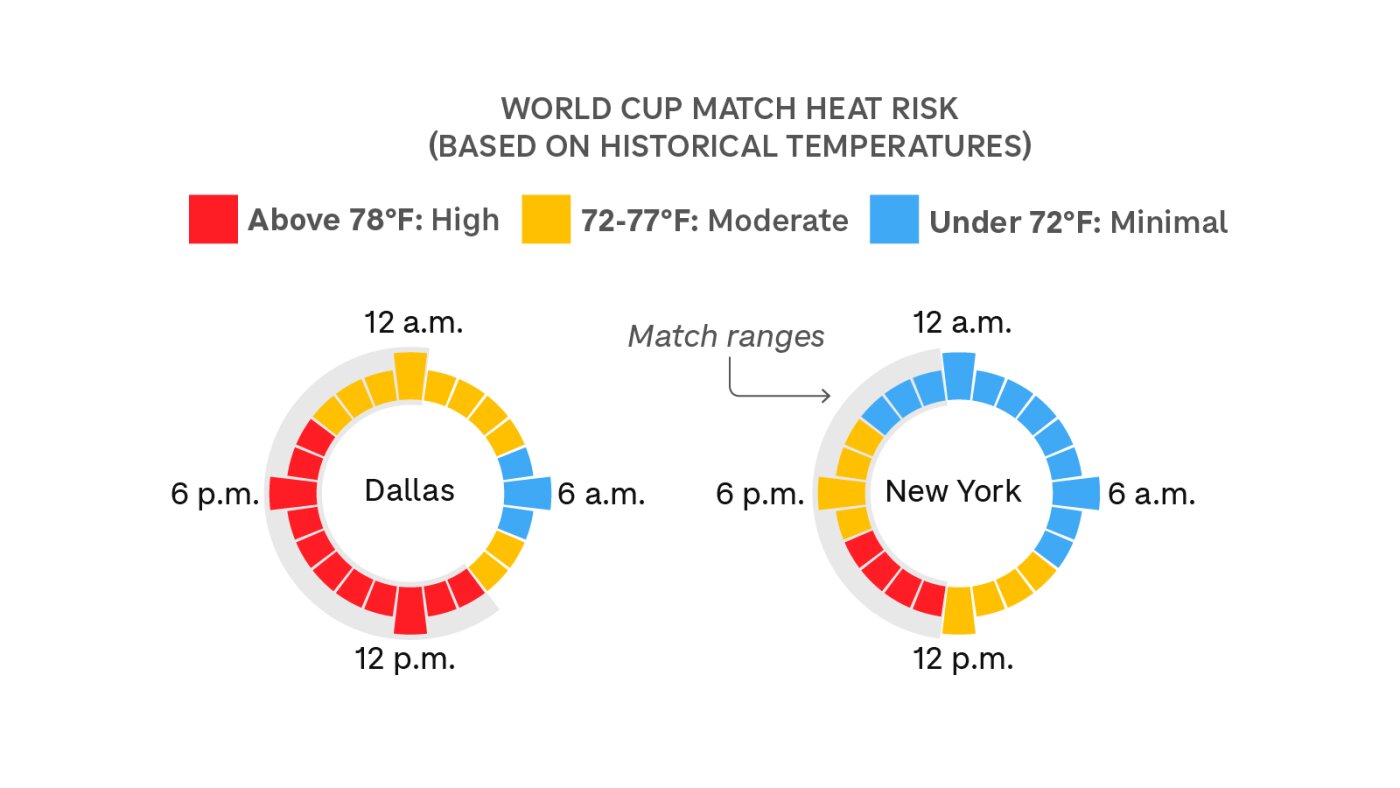
World Cup weather has been a hot topic.In May, World Weather Attribution released a report that analyzed the potential impact of heat at the World Cup — warning that roughly one in four matches could be played in risky heat conditions.NPR then recently calculated the most risky games for hot weather, an analysis that found as many as one-third of matches are at high risk for hot and humid conditions. Bloomberg also published a visual story tracking which teams will be playing a riskier heat schedule.Ahead of the World Cup kicking off on June 11, USA TODAY conducted a further analysis of recent weather trends at World Cup venues.This analysis specifically counted the number of days during the World Cup period from 2016-25 when each host venue exceeded an estimated Wet Bulb Globe Temperature of 78.8 degrees Fahrenheit (26 degrees Celsius) — a threshold at which the global players’ union, FIFPRO, says heat strain becomes a real risk.USA TODAY found that Houston, Miami and Dallas had the most frequent recent history of outdoor heat burden during the World Cup window.At 82.4 degrees Fahrenheit (28 degrees Celsius) WBGT, FIFPRO recommends delaying or postponing play. The current FIFA regulations don’t consider postponement until 89.6 degrees Fahrenheit (32 degrees Celsius) WBGT.The 2026 tournament will feature three-minute hydration breaks for all 104 matches, 22 minutes into each half.WBGT is a heat-stress index that accounts for temperature, humidity, sun, and wind. For this analysis, USA TODAY estimated shaded/sheltered WBGT via hourly ERA5-Land temperature and dewpoint data from the European Union’s Copernicus program.This is not the first World Cup to see adverse conditions. In Brazil for the 2014 men’s tournament, FIFA introduced cooling breaks when weather conditions reached 89.6 degrees Fahrenheit. And last time in Qatar, the World Cup was staged during the winter to avoid the country’s most grueling weather.It’s also worth noting that some matches at the 2026 World Cup will be played indoors, including those in Houston and Dallas — two of the cities with the highest outdoor heat burden in this analysis.However, fans will still be affected by the heat on their way to and around the stadium. World Weather Attribution specifically noted in its report that fans “may also be adversely affected by elevated WBGTs.”In this analysis, heat burden also generally worsened in July. And one stadium with a frequent heat burden history — Hard Rock in Miami — will host three matches that month, including a quarterfinal and the third-place match. Hard Rock Stadium is notably outdoors — and Miami cracked 78.8 degrees Fahrenheit WBGT on 90% of analyzed days, second only to Houston at 94.1%.The semifinals will be played in Dallas, which broke 78.8 degrees Fahrenheit WBGT on 87.9% of the analyzed days, and Atlanta, which hit 78.8 degrees Fahrenheit WBGT 46.2% of the time. However, both venues are climate-controlled.The final will be outside, although the host venue in East Rutherford, New Jersey, only broke the threshold 20% of the time. Three host cities — Mexico City, Guadalajara and Toronto — failed to reach the threshold during the analyzed period.Methodology: USA TODAY analyzed hourly ERA5-Land temperature and dewpoint data near each 2026 World Cup host venue from June 11-July 19 in 2016-25. Shaded/sheltered WBGT was estimated from temperature and humidity using the indoor/no-solar-load WBGT approximation. Results show outdoor conditions near each venue, not in-stadium or direct-sun field conditions.
Heat burden is real. Which World Cup cities face the biggest risk?
Recent weather trends suggest some World Cup host cities will face more outdoor heat stress than others and this chart shows where the burden is highest.
TL;DRAI
Houston, Miami, and Dallas exceed heat-stress WBGT threshold 87-94% of 2026 World Cup days per 2016-25 historical analysis. Fan exposure risks and threshold conflict (FIFPRO 82.4°F vs FIFA 89.6°F) may force tournament scheduling adjustments.
562 words~3 min read