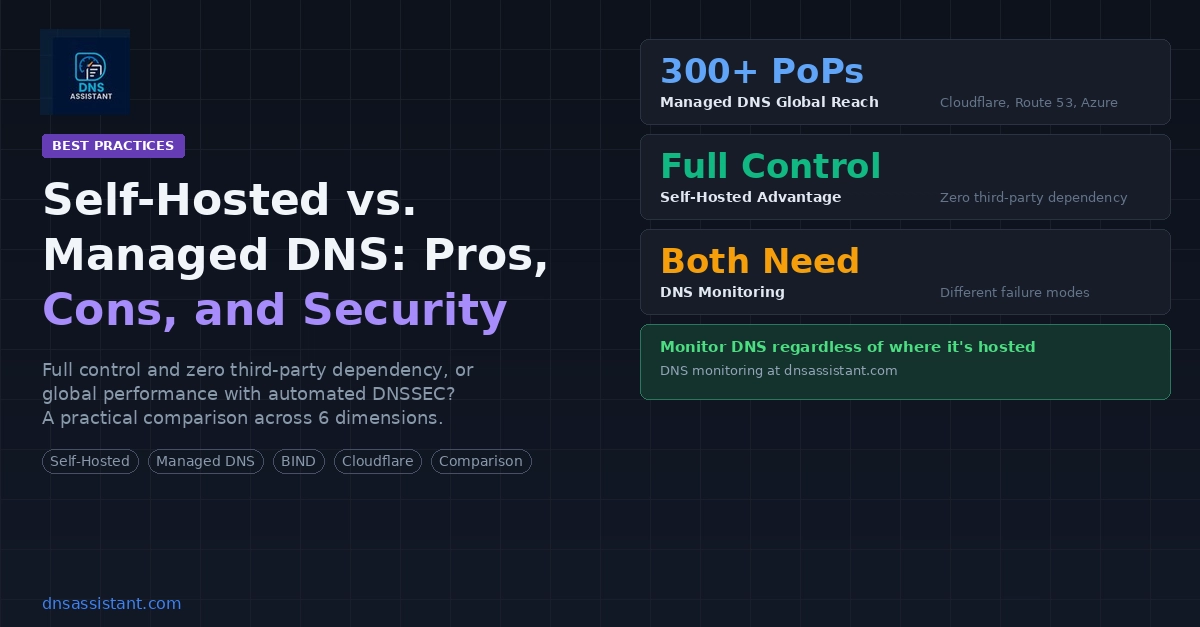
When you register a domain, one of the first decisions you make is where your DNS lives. Most organizations default to their registrar's DNS service (GoDaddy, Namecheap, Squarespace) or a managed provider (Cloudflare, AWS Route 53, Azure DNS). Some, particularly those with strict compliance requirements or complex internal architectures, run their own authoritative nameservers using BIND, PowerDNS, Knot, or NSD.
The choice between self-hosted and managed DNS isn't just a technical preference. It affects your uptime, your security posture, your operational burden, and your ability to respond to incidents. Each approach has legitimate strengths and real tradeoffs.
This guide breaks down both options across the dimensions that matter: reliability, security, performance, control, cost, and operational complexity.
What "Self-Hosted" and "Managed" Actually Mean
Self-hosted DNS means you operate your own authoritative nameservers. You install DNS server software (BIND, PowerDNS, Knot DNS, NSD) on infrastructure you control, configure zones, manage records, handle replication between primary and secondary servers, and maintain the servers themselves. Your nameservers are listed at the registrar as the authoritative source for your domain.