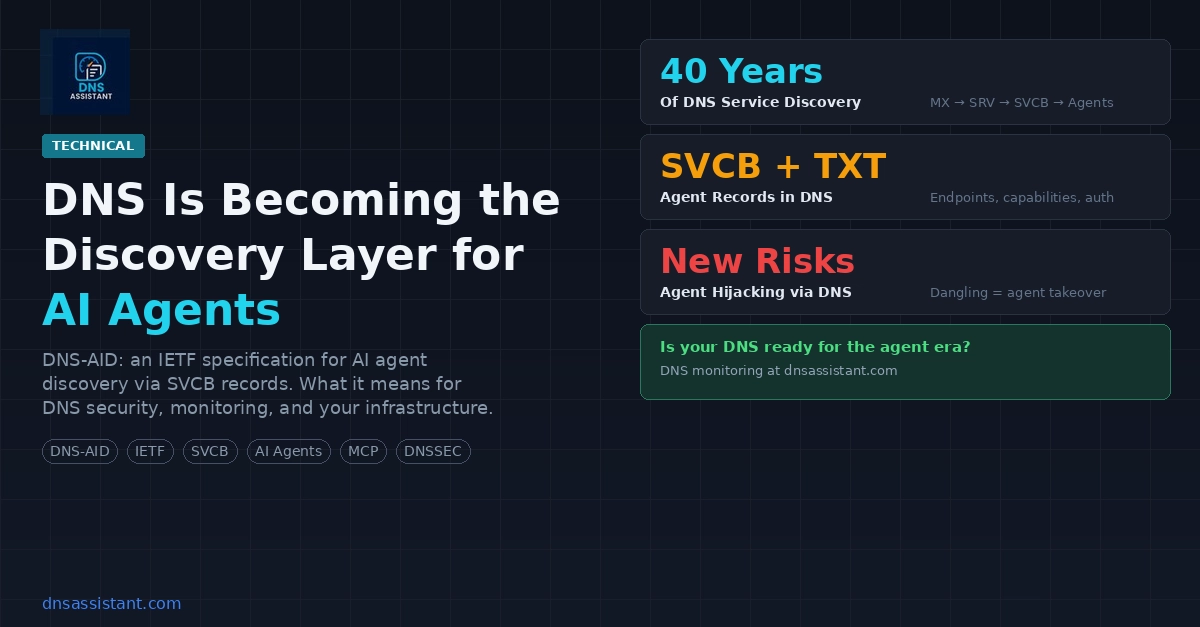
DNS has been quietly evolving for forty years. In 1986, MX records taught the internet where to deliver email. In 2000, SRV records enabled service discovery for VoIP, instant messaging, and directory services. In 2023, SVCB records (RFC 9460) optimized how browsers find and connect to HTTPS services.
Now, in 2026, DNS is taking its next step: becoming the discovery layer for AI agents.
The DNS-AID specification (DNS-based Agent Identification and Discovery), currently being developed within the IETF, proposes using DNS as the standard mechanism for AI agents to publish themselves and discover each other. Instead of centralized registries, hardcoded URLs, or proprietary directories, agents advertise their capabilities, endpoints, and authentication requirements through DNS records that any resolver on the internet can query.
The reference implementation, developed by Infoblox and hosted under the Linux Foundation, already supports publishing, discovery, verification, and invocation across multiple DNS providers including Route 53, Cloudflare, NS1, Google Cloud DNS, and BIND via RFC 2136.
This is a significant development for anyone who manages DNS infrastructure. If DNS-AID gains adoption, the DNS records you monitor today gain an entirely new category of entries, and the security implications of DNS misconfiguration, hijacking, and neglect become substantially more severe.