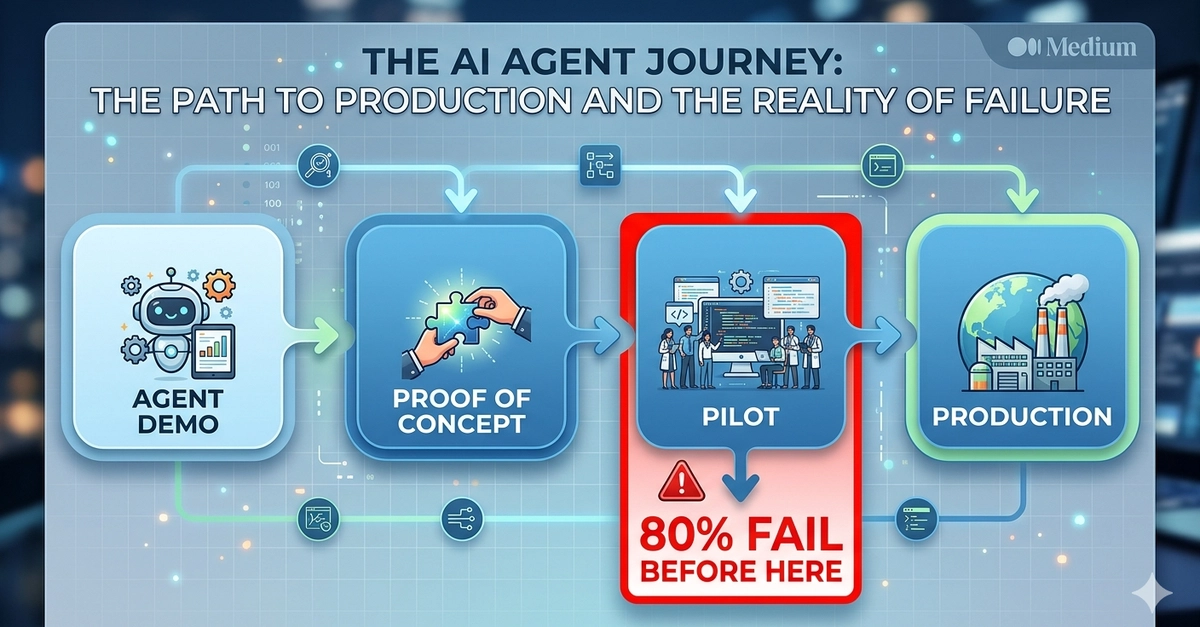
Praveen Satyanarayana, data and AI leader at Tredence, advancing domain-specific agentic systems for enterprise decision intelligence.gettyEnterprise ambition has shifted from AI that talks to AI that acts, but the reality has been sobering. MIT's Project NANDA found that despite as much as $40 billion in enterprise GenAI spending, 95% of organizations reported no measurable return, and only 5% of pilots reached production.Those numbers track with what I see at Tredence. Few pilots made production. The rest died because organizations tried to solve too many problems with one generalist tool instead of committing to narrow, high-value domain-specific workflows. Postmortems point to a consistent strategic error: the super-agent fallacy, or the belief that one general-purpose agent can span every department, interpret every definition, touch every system and still remain reliable. The real reason super agents fail is not model weakness. It is that enterprises are federated political systems. AI breaks when ownership of meaning, risk and action is centralized more aggressively than the organization itself.I call this the principle of semantic jurisdiction: Each business function owns the meaning of its terms, the data contracts that govern those terms and the escalation rules that apply when those terms drive a decision. Sales owns what "pipeline" means. Finance owns "recognized revenue." Risk owns "exposure." An agent that flattens those distinctions is not helpful. It is breaking the operating model.Consider a composite banking scenario: A single AI assistant is built to serve retail lending, wealth advisory and risk operations from one interface. Six weeks in, a relationship manager asks for the lifetime value of a priority client. The agent answers using risk-weighted asset definitions from the credit policy corpus, not the assets under management (AUM)-based customer lifetime value (CLV) that the wealth team uses. The number is off by a factor of four. Risk pulls the logs and finds that the agent answering exposure questions is using retail lending language that does not match Basel definitions. By month four, every function has built a workaround, and the pilot is shelved.Why The Monolithic Agent BreaksIn practice, this is usually the point where pilots start to unravel. Here's what this usually looks like:Semantic drift becomes operational risk. "Revenue" to sales means bookings. To finance it means recognized revenue. To tax it maps to an entirely different classification. A generalist agent produces confident but inconsistent decisions because nothing anchors meaning to domain ownership.The blast radius becomes unacceptable. A super agent needs broad permissions across sensitive data, tools and systems. In one banking engagement I was involved in, the CISO said, "This agent can read KYC records, loan performance data and relationship manager notes in one session. No human role has that combination. How do we audit that?"Accountability disappears.When a super agent fails, responsibility fragments across retrieval, reasoning, tooling and policy. In regulated environments, "We are not sure why it did that" is an audit liability.The Better Pattern: Bounded AutonomyThe enterprise AI race is not a race to build the smartest agent. It is a race to design the narrowest agent that can be trusted with real authority.A durable architecture has three layers: 1. Domain-sovereign agents owned by business functions2. A lightweight orchestrator that routes work to the right specialist3. A governance plane for policy enforcement, logging and auditabilityEach agent operates within its semantic jurisdiction. Start with one high-frequency workflow like field sales call planning, claims triage or AP exception handling. Build a single domain agent with narrow tool access and prove it works before adding orchestration. The most common mistake is building the orchestrator first and assuming specialists will materialize later.Memory: The Real DifferentiatorAdvantage is shifting from raw model access toward how well systems remember and apply context. I've found that the five categories below matter most:1. Business Definitions: The agent knows "NPA" follows the regulator's 90-day classification, "sell-through" is store-SKU level in retail and "RevPAR" uses total available inventory.2. How Work Gets Done: A claims agent that skips supervisory review above $10,000 is useless. A markdown agent that bypasses category manager approval gets overridden.3. Who Is Asking: A branch manager and a teller asking about the same customer need different answers shaped by entirely different rules of engagement.4. What Happened Before: If a fraud model flagged a legitimate transfer and was overruled, the agent carries that forward. Agents that repeat known mistakes destroy trust.5. What Is Allowed: The agent should not recommend products during a regulatory cooling-off period or surface off-label pharma messaging.A Five-Step Executive Action PlanI believe that getting this right means treating it less like a model problem and more like an operating model problem. Here are five ways you can achieve this:1. Start with narrow autonomy. Identify workflows that can safely run end to end today.2. Enforce semantic jurisdiction. Each function owns its definitions, data contracts and escalation rules.3. Fund specialists, not generalists. Business units own agents. Platform teams own guardrails.4. Test like software. Shadow test before granting write access. No staging environment means no deployment.5. Invest in context layers and knowledge graphs per domain. A context layer encodes the definitions, contracts and entity relationships a function owns. A domain knowledge graph makes those relationships queryable and auditable. No context layer means no agent.I saw the consequences of this firsthand with a retail client analyzing omnichannel behavior. Because the organization lacked a defined business context layer, the system could not reliably connect mobile app user IDs with e-commerce customer IDs, missed household relationships and ultimately produced fragmented customer profiles.For leaders in siloed environments, align AI ambition with data maturity and use-case-specific context layers. Again, don't start with a massive orchestrator. Begin with a focused, high-impact workflow and force precise data relationship definitions before expanding the scope. The future of enterprise AI does not belong to agents that know everything. It belongs to systems that know exactly where their authority starts, where it ends and when to hand off work.Forbes Technology Council is an invitation-only community for world-class CIOs, CTOs and technology executives. Do I qualify?
Why The “Super Agent” Strategy Is Failing In The Enterprise
Few pilots are making it to production because organizations are trying to solve too many problems with one generalist tool.
991 words~5 min read