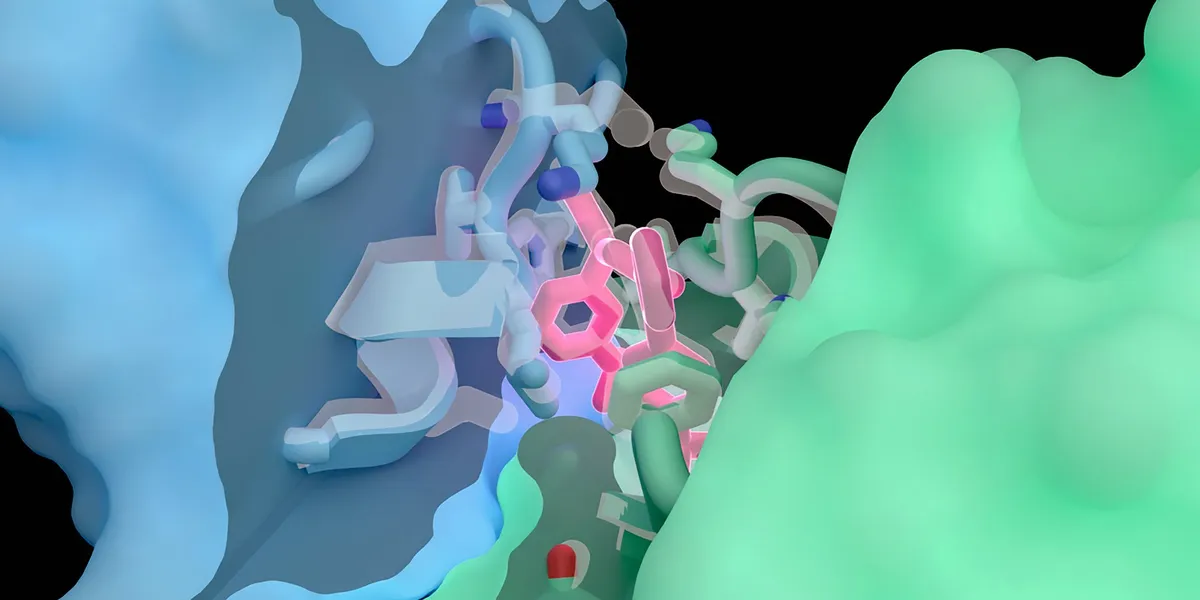
For more than a decade, artificial intelligence has been touted as a way to dramatically accelerate drug discovery. Yet despite billions of dollars in investment, relatively few AI-designed medicines have made it to patients. That’s partially because the timelines for careful drug testing can’t be easily compressed—and partially because drug development is just really hard. Isomorphic Labs, the Google DeepMind spinout that’s building on DeepMind’s Nobel Prize-winning work on protein structure prediction, may be making the most progress. The company has signed major drug-discovery partnerships with Novartis and Eli Lilly, recently raised US $2.1 billion in funding, and in February published a technical report describing its new Isomorphic Drug Design Engine, a system designed to discover the “pockets” on proteins where drugs can bind, and in general to predict how proteins and drug molecules interact. IEEE Spectrum spoke with Adrian Stecuła, a group leader in the machine learning organization at Isomorphic Labs, about how close AI may be to becoming a practical tool for designing new medicines.Going Beyond AlphaFoldAlphaFold2 and AlphaFold3 were massive leaps forward for computational biology. Why weren’t those models sufficient for actually designing drugs?Adrian Stecuła: AlphaFold2 was eventually recognized with the Nobel Prize, because it arguably solved the problem of protein folding. But proteins don’t exist in a vacuum, right? They interact with a wide variety of other types of biomolecules, which involves nucleic acids, small molecule ligands, ions, and other proteins. AlphaFold3 introduced a way to model the rest of these cellular biomolecules as part of a single framework. So, all of a sudden, we have a single model that can model all of these interactions all at the same time.That said, in the years since the AF3 release, multiple groups have evaluated it along the axis of pocket novelty. And you could see that as the pocket distance grows away from the training set, the model performance decreases. So if you define the success as “how well did the model actually fold this particular ligand with this particular protein,” as those systems become more novel, you can see a decline in performance.But for drug discovery, ideally we do want to pursue novel mechanisms of action, which might involve targeting a never-before-observed pocket. And so it is absolutely important for us to have our models generalize to these regions that are distant from training.How does the Isomorphic Drug Design Engine (IsoDDE) address these limitations, and what exactly is it predicting?Stecuła: It takes a lot more than just structure prediction to create a molecule that will ultimately become a drug. You don’t just need to predict where the ligand binds with the protein, but also potentially how it binds, how tightly it binds, and a plethora of other properties about the ligand and how the ligand interacts with the rest of the proteins in the body.IsoDDE is a unified computational system that lends itself to a number of different endpoints. As part of the technical report about IsoDDE, we have described three of those endpoints, which are structure prediction, pocket identification, and binding affinity prediction. [Editor’s note: Binding affinity measures how strongly a molecule binds to a target protein.]Finding Hidden Protein PocketsIn your technical report about IsoDDE, you highlighted a key example involving a protein called cereblon and its “cryptic pocket.” First, can you tell readers about this protein and what a cryptic pocket is?Stecuła: Cereblon is one of the most important and well-studied proteins in the targeted protein degradation pathway. It’s part of the mechanism that’s responsible for degrading proteins in the cell. [Editor’s note: Some drugs use cereblon to mark disease-causing proteins for destruction by the cell.] And cryptic pockets are pockets on protein surfaces that are non-obvious in that in the [unbound] state of the protein, meaning that if you were to look at the protein by itself, it would not have a cavity there. This pocket only opens upon the binding of just the right ligand. So you can think of it as: You need the perfect key to unlock this lock.How did you use recently published findings about cereblon to validate IsoDDE?Stecuła: In January of this year a Nature paper published a completely novel, never-before-observed cryptic pocket on the surface of this protein. First we asked the question: Can IsoDDE find this pocket just using the protein sequence as input? And we were able to perfectly predict the location of this cryptic pocket. Again, note that this pocket had never been disclosed before. The second question was, Can IsoDDE accurately predict how the ligands bind to the protein? Are we able to recapitulate the crystal structure shown in the Nature paper? And the model was able to place both the orthosteric ligand [at the known binding site] as well as the allosteric ligand [at the new, cryptic pocket] in exactly the perfect locations.Most drugs today are small molecules—relatively simple compounds that bind to proteins. Does IsoDDE expand the toolkit for tackling diseases?Stecuła: I think many of the hopes for machine learning for drug design revolve around making more protein targets tractable. There are already many diseases that have known associated proteins. So we know that if only we could target a particular protein, we would have a chance at helping the patient population suffering from a particular disease.But in many of those instances, the protein that is associated with that disease doesn’t have a pocket or mechanism that can be easily drugged. IsoDDE is enabling us to find those mechanisms. Further, these methods generalize not just to small molecules, but also to antibodies, molecular glues, and peptides. It’s not just a breakthrough that will impact small molecule design, but these other therapeutic modalities will also benefit from this.There is a lot of hype around AI in drug discovery. What do people commonly misunderstand about where the field is right now?Stecuła: Perhaps the misunderstanding that just because we are able to accurately model structure, that drug discovery is a solved problem. It does take, we believe, a unified system such as IsoDDE with a plethora of other endpoints to really model these systems. We will continue to improve our performance on the endpoints that we have disclosed as part of the IsoDDE report, and will also continue to push on the endpoints that we have not yet disclosed.Do you imagine more of the drug discovery process becoming automated, with AI systems generating hypotheses, testing hypotheses, and analyzing results?Stecuła: Absolutely. This was quite nicely framed by our president Max Jaderberg as part of his TED AI talk, where he was discussing the future of agentic workflows in drug discovery. I absolutely think that is part of our collective future.
The Google DeepMind Spinoff Chasing Hidden Drug Targets
Isomorphic Labs is developing a new engine for AI drug discovery
1,105 words~5 min read