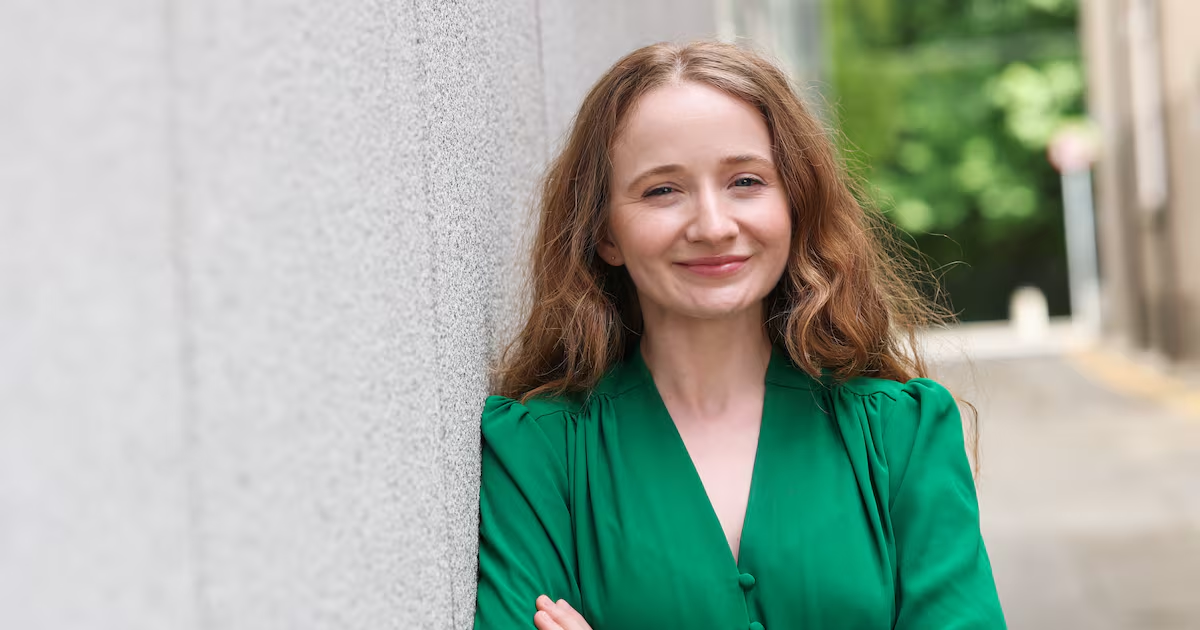
My mother’s work to improve access to neurorehabilitation services for patients has been a source of inspiration to meDr Liah McElligott: 'I work as a neurology specialist registrar, with clinical interests in movement and cognitive disorders, and the potential benefits of exercise and dance' Dr Liah McElligottThu Jun 11 2026 - 06:01 • 3 MIN READMy parents met at RCSI and are both doctors, so medicine was familiar to me from a young age. I always enjoyed both English and the sciences, especially biology and chemistry, and I loved problem solving. Medicine felt like a good fit: challenging, practical and centred on helping people.Some of my best memories are from my time at RCSI. It was demanding, and I don’t think I fully understood the workload when I started, but there was a real sense of solidarity in going through it together. I also met my husband, Dr Manuel Calvo-Gurry, while studying there. He now works as an anaesthetist, and his support has been enormously important throughout my career.After graduating, I completed my intern year in Letterkenny and Galway, then basic specialist training at Beaumont Hospital. It was there that I met my mentor, Dr Eavan McGovern, who encouraged my interest in teaching and showed me that education could sit alongside a clinical career as a meaningful pursuit in its own right.I would not be where I am without the support of people like her. Supporting a mentee takes enormous time, patience and generosity, and she spent years reading the first, second and 50th drafts of my manuscripts until they were publication ready.I didn’t get on to higher specialist training at my first attempt, which was difficult at the time but, looking back, helped me grow. By the time I interviewed again I had more confidence, broader experience and a clearer sense of the kind of clinician I wanted to become. That period led me to RCSI’s StAR MD/PhD programme, where Dr McGovern and I worked with academic colleagues to develop the neurology curriculum for final-year medical students.My PhD focused on neurophobia, which is the fear that students and doctors can feel around neurology. I had experienced some of that myself, so I wanted to understand it better and help make the subject more accessible.My mother, Dr Jacinta McElligott, whose work to improve access to neurorehabilitation services for patients has been a great source of inspiration to me, is never far from my mind when I think about why this matters. I hope that in time I can make a similar contribution.I’m now working as a neurology specialist registrar, with clinical interests in movement and cognitive disorders and the potential benefits of exercise and dance, which we are exploring through ongoing research. Medical training can be demanding – the rotations, the relocations, the competing expectations around research and clinical development – but taking dedicated time to complete education research was the right path for me. It helped me develop in ways that have made me a better clinician.My plan is to pursue fellowship training abroad before returning to Ireland to work in neurology, to keep teaching, and to focus on social determinants of health within neurological services. I’d also like to see better supports for junior doctors, including improved access to teaching, research opportunities and protected development time. When staff are well supported, patients benefit too.IN THIS SECTION
A graduate’s story: ‘Supporting a mentee takes enormous time, patience and generosity’
My mother’s work to improve access to neurorehabilitation services for patients has been a source of inspiration to me
558 words~3 min read