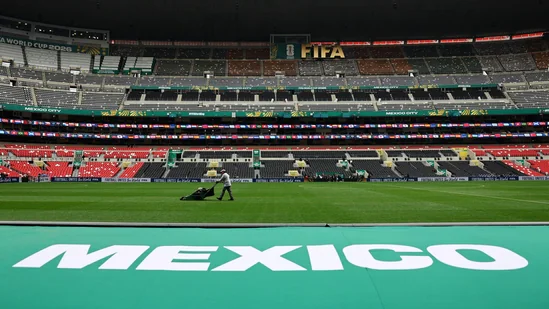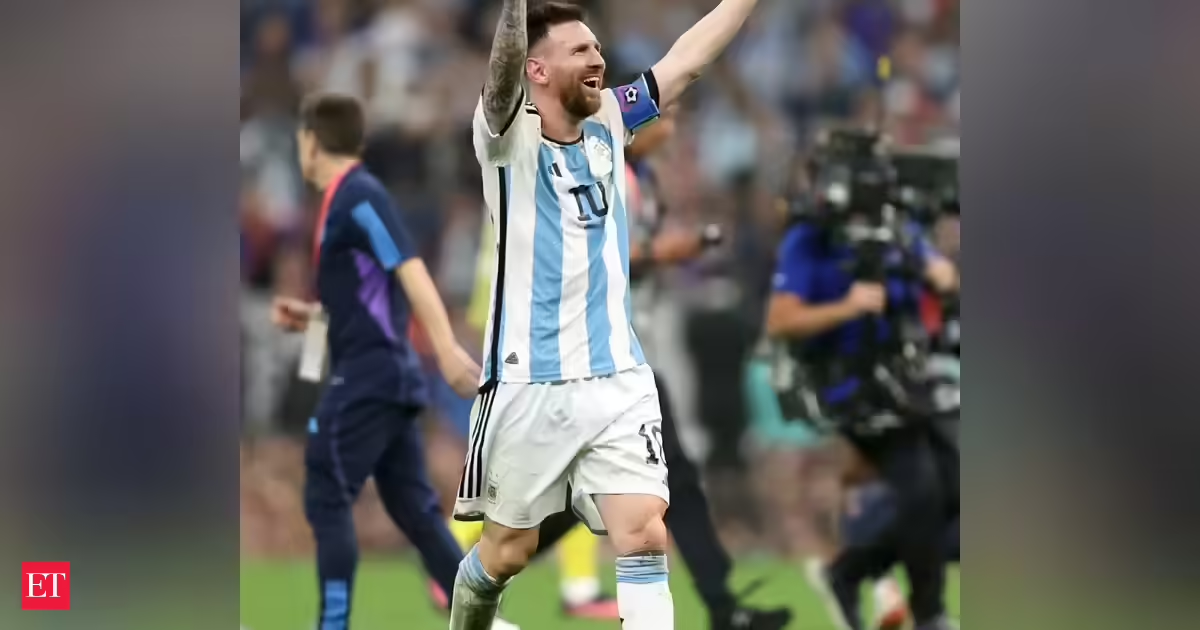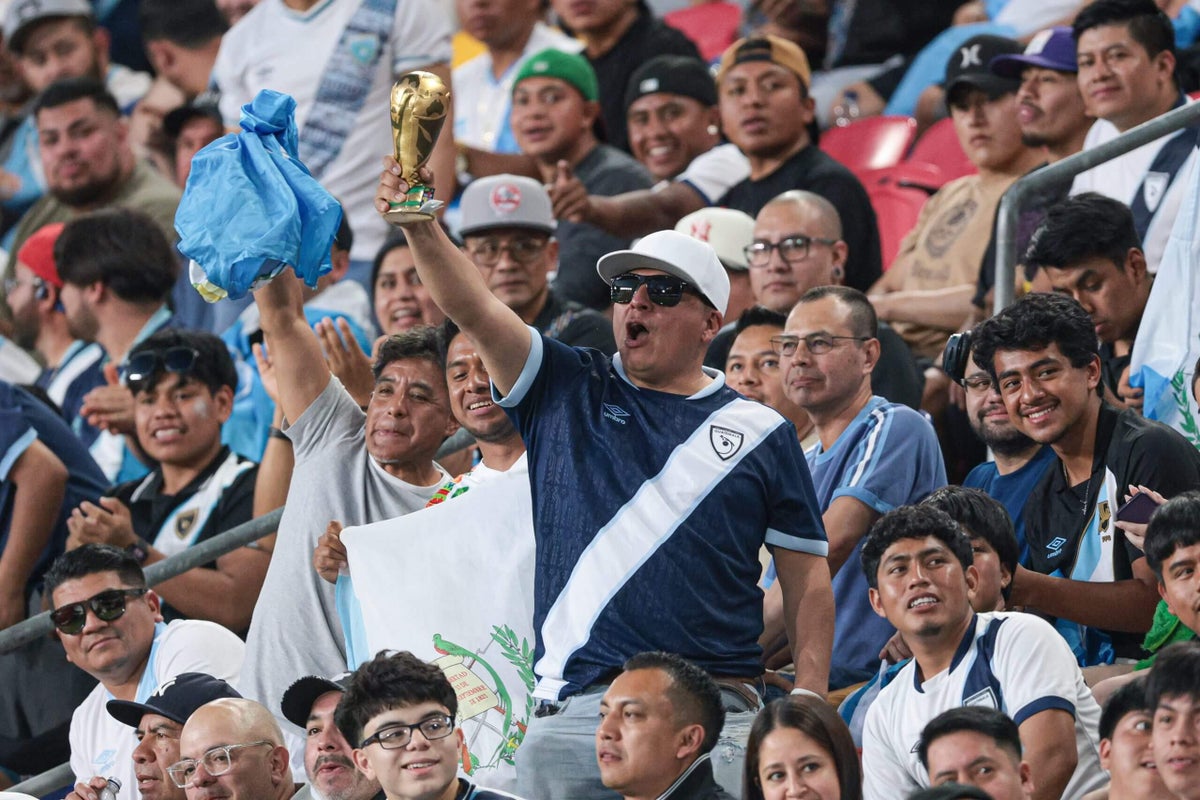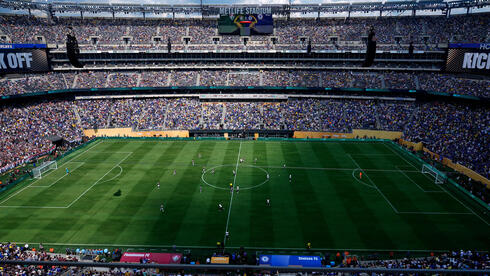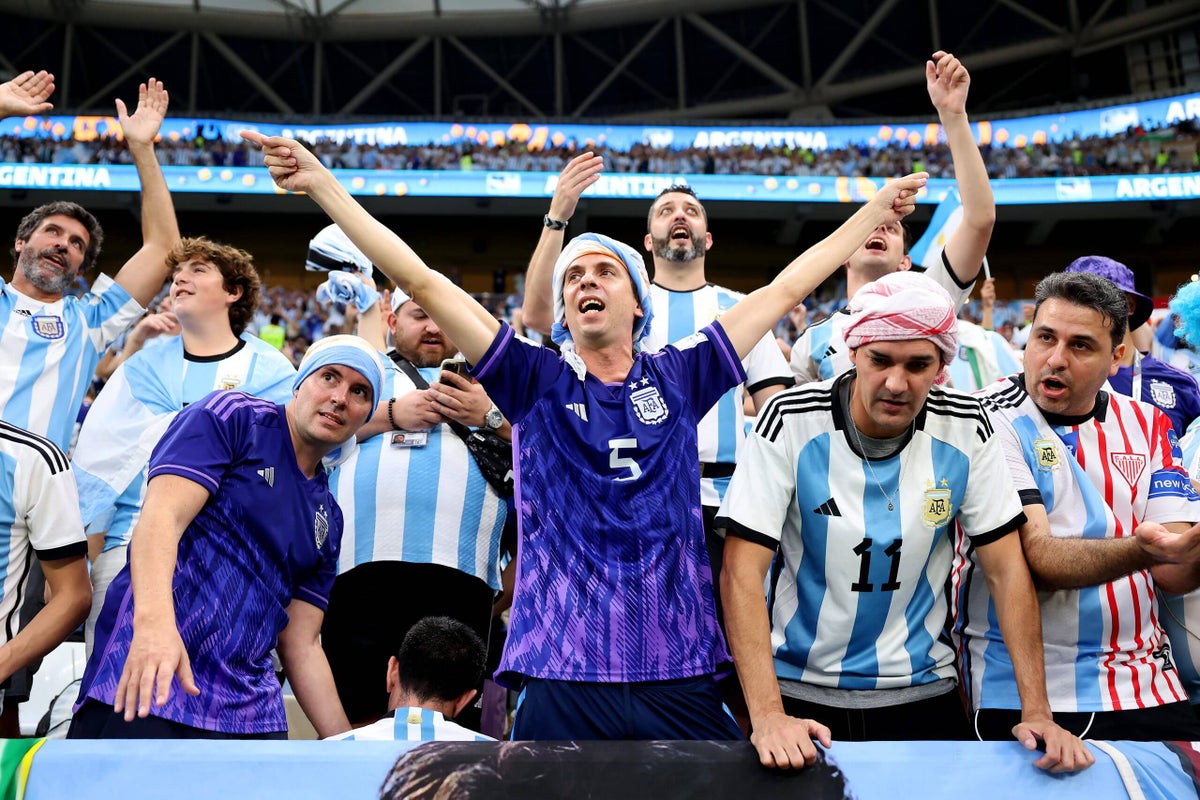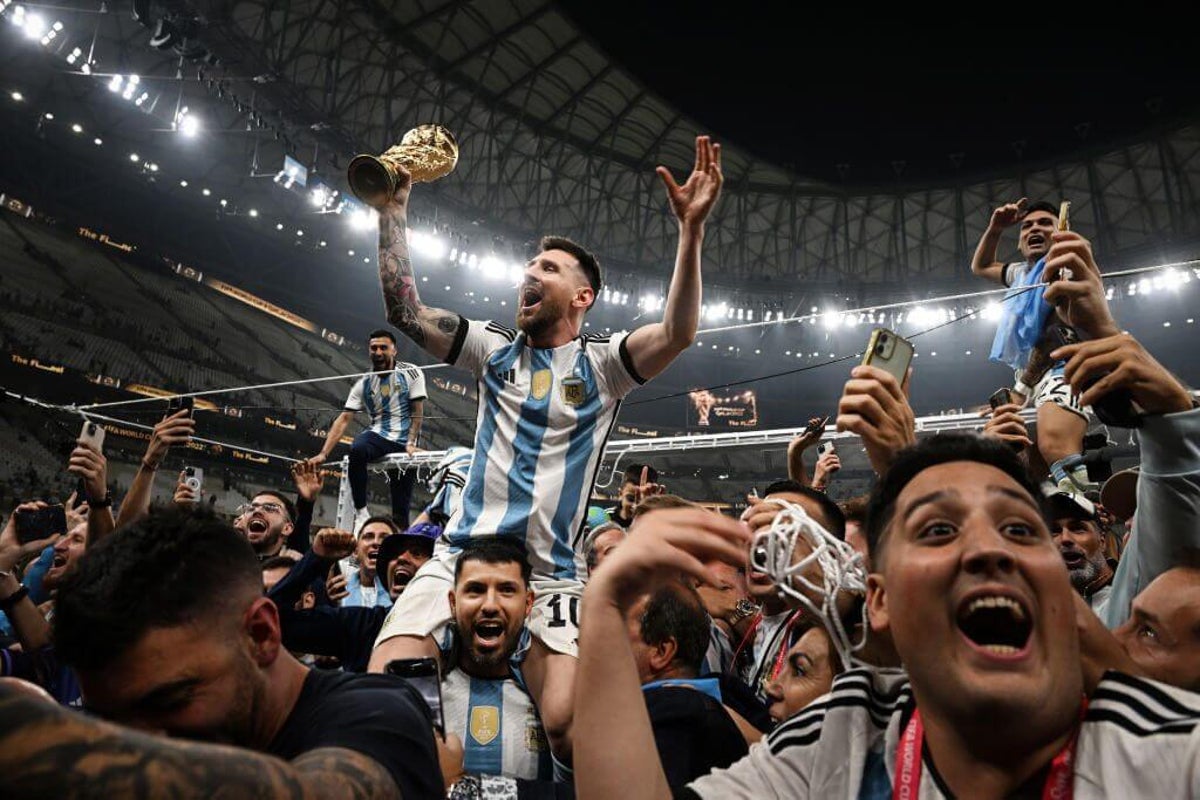
Get free access to the most comprehensive World Cup coverage in The Athletic app.It’s here. Ten years in the making, sprawling in its scale, the 2026 World Cup is finally upon us: a 48-team extravaganza kicking off in Mexico City on Thursday afternoon, 104 games spanning 16 cities across three countries. For the next five and a half weeks, it will hold the world in thrall.In the past, it has been hyped as “the greatest show on earth”. For the 2026 edition, by far the biggest in the competition’s 96-year history, even that grandiose billing is nothing like bombastic enough. FIFA’s president Gianni Infantino has taken to calling this World Cup, to be held in the United States, Canada and Mexico, “simply the greatest event that humanity — that mankind — has ever seen and will ever see”.In terms of significance, of course, it is nothing of the sort. (If he had said the greatest rip-off in history, then possibly.) But there is no escaping the cultural and economic reach of this World Cup. FIFA expects the total attendance to soar well beyond five million and generate around $3billion in revenue — more than four times the ticket revenue of the last men’s World Cup in Qatar in 2022.Then there is the wider global audience. FIFA claims six billion people, almost three-quarters of the world’s population, will engage with this World Cup in one way or another. It will be followed avidly not just in the 48 qualifying countries but in China, India and so many other countries where the prospect of watching Lionel Messi and Cristiano Ronaldo on the biggest stage for the last time — and indeed watching Lamine Yamal and Desire Doue on the biggest stage for the first time — will be captivating.“The world,” as Infantino has said in various addresses over recent months, “will stand still”.To some, the obvious question at this point will be, “Why?” Football — soccer, if you prefer — is a low-scoring game. It lacks anything like the end-to-end speed and excitement of basketball or the physicality of American football. The 2022 World Cup saw seven goalless draws and an average of 2.69 goals per game, which sounds low until you learn it was the highest-scoring tournament since 1994.At its purest level, football’s appeal lies in its universality. It is simple and accessible in a way that most team sports are not. At any given moment, on pitches or beaches or strips of concrete in any city in the world, there are people of all shapes and sizes, young and old, rich and poor, kicking a ball around. Passers-by will often stop to watch, silently hoping the ball runs out of play so they have the chance to kick it back.Elite-level football, particularly on FIFA’s watch, seems a world away from such innocence. These days World Cups are as likely to be remembered for politics: Infantino cosying up Russian President Vladimir Putin in 2018, accepting the Russian Order of Friendship in return, declaring a new dawn, then forced to ban Russia from international competition barely four years later following its full-scale invasion of Ukraine; Infantino repeatedly rejecting criticism of Qatar’s human rights record in 2022, a tournament built on the sweat and blood of migrant workers.In 2026, it has been all about Infantino in the Oval Office, smiling and simpering along to whatever President Donald Trump says. Whatever he imagined he and FIFA were letting themselves in for when he put his friendship with Trump at the hearts of his presidency, he surely didn’t expect to be in a position where one of the World Cup hosts, the U.S., a) declared war on one of the competing nations (Iran) and b) banned Africa’s most prominent referee (Somalia’s Omar Artan) from entry at Miami International Airport three days before the tournament began.Earlier this week, Jerry Brewer asked, “Who, exactly, is this World Cup for?” He pointed out that die-hard supporters have been priced out — and that even among those willing to pay the exorbitant prices, there are fans from Haiti, Iran, Senegal and Ivory Coast who have been barred from entry to the U.S.. “The World Cup has widened its doorway, but it still feels more closed than ever,” Jerry wrote. “It is more expensive and more exposed to geopolitical forces that care little about football and obsess over the content of your passport.”Gianni Infantino and Vladimir Putin at the final in 2018 (VI Images via Getty Images)But if you can look beyond the ugliness, the craven administrators, the sportswashing, the skullduggery and the exploitation of fans, there is beauty to be found. Russia 2018 saw the deeply regrettable Putinfantino bromance, but it also brought famous victories for South Korea and Mexico over champions Germany, Kylian Mbappe scorching through the Argentina defence in Kazan, and parties every night on Moscow’s Nikolskaya Street.Qatar 2022 was an abomination in so many ways, a World Cup staged in a nation roughly the size of Connecticut, with an appalling human rights record, but the football was frequently thrilling. The final, a classic between Messi’s Argentina and Mbappe’s France, was watched by a global television audience in the region of 1.5billion.At its highest level, football’s appeal is self-perpetuating. The more it matters, the more it matters. There is a reason why, if and when a goal is scored in the opening game between Mexico and South Africa on Thursday afternoon, TV directors will focus on the scenes of agony and ecstasy both on the pitch and in the stands at Estadio Azteca.Those raw emotions and moments of shared experience, which can be so hard to find in a fractured society, will be replicated all over the world in the coming weeks, bring families, communities and entire nations together, uniting them in hope, joy and, of course, despair.That applies not just in the football hotbeds and strongholds of Brazil, Argentina and Germany but in nations as diverse as Bosnia and Herzegovina, Japan, Uzbekistan, Saudi Arabia, Jordan, Morocco, Cape Verde, DR Congo, New Zealand, Panama and Curacao, which, with a population of around 156,000, has become the smallest nation ever to qualify for the World Cup.Saturday evening in Foxborough, Massachusetts, will see Scotland, playing their first World Cup since 1998, take on Haiti, whose only previous tournament was in 1974. Haiti is one of the world’s poorest countries, in the grip of a political and humanitarian crisis. As Jacob Herard, a New York-based Haitian, told The Athletic here, “there’s nothing that can unite us the way soccer can”.It was a theme explored by Adam Leventhal in his recent podcast The World Cup and War. DR Congo defender Samuel Mutasami told The Athletic that reaching the World Cup was “a reward for the Congolese people who suffered, who are still suffering” as a result of conflict, instability and poverty in the region. “It’s a little dose of joy,” he said. “A reason to smile.”The World Cup is known for upsets. From an American team of part-timers stunning England in 1950 to famous victories for North Korea over Italy in 1966, Algeria over West Germany in 1982, Cameroon over Argentina in 1990, Senegal over France in 2002, Costa Rica over Italy in 2014, South Korea over Germany in 2018 and Saudi Arabia over Argentina in 2022, there have been so many shocks down the years. In 2022, Morocco knocked out Spain and Portugal as they became the first African nation to reach the semi-finals.At previous tournaments, some teams and supporters have appeared happy just to enjoy the experience with little hope of progressing beyond the group stage. Perhaps that changes with the expansion to 48 teams, whereby eight of the 12 third-placed teams will make it through to the knock-out stage. In The Athletic’s data-based evaluation of all 48 teams’ prospects, even tiny Curucao are given a 22 per cent chance of progressing from Group E, where they are up against Germany, Ivory Coast and Ecuador.Our model gives each of Brazil, Germany, Belgium, Spain, France, Portugal, France, England and world champions Argentina at least a 95 per chance of reaching the knockout phase. The U.S., despite losing three of their last four warm-up matches, are given an 85 per cent chance and Canada and Mexico 90 per cent. The tournament’s expansion (from 32 teams to 48) and awkward format bring the very real danger that, as well as a dilution of quality, a lack of jeopardy turns the group stage into a formality: 72 games, many of them mismatches, just to whittle it back down to 32.The knockout stage is where the stakes get higher and the pressure becomes stifling. European champions Spain have not tasted victory in a World Cup knockout game since winning the 2010 tournament in South Africa; they fell at the group stage in 2014 and were beaten on penalties by Russia in 2018 and Morocco in 2022. Ronaldo is the all-time record scorer in men’s football, with 830 goals at club level and 143 goals for Portugal, but remarkably he has never scored in a World Cup knockout game.As much as the World Cup is about teams battling to make history, it is also about individuals. As much as Pele and Diego Maradona achieved in their glittering club careers, it is their exploits on the World Cup stage, with Brazil and Argentina respectively, that burnished their legend. Even in the 21st century, when club football in Europe so often leaves the international game in the shade, it was winning the World Cup with Argentina in 2022 that represented the pinnacle of Messi’s career — if not in terms of performance level, at the age of 35, then certainly in terms of significance.This summer brings so much focus on a generation of legendary players who will surely be making their final appearances on the world stage. Messi will turn 39 during the group phase and Germany goalkeeper Manuel Neuer and the great Croatian midfielder Luka Modric are 40. Ronaldo seemed finished at the highest level when he endured a miserable World Cup in Qatar and then a frustrating European Championship two years ago, but here he is, at the age of 41, desperate to go again.For Thibaut Courtois, Virgil van Dijk, Kevin De Bruyne, Harry Kane, Sadio Mane, Son Heung-min, Mohamed Salah, James Rodriguez and perhaps above all for Neymar, recalled by Brazil at the age of 34, it could be the last chance to grace a World Cup. Erling Haaland is only 25, but he knows, having helped Norway reach their first World Cup since 1998, that an opportunity like this has to be seized.For his entire adult life, Mbappe has been seen as the player at the vanguard of the post-Messi, post-Ronaldo, post-Neymar era. He was a World Cup winner at 19 and scored a hat-trick in the final at 23, only for his France team to lose on penalties to Messi’s Argentina. At 27, he is, in theory, at the peak of his powers but he goes into his third World Cup with a point to prove, his 86 goals across his first two seasons at Real Madrid having coincided with a golden era at his former club Paris Saint-Germain. For Portugal’s Vitinha, 26, Brazil’s Vinicius Junior and Norway’s Haaland, both 25, and France’s Michael Olise, 24, there might be no better opportunity to seize.Olise could become a global star this summer after a super season (Franck Fife/AFP via Getty Images)Then there is the new generation led by Yamal, who starred in Spain’s Euro 2024 final victory over England the day before he turned 17. At 18, he is already recognised as one of the sport’s outstanding talents, but this is his first World Cup. For others —Mexico’s Gilberto Mora, Turkey’s Kenan Yildiz, Algeria’s Ibrahim Maza, Ivory Coast’s Yan Diomande, Ecuador’s Kendry Paez, Argentina’s Nico Paz and the Brazilian duo of Endrick and Rayan, to name just eight — this tournament is an opportunity to announce themselves to the world.The World Cup is not, to use Infantino’s crass characterisation, “104 Super Bowls”. Yes, there are 104 games, but some will be a hard sell — not just to a global television audience but to locals who might wonder why, for example, Jordan vs Algeria in San Francisco is worth even the lowest admission price of $140. It came to something when even Trump, informed that there were tickets costing $1,000 for the USMNT’s opening game of the tournament against Paraguay in Los Angeles on Friday, told reporters, “I wouldn’t pay it either, to be honest with you.”Inevitably, Infantino will call it the best World Cup ever, just as he did the 2018 and 2022 editions — and just as he will the 2030 edition if, as he hopes, he secures another four-year term as FIFA president next year.But as much as it can feel otherwise, it is not Infantino’s and FIFA’s game. The World Cup is far bigger than Infantino, far bigger than FIFA.It is a source of frustration to Infantino and FIFA that the highest expression of football in 2026 can be found in the later stages of UEFA’s Champions League; whatever the next few weeks hold in store, it is doubtful whether any national team can perform with the fluency of Luis Enrique’s Paris Saint-Germain, European champions for the past two seasons.But in terms of global impact, socially, culturally and economically, nothing comes close to the World Cup. As Jonathan Wilson writes in The Power and the Glory: A New History of the World Cup, the competition survived its association with Benito Mussolini’s Fascist regime in Italy in 1934 and with the Argentinian military junta in 1978 and it will survive the many indignities of Russia 2018, Qatar 2022 and whatever the next few weeks might bring.It will. And the world will be captivated, as it always is. And some of us will feel like kids again, marvelling at Messi, Mbappe and Yamal the way we once marvelled at Zico, Michel Platini and Maradona.“Whatever else is happening, however corrupted and exploited the institution of the World Cup may become,” Wilson writes, “the magic goes on.”
Why a World Cup is the biggest event on planet Earth
In terms of global impact, socially, culturally and economically, nothing comes close to the World Cup
2,354 words~11 min read