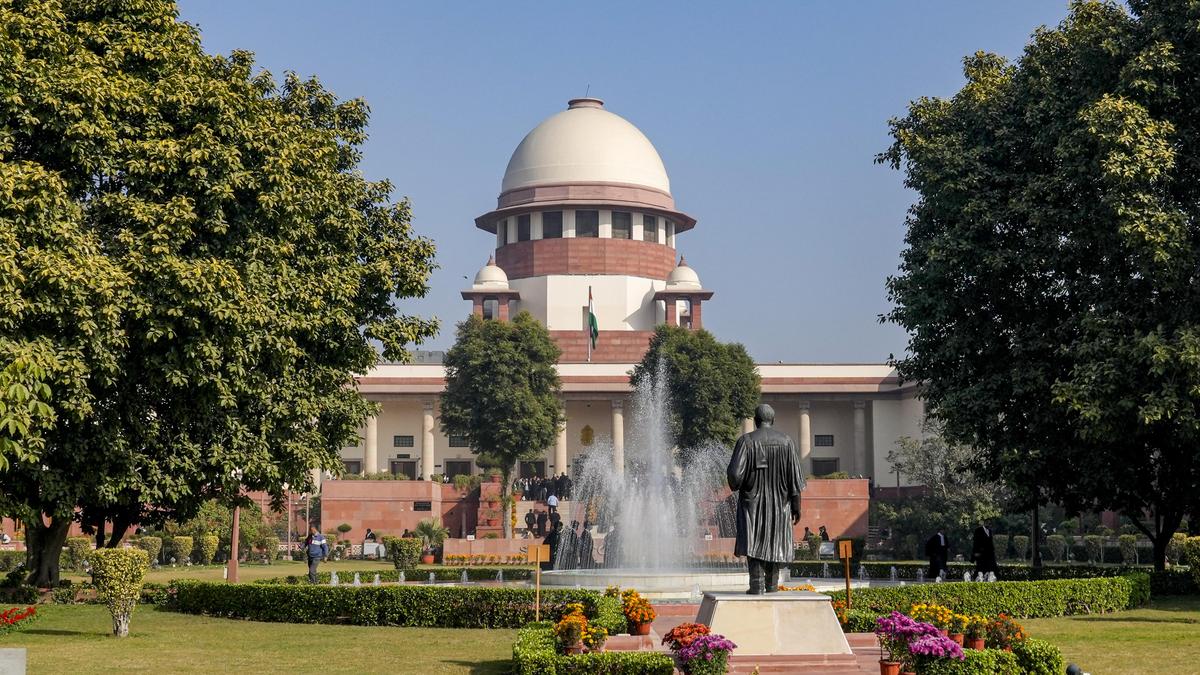
The Supreme Court said the order has been passed in the peculiar facts of the case and will not be treated as a precedent for any other purpose. File
| Photo Credit: PTI
The Supreme Court has invoked its extraordinary powers under Article 142 of the Constitution to set aside the conviction of a man sentenced under the Protection of Children from Sexual Offences (POCSO) Act, 2012, noting that his victim had married him when she became a legal adult. The court observed that the couple should now be allowed to live “peacefully in society as spouses”.Arguing before a trial court is like playing a Test match, while appeals are like IPL matches: Madras High CourtArticle 142 empowers the top court to do “complete justice” in situations where the law may not provide an adequate remedy. The provision enables the court to mould relief in a manner suited to the peculiar facts and circumstances of a case.The man and woman in this case had fallen in love while she was still a minor, studying in Class 12. According to the case records, she lodged a criminal complaint after he refused to marry her. This culminated in his conviction by a trial court in Harur in 2019 for aggravated penetrative sexual assault under the POCSO Act. He was sentenced to 10 years’ imprisonment and fined for having a physical relationship with a minor.Appeal to SCThe couple later reconciled, solemnised their marriage, and began living together. A plea was subsequently moved before the Madras High Court seeking to have the conviction set aside. The High Court, however, declined the request and also rejected the woman’s application seeking permission to place additional evidence on record and depose in support of the convict.Aggrieved by the High Court’s order, the convict approached the Supreme Court seeking to have the conviction set aside. He submitted that the criminal case had arisen out of a “misunderstanding” and that they had been in a relationship since 2012. The court was also informed that they were now living together as husband and wife and sought its intervention to “put quietus to the litigation”.Victim’s requestA Bench of Justices J.K. Maheshwari and Atul S. Chandurkar personally interacted with the victim through a video call to ascertain her stand, during which she stated that she had no objection to the conviction being set aside. The victim also informed the court that she wished to receive ₹1 lakh from the appellant “towards the security of her life”, after which she did not wish to pursue the litigation any further. The appellant subsequently deposited the amount before the court.The State government also informed the Bench that, in order to preserve the social fabric and enable the couple to lead a peaceful domestic life, it had no objection to the conviction being quashed.Accordingly, the judges concluded that, in view of the couple’s reconciliation and the victim’s wish to continue her married life with the appellant, the ends of justice would be served by setting aside the conviction.“...the appellant and the victim have solemnised their marriage after she attained majority and have been residing together. Therefore, without entering into the merits of the case, and having regard to the peculiar facts and circumstances, we deem it appropriate to exercise our plenary powers under Article 142 of the Constitution to set aside the judgment of conviction and sentence,” the Bench observed, acquitting the appellant of the POCSO charge.‘Not a precedent’The Bench, however, clarified that the relief was granted due to the peculiar facts of this case and would not operate as a precedent.“The appellant and the victim are left free to live their life peacefully in society as spouses. We make it clear that the present order has been passed in the peculiar facts of the case, therefore, it will not be treated as a precedent for any other purpose,” it added. Published - June 10, 2026 02:38 pm IST